Artículo
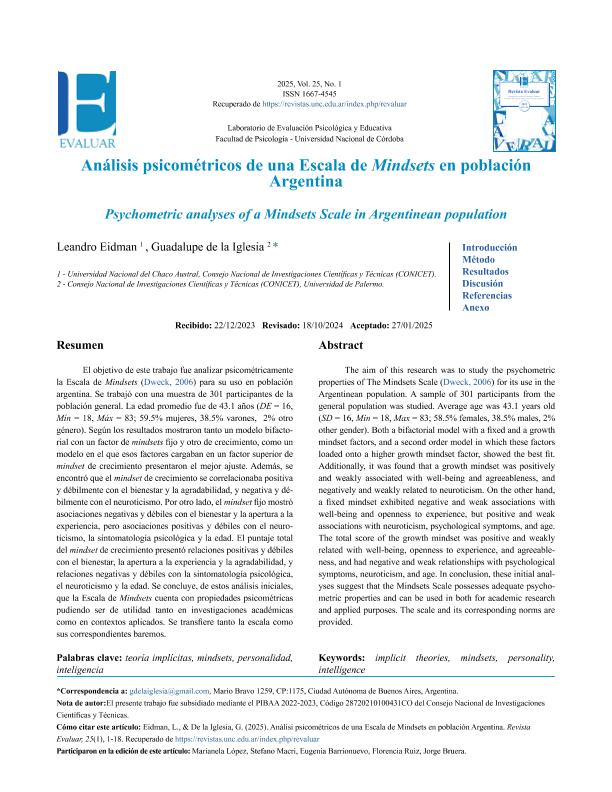
El objetivo de este trabajo fue analizar psicométricamente la Escala de Mindsets (Dweck, 2006) para su uso en población argentina. Se trabajó con una muestra de 301 participantes de la población general. La edad promedio fue de 43.1 años (DE = 16, Mín = 18, Máx = 83; 59.5% mujeres, 38.5% varones, 2% otro género). Según los resultados mostraron tanto un modelo bifactorial con un factor de mindsets fijo y otro de crecimiento, como un modelo en el que esos factores cargaban en un factor superior de mindset de crecimiento presentaron el mejor ajuste. Además, se encontró que el mindset de crecimiento se correlacionaba positiva y débilmente con el bienestar y la agradabilidad, y negativa y débilmente con el neuroticismo. Por otro lado, el mindset fijo mostró asociaciones negativas y débiles con el bienestar y la apertura a la experiencia, pero asociaciones positivas y débiles con el neuroticismo, la sintomatología psicológica y la edad. El puntaje total del mindset de crecimiento presentó relaciones positivas y débiles con el bienestar, la apertura a la experiencia y la agradabilidad, y relaciones negativas y débiles con la sintomatología psicológica, el neuroticismo y la edad. Se concluye, de estos análisis iniciales, que la Escala de Mindsets cuenta con propiedades psicométricas pudiendo ser de utilidad tanto en investigaciones académicas como en contextos aplicados. Se transfiere tanto la escala como sus correspondientes baremos. The aim of this research was to study the psychometric properties of The Mindsets Scale (Dweck, 2006) for its use in the Argentinean population. A sample of 301 participants from the general population was studied. Average age was 43.1 years old (SD = 16, Min = 18, Max = 83; 58.5% females, 38.5% males, 2% other gender). Both a bifactorial model with a fixed and a growth mindset factors, and a second order model in which these factors loaded onto a higher growth mindset factor, showed the best fit. Additionally, it was found that a growth mindset was positively and weakly associated with well-being and agreeableness, and negatively and weakly related to neuroticism. On the other hand, a fixed mindset exhibited negative and weak associations with well-being and openness to experience, but positive and weak associations with neuroticism, psychological symptoms, and age. The total score of the growth mindset was positive and weakly related with well-being, openness to experience, and agreeableness, and had negative and weak relationships with psychological symptoms, neuroticism, and age. In conclusion, these initial analyses suggest that the Mindsets Scale possesses adequate psychometric properties and can be used in both for academic research and applied purposes. The scale and its corresponding norms are provided.
Análisis psicométricos de una Escala de Mindsets en población Argentina
Título:
Psychometric analyses of a Mindsets Scale in Argentinean population

Fecha de publicación:
08/2025
Editorial:
Universidad Nacional de Córdoba. Facultad de Psicología. Laboratorio de Evaluación Psicológica y Educativa
Revista:
Evaluar
e-ISSN:
1667-4545
Idioma:
Español
Tipo de recurso:
Artículo publicado
Clasificación temática:
Resumen
Palabras clave:
Teorías implícitas
,
Mindset
,
Personalidad
,
Inteligencia
Archivos asociados

Tamaño:
633.5Kb
Formato:
PDF
Licencia
 Excepto donde se diga explícitamente, este item se publica bajo la siguiente descripción:
Creative Commons Attribution 2.5 Unported (CC BY 2.5)
Excepto donde se diga explícitamente, este item se publica bajo la siguiente descripción:
Creative Commons Attribution 2.5 Unported (CC BY 2.5)
Identificadores
Colecciones
Articulos(SEDE CENTRAL)
Articulos de SEDE CENTRAL
Articulos de SEDE CENTRAL
Citación
Eidman, Leandro; de la Iglesia, Guadalupe; Análisis psicométricos de una Escala de Mindsets en población Argentina; Universidad Nacional de Córdoba. Facultad de Psicología. Laboratorio de Evaluación Psicológica y Educativa; Evaluar; 25; 1; 8-2025; 1-18
Compartir


Altmétricas