Mostrar el registro sencillo del ítem
dc.contributor.author
Splendido, Mariano Agustín
dc.date.available
2025-10-02T14:48:45Z
dc.date.issued
2024-06
dc.identifier.citation
Splendido, Mariano Agustín; `οἱ κοιμηθέντες`:La muerte como sueño en la primera literatura cristiana; Universidad Autónoma de Entre Ríos; Hablemos de Historia; 2; 2; 6-2024; 48-58
dc.identifier.uri
http://hdl.handle.net/11336/272646
dc.description.abstract
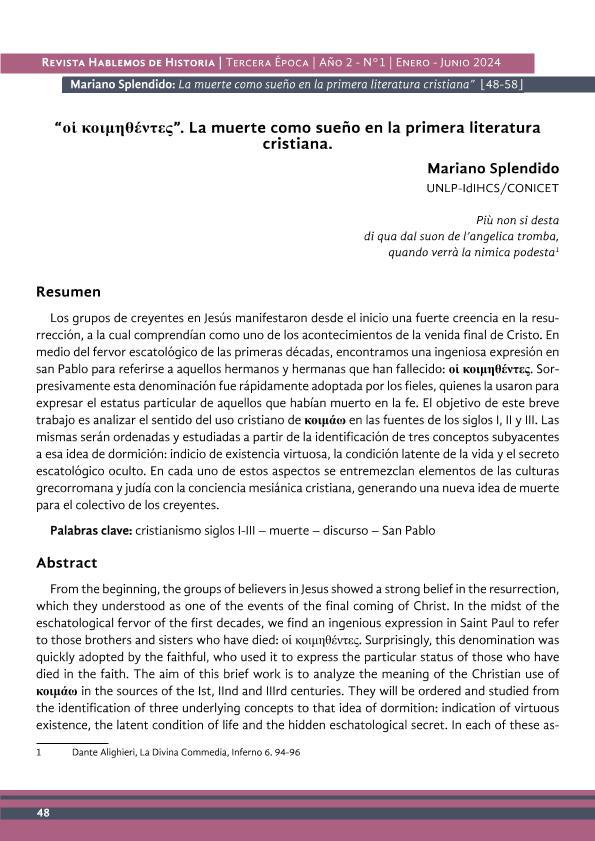
Los grupos de creyentes en Jesús manifestaron desde el inicio una fuerte creencia en la resurrección, a la cual comprendían como uno de los acontecimientos de la venida final de Cristo. En medio del fervor escatológico de las primeras décadas, encontramos una ingeniosa expresión en san Pablo para referirse a aquellos hermanos y hermanas que han fallecido: οἱ κοιμηθέντες. Sorpresivamente esta denominación fue rápidamente adoptada por los fieles, quienes la usaron para expresar el estatus particular de aquellos que habían muerto en la fe. El objetivo de este breve trabajo es analizar el sentido del uso cristiano de κοιμάω en las fuentes de los siglos I, II y III. Las mismas serán ordenadas y estudiadas a partir de la identificación de tres conceptos subyacentes a esa idea de dormición: indicio de existencia virtuosa, la condición latente de la vida y el secreto escatológico oculto. En cada uno de estos aspectos se entremezclan elementos de las culturas grecorromana y judía con la conciencia mesiánica cristiana, generando una nueva idea de muerte para el colectivo de los creyentes.
dc.description.abstract
From the beginning, the groups of believers in Jesus showed a strong belief in the resurrection, which they understood as one of the events of the final coming of Christ. In the midst of the eschatological fervor of the first decades, we find an ingenious expression in Saint Paul to refer to those brothers and sisters who have died: οἱ κοιμηθέντες. Surprisingly, this denomination was quickly adopted by the faithful, who used it to express the particular status of those who have died in the faith. The aim of this brief work is to analyze the meaning of the Christian use of κοιμάω in the sources of the Ist, IInd and IIIrd centuries. They will be ordered and studied from the identification of three underlying concepts to that idea of dormition: indication of virtuous existence, the latent condition of life and the hidden eschatological secret. In each of these aspects, elements of the Greco-Roman and Jewish cultures are intermingled with the Christian messianic consciousness, generating a new idea of death for the group of believers.
dc.format
application/pdf
dc.language.iso
spa
dc.publisher
Universidad Autónoma de Entre Ríos
dc.rights
info:eu-repo/semantics/openAccess
dc.rights.uri
https://creativecommons.org/licenses/by/2.5/ar/
dc.subject
MUERTE
dc.subject
SUEÑO
dc.subject
DISCURSO
dc.subject
CRISTIANISMO ANTIGUO
dc.subject.classification
Historia
dc.subject.classification
Historia y Arqueología
dc.subject.classification
HUMANIDADES
dc.title
`οἱ κοιμηθέντες`:La muerte como sueño en la primera literatura cristiana
dc.type
info:eu-repo/semantics/article
dc.type
info:ar-repo/semantics/artículo
dc.type
info:eu-repo/semantics/publishedVersion
dc.date.updated
2025-09-29T13:03:00Z
dc.identifier.eissn
1666-5414
dc.journal.volume
2
dc.journal.number
2
dc.journal.pagination
48-58
dc.journal.pais
Argentina
dc.journal.ciudad
Entre Ríos
dc.description.fil
Fil: Splendido, Mariano Agustín. Consejo Nacional de Investigaciones Científicas y Técnicas. Centro Científico Tecnológico Conicet - La Plata. Instituto de Investigaciones en Humanidades y Ciencias Sociales. Universidad Nacional de La Plata. Facultad de Humanidades y Ciencias de la Educación. Instituto de Investigaciones en Humanidades y Ciencias Sociales; Argentina
dc.journal.title
Hablemos de Historia
dc.relation.alternativeid
info:eu-repo/semantics/altIdentifier/url/https://ojs.fhaycs-uader.edu.ar/index.php/hablemosdehistoria/article/view/46
Archivos asociados

Tamaño:
130.8Kb
Formato:
PDF