Mostrar el registro sencillo del ítem
dc.contributor.author
Vukadinovic, M.
dc.contributor.author
Smole, F.
dc.contributor.author
Topič, M.
dc.contributor.author
Schropp, R. E. .
dc.contributor.author
Rubinelli, Francisco Alberto
dc.date.available
2017-10-31T17:27:27Z
dc.date.issued
2004-09
dc.identifier.citation
Vukadinovic, M.; Smole, F.; Topič, M.; Schropp, R. E. .; Rubinelli, Francisco Alberto; Transport in tunnelling recombination junctions: a combined computer simulation study; American Institute of Physics; Journal of Applied Physics; 96; 12; 9-2004; 7289-7299
dc.identifier.issn
0021-8979
dc.identifier.uri
http://hdl.handle.net/11336/27246
dc.description.abstract
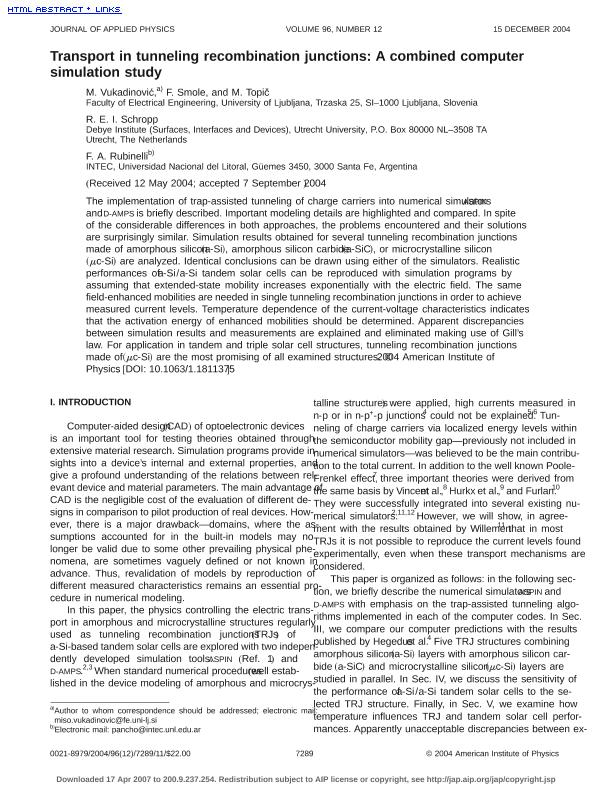
The implementation of trap-assisted tunneling of charge carriers into numerical simulators ASPIN and D-AMPS is briefly described. Important modeling details are highlighted and compared. In spite of the considerable differences in both approaches, the problems encountered and their solutions are surprisingly similar. Simulation results obtained for several tunneling recombination junctions made of amorphous silicon (a-Si), amorphous silicon carbide (a-SiC), or microcrystalline silicon (µc-Si) are analyzed. Identical conclusions can be drawn using either of the simulators. Realistic performances of a-Si/a-Si tandem solar cells can be reproduced with simulation programs by assuming that extended-state mobility increases exponentially with the electric field. The same field-enhanced mobilities are needed in single tunneling recombination junctions in order to achieve measured current levels. Temperature dependence of the current-voltage characteristics indicates that the activation energy of enhanced mobilities should be determined. Apparent discrepancies between simulation results and measurements are explained and eliminated making use of Gill’s law. For application in tandem and triple solar cell structures, tunneling recombination junctions made of (µc-Si) are the most promising of all examined structures.
dc.format
application/pdf
dc.language.iso
eng
dc.publisher
American Institute of Physics
dc.rights
info:eu-repo/semantics/openAccess
dc.rights.uri
https://creativecommons.org/licenses/by-nc-sa/2.5/ar/
dc.subject
Tandem Solar Cells
dc.subject
Recombination Junctions
dc.subject
Modelling
dc.subject
Electrical Transport
dc.subject.classification
Ingeniería de Sistemas y Comunicaciones
dc.subject.classification
Ingeniería Eléctrica, Ingeniería Electrónica e Ingeniería de la Información
dc.subject.classification
INGENIERÍAS Y TECNOLOGÍAS
dc.title
Transport in tunnelling recombination junctions: a combined computer simulation study
dc.type
info:eu-repo/semantics/article
dc.type
info:ar-repo/semantics/artículo
dc.type
info:eu-repo/semantics/publishedVersion
dc.date.updated
2017-10-30T18:43:53Z
dc.journal.volume
96
dc.journal.number
12
dc.journal.pagination
7289-7299
dc.journal.pais
Estados Unidos
dc.journal.ciudad
Newswille
dc.description.fil
Fil: Vukadinovic, M.. University of Ljubljana; Eslovenia
dc.description.fil
Fil: Smole, F.. University of Ljubljana; Eslovenia
dc.description.fil
Fil: Topič, M.. University of Ljubljana; Eslovenia
dc.description.fil
Fil: Schropp, R. E. .. Utrecht University; Países Bajos
dc.description.fil
Fil: Rubinelli, Francisco Alberto. Consejo Nacional de Investigaciones Científicas y Técnicas. Centro Científico Tecnológico Conicet - Santa Fe. Instituto de Desarrollo Tecnológico para la Industria Química. Universidad Nacional del Litoral. Instituto de Desarrollo Tecnológico para la Industria Química; Argentina
dc.journal.title
Journal of Applied Physics
dc.relation.alternativeid
info:eu-repo/semantics/altIdentifier/doi/http://dx.doi.org/10.1063/1.1811375
dc.relation.alternativeid
info:eu-repo/semantics/altIdentifier/url/http://aip.scitation.org/doi/10.1063/1.1811375
Archivos asociados

Tamaño:
176.3Kb
Formato:
PDF