Artículo
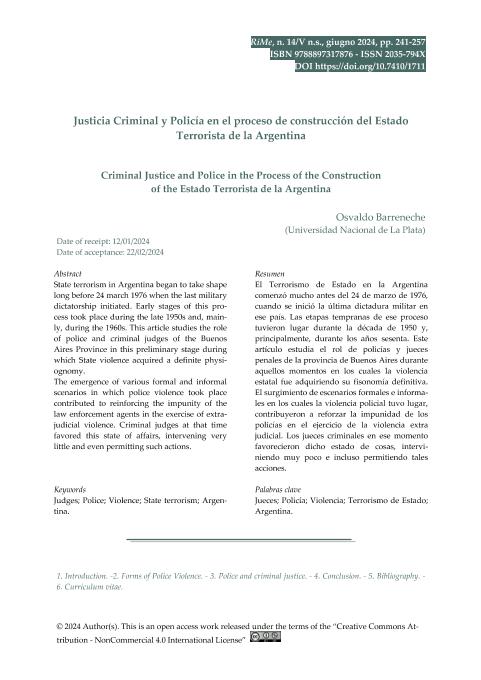
In the years following the end of the last bloody civil-military dictatorship in Argentina (1976-1983), and even today, the new generations that did not live through it ask their elders: Did you not realize what was happening? Did you not know that you were living under a dictatorship that not only imprisoned and tortured people but also eliminated them by making them "disappear"? The answers to these questions have a degree of complexity and variety. But beyond that, it is common to find people who point out that during those years, for them, life went by without any major upheavals. The military presence in the streets and the sounds of police sirens at night could signal that they were under a dictatorship, but these same people say that they went to work and live their lives "normally" every day. Then a central question emerges: How is it possible to build a "normality" of life for many in a context of great repression and violence against people? In order to contribute to a possible answer to this question, this article adopts a historical approach. The most critical stage of state terrorism in Argentina began to be built long before 1976. A central aspect of this process was the (re)shaping of justice and its administration. This piece analyzes the changes in the justice system (especially criminal justice) from the middle of the 20TH Century on. It starts from the last years of the second government of Juan Domingo Peron in Argentina, passing through the military coup that overthrew him in 1955, and continuing through the various forms of "application" of criminal justice that were implemented during the 1960s. Through this process, I analyze how different levels of criminal justice administration coexisted during that period. El Terrorismo de Estado en la Argentina comenzó mucho antes del 24 de marzo de 1976, cuando se inició la última dictadura militar en ese país. Las etapas tempranas de ese proceso tuvieron lugar durante la década de 1950 y, principalmente, durante los años sesenta. Este artículo estudia el rol de policías y jueces penales de la provincia de Buenos Aires durante aquellos momentos en los cuales la violencia estatal fue adquiriendo su fisonomía definitiva. El surgimiento de escenarios formales e informales en los cuales la violencia policial tuvo lugar, contribuyeron a reforzar la impunidad de los policías en el ejercicio de la violencia extra judicial. Los jueces criminales en ese momento favorecieron dicho estado de cosas, interviniendo muy poco e incluso permitiendo tales acciones.
Criminal justice and police in the process of the construction of state terrorism in Argentina
Título:
Justicia Criminal y Policía en el proceso de construcción del Estado Terrorista de la Argentina

Fecha de publicación:
06/2024
Editorial:
Istituto di Storia dell’Europa Mediterranea
Revista:
RiMe
e-ISSN:
2035-794X
Idioma:
Inglés
Tipo de recurso:
Artículo publicado
Clasificación temática:
Resumen
Palabras clave:
TERRORISMO DE ESTADO
,
JUSTICIA
,
POLICÍA
,
JUECES
Archivos asociados

Tamaño:
397.7Kb
Formato:
PDF
Licencia
 Excepto donde se diga explícitamente, este item se publica bajo la siguiente descripción:
Creative Commons Attribution-NonCommercial 2.5 Unported (CC BY-NC 2.5)
Excepto donde se diga explícitamente, este item se publica bajo la siguiente descripción:
Creative Commons Attribution-NonCommercial 2.5 Unported (CC BY-NC 2.5)
Identificadores
Colecciones
Articulos(IDIHCS)
Articulos de INST.DE INVEST.EN HUMANIDADES Y CS SOCIALES
Articulos de INST.DE INVEST.EN HUMANIDADES Y CS SOCIALES
Citación
Barreneche, Osvaldo; Criminal justice and police in the process of the construction of state terrorism in Argentina; Istituto di Storia dell’Europa Mediterranea; RiMe; 5; 14; 6-2024; 241-257
Compartir


Altmétricas