Artículo
Phylogeography of the catfish Hatcheria macraei reveals a negligible role of drainage divides in structuring populations

Fecha de publicación:
02/2012
Editorial:
Wiley Blackwell Publishing, Inc
Revista:
Molecular Ecology
ISSN:
0962-1083
Idioma:
Inglés
Tipo de recurso:
Artículo publicado
Clasificación temática:
Resumen
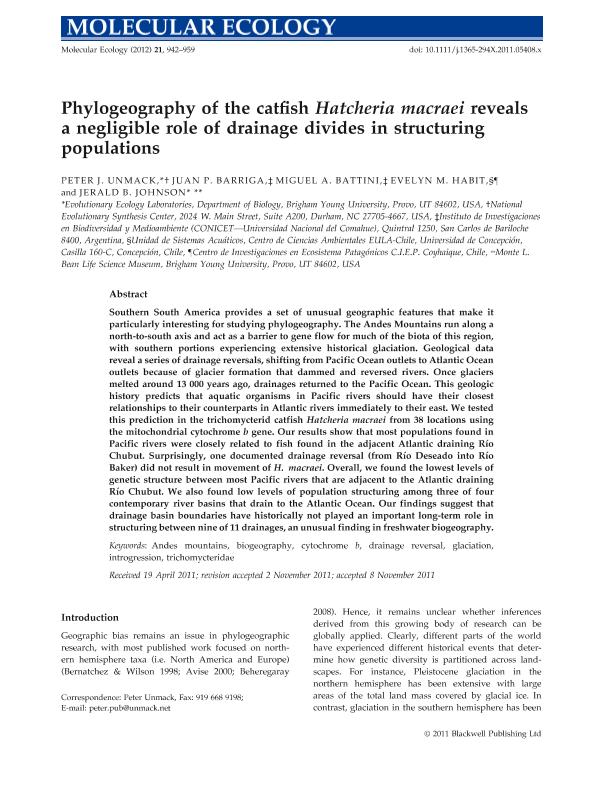
Southern South America provides a set of unusual geographic features that make it particularly interesting for studying phylogeography. The Andes Mountains run along a north-to-south axis and act as a barrier to gene flow for much of the biota of this region, with southern portions experiencing extensive historical glaciation. Geological data reveal a series of drainage reversals, shifting from Pacific Ocean outlets to Atlantic Ocean outlets because of glacier formation that dammed and reversed rivers. Once glaciers melted around 13 000 years ago, drainages returned to the Pacific Ocean. This geologic history predicts that aquatic organisms in Pacific rivers should have their closest relationships to their counterparts in Atlantic rivers immediately to their east. We tested this prediction in the trichomycterid catfish Hatcheria macraei from 38 locations using the mitochondrial cytochrome b gene. Our results show that most populations found in Pacific rivers were closely related to fish found in the adjacent Atlantic draining Río Chubut. Surprisingly, one documented drainage reversal (from Río Deseado into Río Baker) did not result in movement of H. macraei. Overall, we found the lowest levels of genetic structure between most Pacific rivers that are adjacent to the Atlantic draining Río Chubut. We also found low levels of population structuring among three of four contemporary river basins that drain to the Atlantic Ocean. Our findings suggest that drainage basin boundaries have historically not played an important long-term role in structuring between nine of 11 drainages, an unusual finding in freshwater biogeography.
Palabras clave:
Andes mountains
,
Biogeography
,
Cytochrome b
,
Drainage reversal
Archivos asociados

Tamaño:
1.090Mb
Formato:
PDF
Licencia
 Excepto donde se diga explícitamente, este item se publica bajo la siguiente descripción:
Creative Commons Attribution-NonCommercial-ShareAlike 2.5 Unported (CC BY-NC-SA 2.5)
Excepto donde se diga explícitamente, este item se publica bajo la siguiente descripción:
Creative Commons Attribution-NonCommercial-ShareAlike 2.5 Unported (CC BY-NC-SA 2.5)
Identificadores
Colecciones
Articulos(INIBIOMA)
Articulos de INST. DE INVEST.EN BIODIVERSIDAD Y MEDIOAMBIENTE
Articulos de INST. DE INVEST.EN BIODIVERSIDAD Y MEDIOAMBIENTE
Articulos(SEDE CENTRAL)
Articulos de SEDE CENTRAL
Articulos de SEDE CENTRAL
Citación
Unmack, Peter J.; Barriga, Juan Pablo; Battini, Miguel Ángel; Habit, Evelyn M.; Johnson, Jerald B.; Phylogeography of the catfish Hatcheria macraei reveals a negligible role of drainage divides in structuring populations; Wiley Blackwell Publishing, Inc; Molecular Ecology; 21; 4; 2-2012; 942-959
Compartir


Altmétricas