Mostrar el registro sencillo del ítem
dc.contributor.author
Lucy, A. B.
dc.contributor.author
Sokoloski, J. L.
dc.contributor.author
Luna, Gerardo Juan Manuel
dc.contributor.author
Mukai, K.
dc.contributor.author
Nuñez, N. E.
dc.contributor.author
Buckley, D. A. H.
dc.contributor.author
Breytenbach, H.
dc.contributor.author
Paul, B.
dc.contributor.author
Potter, S. B.
dc.contributor.author
Manick, R.
dc.contributor.author
Howell, D. A.
dc.contributor.author
Wolf, C.
dc.contributor.author
Onken, C. A.
dc.date.available
2025-09-17T10:07:37Z
dc.date.issued
2025-08
dc.identifier.citation
Lucy, A. B.; Sokoloski, J. L.; Luna, Gerardo Juan Manuel; Mukai, K.; Nuñez, N. E.; et al.; A new way to find symbiotic stars: accretion disc detection with continuum survey photometry; Wiley Blackwell Publishing, Inc; Monthly Notices of the Royal Astronomical Society; 8-2025; 1-35
dc.identifier.issn
0035-8711
dc.identifier.uri
http://hdl.handle.net/11336/271209
dc.description.abstract
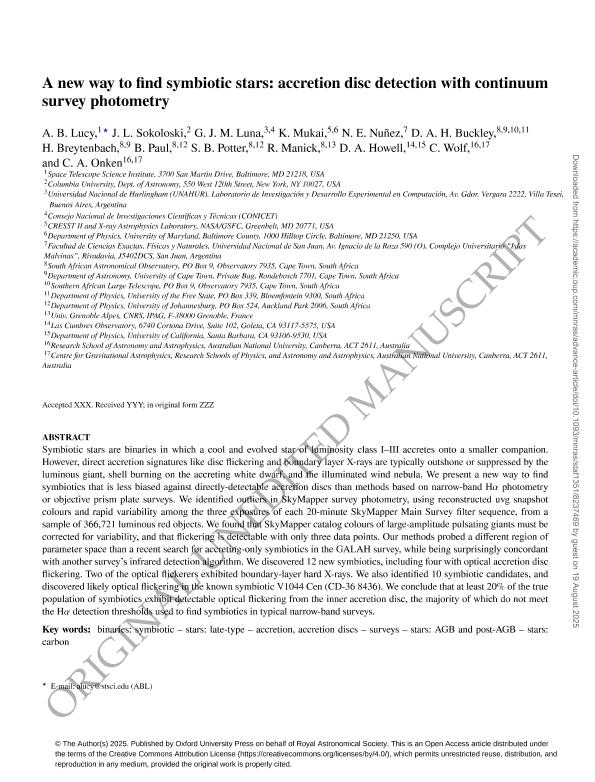
Symbiotic stars are binaries in which a cool and evolved star of luminosity class I–III accretes onto a smaller companion. However, direct accretion signatures like disc flickering and boundary layer X-rays are typically outshone or suppressed by the luminous giant, shell burning on the accreting white dwarf, and the illuminated wind nebula. We present a new way to find symbiotics that is less biased against directly-detectable accretion discs than methods based on narrow-band Hα photometry or objective prism plate surveys. We identified outliers in SkyMapper survey photometry, using reconstructed uvg snapshot colours and rapid variability among the three exposures of each 20-minute SkyMapper Main Survey filter sequence, from a sample of 366,721 luminous red objects. We found that SkyMapper catalog colours of large-amplitude pulsating giants must be corrected for variability, and that flickering is detectable with only three data points. Our methods probed a different region of parameter space than a recent search for accreting-only symbiotics in the GALAH survey, while being surprisingly concordant with another survey’s infrared detection algorithm. We discovered 12 new symbiotics, including four with optical accretion disc flickering. Two of the optical flickerers exhibited boundary-layer hard X-rays. We also identified 10 symbiotic candidates, and discovered likely optical flickering in the known symbiotic V1044 Cen (CD-36 8436). We conclude that at least 20 per cent of the true population of symbiotics exhibit detectable optical flickering from the inner accretion disc, the majority of which do not meet the Hα detection thresholds used to find symbiotics in typical narrow-band surveys.
dc.format
application/pdf
dc.language.iso
eng
dc.publisher
Wiley Blackwell Publishing, Inc
dc.rights
info:eu-repo/semantics/openAccess
dc.rights.uri
https://creativecommons.org/licenses/by-nc-sa/2.5/ar/
dc.subject
binaries: symbiotic
dc.subject
stars: late-type
dc.subject
accretion
dc.subject
accretion-disk
dc.subject.classification
Astronomía
dc.subject.classification
Ciencias Físicas
dc.subject.classification
CIENCIAS NATURALES Y EXACTAS
dc.title
A new way to find symbiotic stars: accretion disc detection with continuum survey photometry
dc.type
info:eu-repo/semantics/article
dc.type
info:ar-repo/semantics/artículo
dc.type
info:eu-repo/semantics/publishedVersion
dc.date.updated
2025-09-16T11:06:26Z
dc.journal.pagination
1-35
dc.journal.pais
Reino Unido
dc.journal.ciudad
Londres
dc.description.fil
Fil: Lucy, A. B.. Space Telescope Science Institute; Estados Unidos
dc.description.fil
Fil: Sokoloski, J. L.. Columbia University; Estados Unidos
dc.description.fil
Fil: Luna, Gerardo Juan Manuel. Universidad Nacional de Hurlingham.; Argentina. Consejo Nacional de Investigaciones Científicas y Técnicas; Argentina
dc.description.fil
Fil: Mukai, K.. University of Maryland; Estados Unidos
dc.description.fil
Fil: Nuñez, N. E.. Universidad Nacional de San Juan; Argentina
dc.description.fil
Fil: Buckley, D. A. H.. South African Astronomical Observatory; Sudáfrica
dc.description.fil
Fil: Breytenbach, H.. University of Cape Town; Sudáfrica
dc.description.fil
Fil: Paul, B.. University of Cape Town; Sudáfrica
dc.description.fil
Fil: Potter, S. B.. University of Cape Town; Sudáfrica
dc.description.fil
Fil: Manick, R.. University of Cape Town; Sudáfrica
dc.description.fil
Fil: Howell, D. A.. University of California; Estados Unidos
dc.description.fil
Fil: Wolf, C.. University Of Western Australia. Faculty Of Science.; Australia
dc.description.fil
Fil: Onken, C. A.. University of Western Australia; Australia
dc.journal.title
Monthly Notices of the Royal Astronomical Society
dc.relation.alternativeid
info:eu-repo/semantics/altIdentifier/url/https://academic.oup.com/mnras/advance-article/doi/10.1093/mnras/staf1351/8237469
dc.relation.alternativeid
info:eu-repo/semantics/altIdentifier/doi/http://dx.doi.org/10.1093/mnras/staf1351
Archivos asociados

Tamaño:
10.47Mb
Formato:
PDF