Artículo
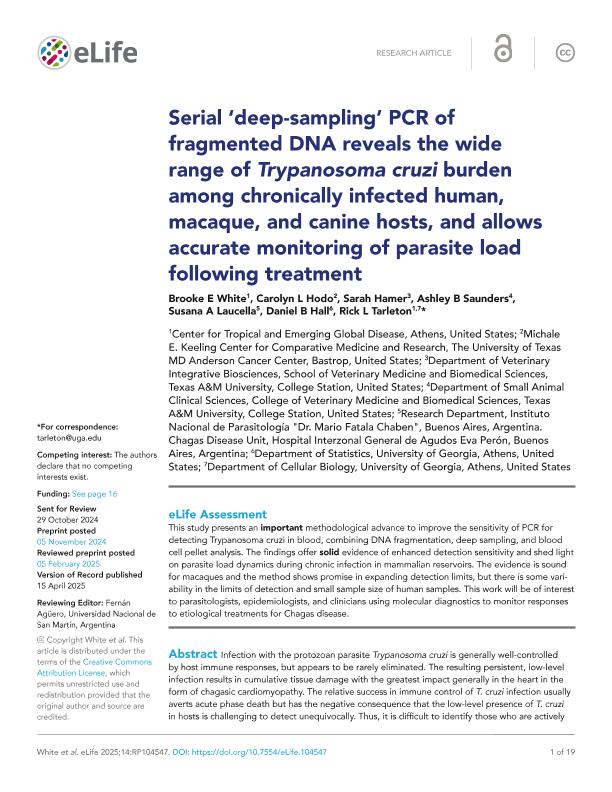
Serial ‘deep-sampling’ PCR of fragmented DNA reveals the wide range of Trypanosoma cruzi burden among chronically infected human, macaque, and canine hosts, and allows accurate monitoring of parasite load following treatment
White, Brooke E.; Hodo, Carolyn L; Hamer, Sarah; Saunders, Ashley B; Laucella, Susana Adriana ; Hall, Daniel B; Tarleton, Rick L.
; Hall, Daniel B; Tarleton, Rick L.
Fecha de publicación:
04/2025
Editorial:
eLife Sciences Publications
Revista:
eLife
e-ISSN:
2050-084X
Idioma:
Inglés
Tipo de recurso:
Artículo publicado
Clasificación temática:
Resumen
Infection with the protozoan parasite Trypanosoma cruzi is generally well-controlledby host immune responses, but appears to be rarely eliminated. The resulting persistent, low-levelinfection results in cumulative tissue damage with the greatest impact generally in the heart in theform of chagasic cardiomyopathy. The relative success in immune control of T. cruzi infection usually averts acute phase death but has the negative consequence that the low-levelpresence of T. cruzi in hosts is challenging to detect unequivocally. Thus, it is difficult to identify those who are infected and, as well, problematic to gauge the impact of treatment, particularly in the evaluation of the relative efficacy of new drugs. In this study, we employ DNA fragmentation and high numbers of replicate PCR reaction (‘deep-sampling’) and to extend the quantitative range of detecting T. cruzi in blood by at least three orders of magnitude relative to current protocols. When combined with sampling blood at multiple time points, deep sampling of fragmented DNA allowed for detection of T. cruzi in all infected hosts in multiple host species, including humans, macaques, and dogs. In addition, we provide evidence for a number of characteristics not previously rigorously quantified in the population of hosts with naturally acquired T. cruzi infection, including, a >6 log variation between chronically infected individuals in the stable parasite levels, a continuing decline in parasite load during the second and third years of infection in some hosts, and the potential for parasite load to change dramatically when health conditions change. Although requiring strict adherence to contamination– prevention protocols and significant resources, deep-samplingPCR provides an important new tool for assessing therapies and for addressing long-standingquestions in T. cruzi infection and Chagas disease.
Palabras clave:
Chagas
,
Trypanosoma cruzi
,
PCR
,
parasite load
Archivos asociados

Tamaño:
9.642Mb
Formato:
PDF
Licencia
 Excepto donde se diga explícitamente, este item se publica bajo la siguiente descripción:
Creative Commons Attribution 2.5 Unported (CC BY 2.5)
Excepto donde se diga explícitamente, este item se publica bajo la siguiente descripción:
Creative Commons Attribution 2.5 Unported (CC BY 2.5)
Identificadores
Colecciones
Articulos(SEDE CENTRAL)
Articulos de SEDE CENTRAL
Articulos de SEDE CENTRAL
Citación
White, Brooke E.; Hodo, Carolyn L; Hamer, Sarah; Saunders, Ashley B; Laucella, Susana Adriana; et al.; Serial ‘deep-sampling’ PCR of fragmented DNA reveals the wide range of Trypanosoma cruzi burden among chronically infected human, macaque, and canine hosts, and allows accurate monitoring of parasite load following treatment; eLife Sciences Publications; eLife; 14; 4-2025; 1-19
Compartir


Altmétricas