Artículo
Haddadus binotatus: Defensive behavior

Fecha de publicación:
12/2024
Editorial:
Society for the Study of Amphibians and Reptiles
Revista:
Herpetological Review
ISSN:
0018-084X
Idioma:
Inglés
Tipo de recurso:
Artículo publicado
Clasificación temática:
Resumen
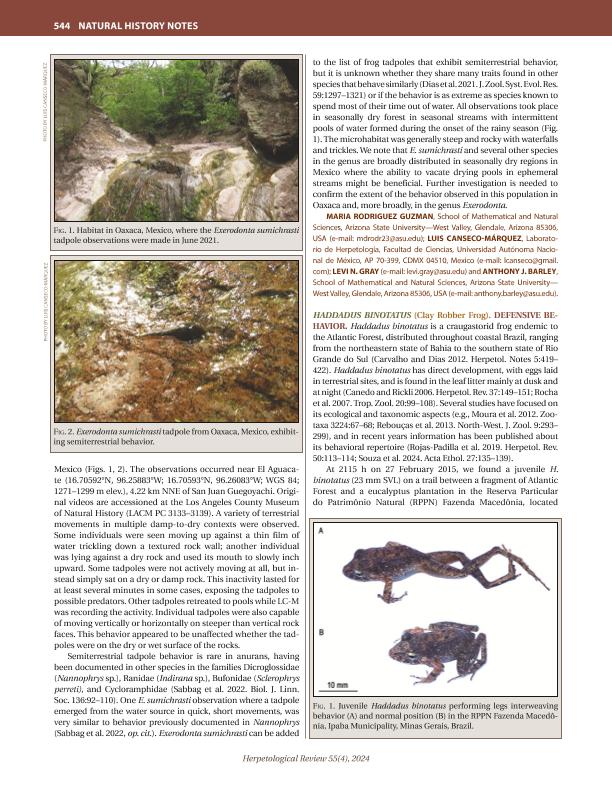
Haddadus binotatus is a craugastorid frog endemic to the Atlantic Forest, distributed throughout coastal Brazil, ranging from the northeastern state of Bahia to the southern state of Rio Grande do Sul (Carvalho and Dias 2012. Herpetol. Notes 5:419– 422). Haddadus binotatus has direct development, with eggs laid in terrestrial sites, and is found in the leaf litter mainly at dusk and at night (Canedo and Rickli 2006. Herpetol. Rev. 37:149–151; Rocha et al. 2007. Trop. Zool. 20:99–108). Several studies have focused on its ecological and taxonomic aspects (e.g., Moura et al. 2012. Zootaxa 3224:67–68; Rebouças et al. 2013. North-West. J. Zool. 9:293– 299), and in recent years information has been published about its behavioral repertoire (Rojas-Padilla et al. 2019. Herpetol. Rev. 50:113–114; Souza et al. 2024. Acta Ethol. 27:135–139). At 2115 h on 27 February 2015, we found a juvenile H. binotatus (23 mm SVL) on a trail between a fragment of Atlantic Forest and a eucalyptus plantation in the Reserva Particular do Patrimônio Natural (RPPN) Fazenda Macedônia, located on the right bank of the Rio Doce, Ipaba Municipality, Minas Gerais, Brazil (19.35971°S, 42.39593°W; WGS 84; 263 m elev.). The individual was temporarily collected and stored in a plastic bag containing moist leaves. The next day at 0900 h, when handled in the dorsolateral region for a photography session, the juvenile H. binotatus crouched, keeping its ventral region of the body glued to the substrate, stretched and intertwined its legs for ca. 7 s, and then returned to its normal position (Fig. 1).
Palabras clave:
ANURA
,
COMPORTAMIENTO
,
HADDADUS BINOTATUS
Archivos asociados

Tamaño:
1.068Mb
Formato:
PDF
Licencia
 Excepto donde se diga explícitamente, este item se publica bajo la siguiente descripción:
Creative Commons Attribution-NonCommercial-ShareAlike 2.5 Unported (CC BY-NC-SA 2.5)
Excepto donde se diga explícitamente, este item se publica bajo la siguiente descripción:
Creative Commons Attribution-NonCommercial-ShareAlike 2.5 Unported (CC BY-NC-SA 2.5)
Identificadores
Colecciones
Articulos(UEL)
Articulos de UNIDAD EJECUTORA LILLO
Articulos de UNIDAD EJECUTORA LILLO
Citación
Silva Guedes Folly, Henrique; Thaler de Souza, Rafaela; Haddadus binotatus: Defensive behavior; Society for the Study of Amphibians and Reptiles; Herpetological Review; 55; 4; 12-2024; 544-545
Compartir

