Mostrar el registro sencillo del ítem
dc.contributor.author
Pardini, Lais Luján
dc.contributor.author
Maksimov, P.
dc.contributor.author
Herrmann, D.C.
dc.contributor.author
Bacigalupe, Diana
dc.contributor.author
Rambeaud, Magdalena
dc.contributor.author
Machuca, Mariana Alejandra
dc.contributor.author
Moré, Gastón Andrés
dc.contributor.author
Basso, Walter Ubaldo
dc.contributor.author
Schares, G.
dc.contributor.author
Venturini, María Cecilia
dc.date.available
2025-09-04T11:34:29Z
dc.date.issued
2012-10
dc.identifier.citation
Pardini, Lais Luján; Maksimov, P.; Herrmann, D.C.; Bacigalupe, Diana; Rambeaud, Magdalena; et al.; Evaluation of an in-house TgSAG1 (P30) IgG ELISA for diagnosis of naturally acquired Toxoplasma gondii infection in pigs; Elsevier Science; Veterinary Parasitology; 189; 2-4; 10-2012; 204-210
dc.identifier.issn
0304-4017
dc.identifier.uri
http://hdl.handle.net/11336/270306
dc.description.abstract
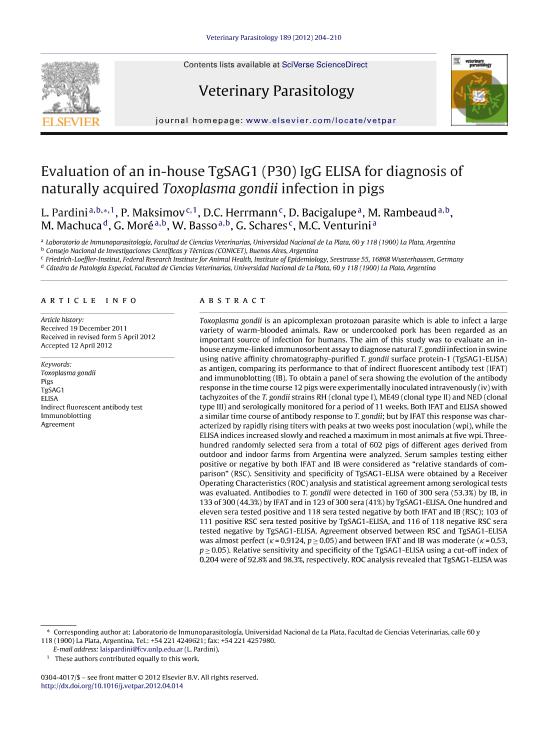
Toxoplasma gondii is an apicomplexan protozoan parasite which is able to infect a large variety of warm-blooded animals. Raw or undercooked pork has been regarded as an important source of infection for humans. The aim of this study was to evaluate an in- house enzyme-linked immunosorbent assay to diagnose natural T. gondii infection in swine using native affinity chromatography-purified T. gondii surface protein-1 (TgSAG1-ELISA) as antigen, comparing its performance to that of indirect fluorescent antibody test (IFAT) and immunoblotting (IB). To obtain a panel of sera showing the evolution of the antibody response in the time course 12 pigs were experimentally inoculated intravenously (iv) with tachyzoites of the T. gondii strains RH (clonal type I), ME49 (clonal type II) and NED (clonal type III) and serologically monitored for a period of 11 weeks. Both IFAT and ELISA showed a similar time course of antibody response to T. gondii; but by IFAT this response was char- acterized by rapidly rising titers with peaks at two weeks post inoculation (wpi), while the ELISA indices increased slowly and reached a maximum in most animals at five wpi. Three- hundred randomly selected sera from a total of 602 pigs of different ages derived from outdoor and indoor farms from Argentina were analyzed. Serum samples testing either positive or negative by both IFAT and IB were considered as relative standards of comparison (RSC). Sensitivity and specificity of TgSAG1-ELISA were obtained by a Receiver Operating Characteristics (ROC) analysis and statistical agreement among serological tests was evaluated. Antibodies to T. gondii were detected in 160 of 300 sera (53.3%) by IB, in 133 of 300 (44.3%) by IFAT and in 123 of 300 sera (41%) by TgSAG1-ELISA. One hundred and eleven sera tested positive and 118 sera tested negative by both IFAT and IB (RSC); 103 of 111 positive RSC sera tested positive by TgSAG1-ELISA, and 116 of 118 negative RSC sera tested negative by TgSAG1-ELISA. Agreement observed between RSC and TgSAG1-ELISA was almost perfect (Kappa = 0.9124, p ≥ 0.05) and between IFAT and IB was moderate (Kappa = 0.53, p ≥ 0.05). Relative sensitivity and specificity of the TgSAG1-ELISA using a cut-off index of 0.204 were of 92.8% and 98.3%, respectively. ROC analysis revealed that TgSAG1-ELISA washighly accurate (AUC = 0.983) relative to the RSC. According to the results in this study, the ELISA based on affinity purified T. gondii surface antigen TgSAG1 was useful for the specific and sensitive detection of antibodies to this protozoan parasite in naturally infected pigs.
dc.format
application/pdf
dc.language.iso
eng
dc.publisher
Elsevier Science
dc.rights
info:eu-repo/semantics/openAccess
dc.rights.uri
https://creativecommons.org/licenses/by-nc-sa/2.5/ar/
dc.subject
Toxoplasma gondii
dc.subject
Pigs
dc.subject
TgSAG1
dc.subject
ELISA
dc.subject.classification
Otras Ciencias Veterinarias
dc.subject.classification
Ciencias Veterinarias
dc.subject.classification
CIENCIAS AGRÍCOLAS
dc.title
Evaluation of an in-house TgSAG1 (P30) IgG ELISA for diagnosis of naturally acquired Toxoplasma gondii infection in pigs
dc.type
info:eu-repo/semantics/article
dc.type
info:ar-repo/semantics/artículo
dc.type
info:eu-repo/semantics/publishedVersion
dc.date.updated
2025-09-01T11:59:41Z
dc.journal.volume
189
dc.journal.number
2-4
dc.journal.pagination
204-210
dc.journal.pais
Países Bajos
dc.journal.ciudad
Amsterdam
dc.description.fil
Fil: Pardini, Lais Luján. Universidad Nacional de La Plata. Facultad de Ciencias Veterinarias. Departamento de Epizootiología y Salud Pública. Laboratorio de Inmunoparasitología; Argentina. Consejo Nacional de Investigaciones Científicas y Técnicas. Centro Científico Tecnológico Conicet - La Plata; Argentina
dc.description.fil
Fil: Maksimov, P.. Federal Research Institute for Animal Health; Alemania
dc.description.fil
Fil: Herrmann, D.C.. Federal Research Institute for Animal Health; Alemania
dc.description.fil
Fil: Bacigalupe, Diana. Universidad Nacional de La Plata. Facultad de Ciencias Veterinarias. Departamento de Epizootiología y Salud Pública. Laboratorio de Inmunoparasitología; Argentina
dc.description.fil
Fil: Rambeaud, Magdalena. Universidad Nacional de La Plata. Facultad de Ciencias Veterinarias. Departamento de Epizootiología y Salud Pública. Laboratorio de Inmunoparasitología; Argentina. Consejo Nacional de Investigaciones Científicas y Técnicas. Centro Científico Tecnológico Conicet - La Plata; Argentina
dc.description.fil
Fil: Machuca, Mariana Alejandra. Universidad Nacional de La Plata. Facultad de Ciencias Veterinarias. Cátedra de Patología Especial; Argentina
dc.description.fil
Fil: Moré, Gastón Andrés. Universidad Nacional de La Plata. Facultad de Ciencias Veterinarias. Departamento de Epizootiología y Salud Pública. Laboratorio de Inmunoparasitología; Argentina. Consejo Nacional de Investigaciones Científicas y Técnicas. Centro Científico Tecnológico Conicet - La Plata; Argentina
dc.description.fil
Fil: Basso, Walter Ubaldo. Universidad Nacional de La Plata. Facultad de Ciencias Veterinarias. Departamento de Epizootiología y Salud Pública. Laboratorio de Inmunoparasitología; Argentina. Consejo Nacional de Investigaciones Científicas y Técnicas. Centro Científico Tecnológico Conicet - La Plata; Argentina
dc.description.fil
Fil: Schares, G.. Federal Research Institute for Animal Health; Alemania
dc.description.fil
Fil: Venturini, María Cecilia. Universidad Nacional de La Plata. Facultad de Ciencias Veterinarias. Departamento de Epizootiología y Salud Pública. Laboratorio de Inmunoparasitología; Argentina
dc.journal.title
Veterinary Parasitology
dc.relation.alternativeid
info:eu-repo/semantics/altIdentifier/url/http://www.sciencedirect.com/science/article/pii/S0304401712002129?v=s5
dc.relation.alternativeid
info:eu-repo/semantics/altIdentifier/doi/http://dx.doi.org/10.1016/j.vetpar.2012.04.014
Archivos asociados

Tamaño:
557.1Kb
Formato:
PDF