Mostrar el registro sencillo del ítem
dc.contributor.author
Id Betan, Rodolfo Mohamed
dc.contributor.author
Nazarewicz, W.
dc.date.available
2025-08-27T09:32:57Z
dc.date.issued
2012-09
dc.identifier.citation
Id Betan, Rodolfo Mohamed; Nazarewicz, W.; α decay in the complex-energy shell model; American Physical Society; Physical Review C: Nuclear Physics; 86; 3; 9-2012; 1-13
dc.identifier.issn
0556-2813
dc.identifier.uri
http://hdl.handle.net/11336/269789
dc.description.abstract
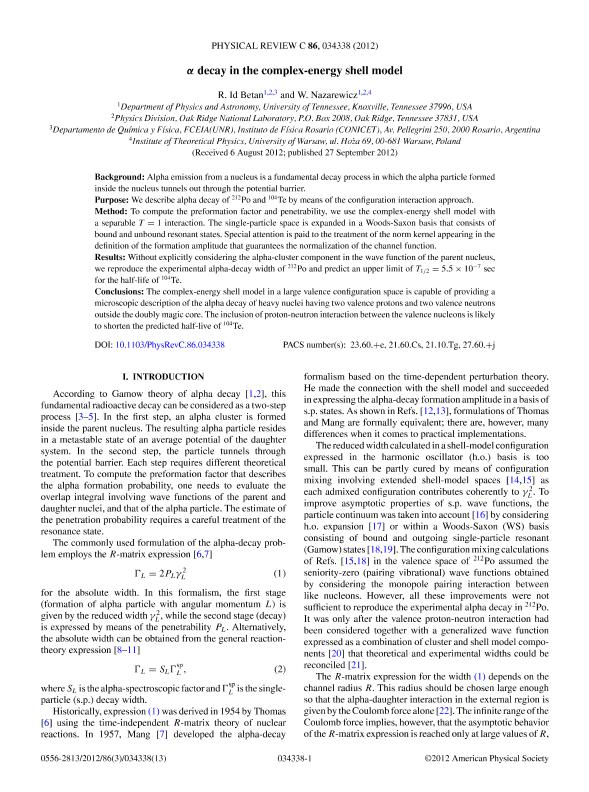
Background: Alpha emission from a nucleus is a fundamental decay process in which the alpha particle formed inside the nucleus tunnels out through the potential barrier.Purpose: We describe alpha decay of 212 Po and 104 Te by means of the configuration interaction approach.Method: To compute the preformation factor and penetrability, we use the complex-energy shell model with a separable T = 1 interaction. The single-particle space is expanded in a Woods-Saxon basis that consists of bound and unbound resonant states. Special attention is paid to the treatment of the norm kernel appearing in the definition of the formation amplitude that guarantees the normalization of the channel function.Results: Without explicitly considering the alpha-cluster component in the wave function of the parent nucleus, we reproduce the experimental alpha-decay width of 212 Po and predict an upper limit of T1/2 = 5.5 × 10⁻⁷ sec for the half-life of 104 Te.Conclusions: The complex-energy shell model in a large valence configuration space is capable of providing a microscopic description of the alpha decay of heavy nuclei having two valence protons and two valence neutrons outside the doubly magic core. The inclusion of proton-neutron interaction between the valence nucleons is likely to shorten the predicted half-live of 104 Te.
dc.format
application/pdf
dc.language.iso
eng
dc.publisher
American Physical Society
dc.rights
info:eu-repo/semantics/openAccess
dc.rights.uri
https://creativecommons.org/licenses/by-nc-sa/2.5/ar/
dc.subject
Alpha decay
dc.subject
Formation amplitude
dc.subject
Half life
dc.subject.classification
Física Nuclear
dc.subject.classification
Ciencias Físicas
dc.subject.classification
CIENCIAS NATURALES Y EXACTAS
dc.title
α decay in the complex-energy shell model
dc.type
info:eu-repo/semantics/article
dc.type
info:ar-repo/semantics/artículo
dc.type
info:eu-repo/semantics/publishedVersion
dc.date.updated
2025-08-26T10:16:18Z
dc.journal.volume
86
dc.journal.number
3
dc.journal.pagination
1-13
dc.journal.pais
Estados Unidos
dc.journal.ciudad
New York
dc.description.fil
Fil: Id Betan, Rodolfo Mohamed. University of Tennessee; Estados Unidos. Consejo Nacional de Investigaciones Científicas y Técnicas. Centro Científico Tecnológico Conicet - Rosario. Instituto de Física de Rosario. Universidad Nacional de Rosario. Instituto de Física de Rosario; Argentina
dc.description.fil
Fil: Nazarewicz, W.. University of Tennessee; Estados Unidos
dc.journal.title
Physical Review C: Nuclear Physics
dc.relation.alternativeid
info:eu-repo/semantics/altIdentifier/url/http://link.aps.org/doi/10.1103/PhysRevC.86.034338
dc.relation.alternativeid
info:eu-repo/semantics/altIdentifier/doi/http://dx.doi.org/10.1103/PhysRevC.86.034338
Archivos asociados

Tamaño:
1.027Mb
Formato:
PDF