Mostrar el registro sencillo del ítem
dc.contributor.author
Pérez, Denisa Soledad
dc.contributor.author
Giantin, Mery
dc.contributor.author
Pauletto, Marianna
dc.contributor.author
Dacasto, Mauro
dc.date.available
2025-08-22T13:05:08Z
dc.date.issued
2025-08
dc.identifier.citation
Pérez, Denisa Soledad; Giantin, Mery; Pauletto, Marianna; Dacasto, Mauro; Pharmaco-toxicological aspects of thymol in veterinary medicine. A systematic review; Frontiers Media; Frontiers in Veterinary Science; 12; 8-2025; 1-41
dc.identifier.issn
2297-1769
dc.identifier.uri
http://hdl.handle.net/11336/269605
dc.description.abstract
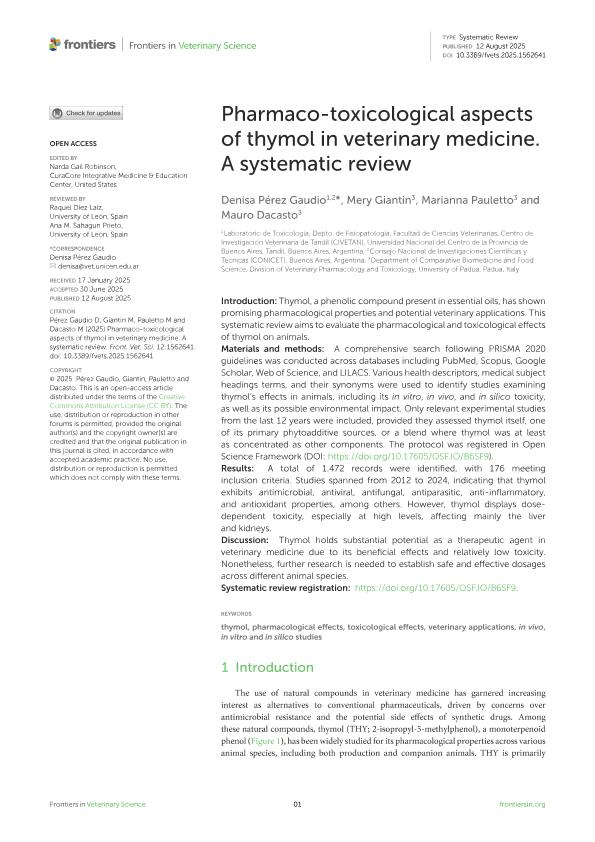
Introduction: Thymol, a phenolic compound present in essential oils, has shown promising pharmacological properties and potential veterinary applications. This systematic review aims to evaluate the pharmacological and toxicological eects of thymol on animals. Materials and methods: A comprehensive search following PRISMA 2020 guidelines was conducted across databases including PubMed, Scopus, Google Scholar, Web of Science, and LILACS. Various health descriptors, medical subject headings terms, and their synonyms were used to identify studies examining thymol’s eects in animals, including its in vitro, in vivo, and in silico toxicity, as well as its possible environmental impact. Only relevant experimental studies from the last 12 years were included, provided they assessed thymol itself, one of its primary phytoadditive sources, or a blend where thymol was at least as concentrated as other components. The protocol was registered in Open Science Framework (DOI: https://doi.org/10.17605/OSF.IO/B6SF9). Results: A total of 1.472 records were identified, with 176 meeting inclusion criteria. Studies spanned from 2012 to 2024, indicating that thymol exhibits antimicrobial, antiviral, antifungal, antiparasitic, anti-inflammatory, and antioxidant properties, among others. However, thymol displays dosedependent toxicity, especially at high levels, aecting mainly the liver and kidneys. Discussion: Thymol holds substantial potential as a therapeutic agent in veterinary medicine due to its beneficial eects and relatively low toxicity. Nonetheless, further research is needed to establish safe and eective dosages across dierent animal species.
dc.format
application/pdf
dc.language.iso
eng
dc.publisher
Frontiers Media
dc.rights
info:eu-repo/semantics/openAccess
dc.rights.uri
https://creativecommons.org/licenses/by/2.5/ar/
dc.subject
THYMOL
dc.subject
PHARMACOLOGICAL EFFECTS
dc.subject
TOXICOLOGICAL EFFECTS
dc.subject
VETERINARY APPLICATIONS
dc.subject.classification
Ciencias Veterinarias
dc.subject.classification
Ciencias Veterinarias
dc.subject.classification
CIENCIAS AGRÍCOLAS
dc.title
Pharmaco-toxicological aspects of thymol in veterinary medicine. A systematic review
dc.type
info:eu-repo/semantics/article
dc.type
info:ar-repo/semantics/artículo
dc.type
info:eu-repo/semantics/publishedVersion
dc.date.updated
2025-08-20T14:44:51Z
dc.journal.volume
12
dc.journal.pagination
1-41
dc.journal.pais
Suiza
dc.journal.ciudad
Lausanne
dc.description.fil
Fil: Pérez, Denisa Soledad. Consejo Nacional de Investigaciones Científicas y Técnicas. Centro Científico Tecnológico Conicet - Tandil. Centro de Investigación Veterinaria de Tandil. Universidad Nacional del Centro de la Provincia de Buenos Aires. Centro de Investigación Veterinaria de Tandil. Provincia de Buenos Aires. Gobernación. Comision de Investigaciones Científicas. Centro de Investigación Veterinaria de Tandil; Argentina
dc.description.fil
Fil: Giantin, Mery. Università di Padova; Italia
dc.description.fil
Fil: Pauletto, Marianna. Università di Padova; Italia
dc.description.fil
Fil: Dacasto, Mauro. Università di Padova; Italia
dc.journal.title
Frontiers in Veterinary Science
dc.relation.alternativeid
info:eu-repo/semantics/altIdentifier/url/https://www.frontiersin.org/journals/veterinary-science/articles/10.3389/fvets.2025.1562641/full
dc.relation.alternativeid
info:eu-repo/semantics/altIdentifier/doi/https://doi.org/10.3389/fvets.2025.1562641
Archivos asociados

Tamaño:
1.461Mb
Formato:
PDF