Artículo
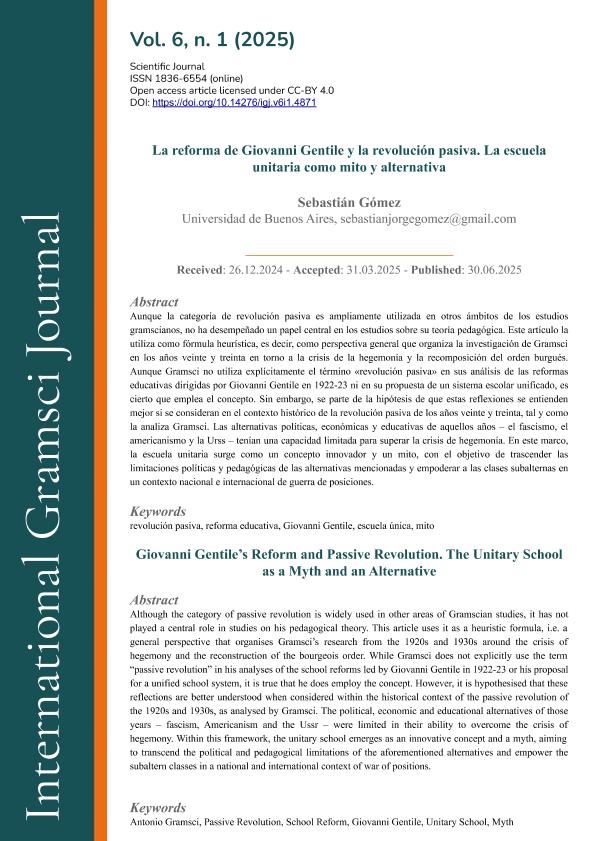
Aunque la categoría de revolución pasiva es ampliamente utilizada en otros ámbitos de los estudios gramscianos, no ha desempeñado un papel central en los estudios sobre su teoría pedagógica. Este artículo la utiliza como fórmula heurística, es decir, como perspectiva general que organiza la investigación de Gramsci en los años veinte y treinta en torno a la crisis de la hegemonía y la recomposición del orden burgués. Aunque Gramsci no utiliza explícitamente el término «revolución pasiva» en sus análisis de las reformas educativas dirigidas por Giovanni Gentile en 1922-23 ni en su propuesta de un sistema escolar unificado, es cierto que emplea el concepto. Sin embargo, se parte de la hipótesis de que estas reflexiones se entienden mejor si se consideran en el contexto histórico de la revolución pasiva de los años veinte y treinta, tal y como la analiza Gramsci. Las alternativas políticas, económicas y educativas de aquellos años – el fascismo, el americanismo y la Urss – tenían una capacidad limitada para superar la crisis de hegemonía. En este marco, la escuela unitaria surge como un concepto innovador y un mito, con el objetivo de trascender las limitaciones políticas y pedagógicas de las alternativas mencionadas y empoderar a las clases subalternas en un contexto nacional e internacional de guerra de posiciones. Although the category of passive revolution is widely used in other areas of Gramscian studies, it has not played a central role in studies on his pedagogical theory. This article uses it as a heuristic formula, i.e. a general perspective that organises Gramsci’s research from the 1920s and 1930s around the crisis of hegemony and the reconstruction of the bourgeois order. While Gramsci does not explicitly use the term “passive revolution” in his analyses of the school reforms led by Giovanni Gentile in 1922-23 or his proposal for a unified school system, it is true that he does employ the concept. However, it is hypothesised that these reflections are better understood when considered within the historical context of the passive revolution of the 1920s and 1930s, as analysed by Gramsci. The political, economic and educational alternatives of those years – fascism, Americanism and the Ussr – were limited in their ability to overcome the crisis of hegemony. Within this framework, the unitary school emerges as an innovative concept and a myth, aiming to transcend the political and pedagogical limitations of the aforementioned alternatives and empower the subaltern classes in a national and international context of war of positions.
La reforma de Giovanni Gentile y la revolución pasiva: La escuela unitaria como mito y alternativa
Título:
Giovanni Gentile’s Reform and Passive Revolution: The Unitary School as a Myth and an Alternative

Fecha de publicación:
06/2025
Editorial:
University of Wollongong
Revista:
International Gramsci Journal
e-ISSN:
1836-6554
Idioma:
Español
Tipo de recurso:
Artículo publicado
Clasificación temática:
Resumen
Palabras clave:
Reforma
,
Gentile
,
Escula unitaria
,
Mito
Archivos asociados

Tamaño:
1.706Mb
Formato:
PDF
Licencia
 Excepto donde se diga explícitamente, este item se publica bajo la siguiente descripción:
Creative Commons Attribution-NonCommercial-ShareAlike 2.5 Unported (CC BY-NC-SA 2.5)
Excepto donde se diga explícitamente, este item se publica bajo la siguiente descripción:
Creative Commons Attribution-NonCommercial-ShareAlike 2.5 Unported (CC BY-NC-SA 2.5)
Identificadores
Colecciones
Articulos(SEDE CENTRAL)
Articulos de SEDE CENTRAL
Articulos de SEDE CENTRAL
Citación
Gómez, Sebastián; La reforma de Giovanni Gentile y la revolución pasiva: La escuela unitaria como mito y alternativa; University of Wollongong; International Gramsci Journal; 6; 1; 6-2025; 271-283
Compartir


Altmétricas