Mostrar el registro sencillo del ítem
dc.contributor.author
Castro, Gisela Natalia
dc.contributor.author
Cayado Gutiérrez, Niubys de Los Milagros
dc.contributor.author
Moncalero, Vera Lucia
dc.contributor.author
Lima, Patricia
dc.contributor.author
De Angelis, Rodolfo Lucero
dc.contributor.author
Chávez, Victor
dc.contributor.author
Cuello Carrión, Fernando Darío
dc.contributor.author
Ciocca, Daniel Ramon
dc.date.available
2025-08-11T13:09:02Z
dc.date.issued
2012-11
dc.identifier.citation
Castro, Gisela Natalia; Cayado Gutiérrez, Niubys de Los Milagros; Moncalero, Vera Lucia; Lima, Patricia; De Angelis, Rodolfo Lucero; et al.; Hsp27 (HSPB1): a possible surrogate molecular marker for loss of heterozygosity (LOH) of chromosome 1p in oligodendrogliomas but not in astrocytomas; Springer; Cell Stress & Chaperones; 17; 6; 11-2012; 779-790
dc.identifier.issn
1355-8145
dc.identifier.uri
http://hdl.handle.net/11336/268601
dc.description.abstract
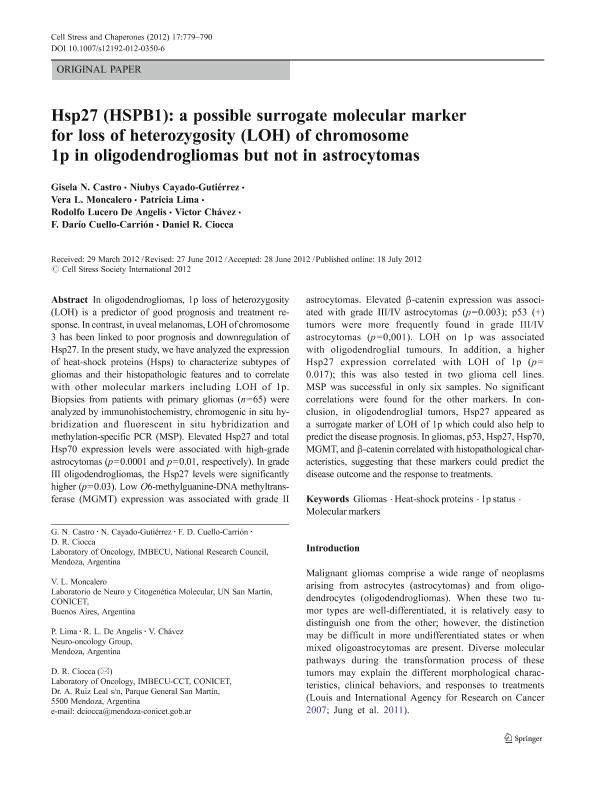
In oligodendrogliomas, 1p loss of heterozygosity (LOH) is a predictor of good prognosis and treatment response. In contrast, in uveal melanomas, LOH of chromosome 3 has been linked to poor prognosis and downregulation of Hsp27. In the present study, we have analyzed the expression of heat-shock proteins (Hsps) to characterize subtypes of gliomas and their histopathologic features and to correlate with other molecular markers including LOH of 1p. Biopsies from patients with primary gliomas (n = 65) were analyzed by immunohistochemistry, chromogenic in situ hybridization and fluorescent in situ hybridization and methylation-specific PCR (MSP). Elevated Hsp27 and total Hsp70 expression levels were associated with high-grade astrocytomas (p = 0.0001 and p = 0.01, respectively). In grade III oligodendrogliomas, the Hsp27 levels were significantly higher (p = 0.03). Low O6-methylguanine-DNA methyltransferase (MGMT) expression was associated with grade II astrocytomas. Elevated β-catenin expression was associated with grade III/IV astrocytomas (p = 0.003); p53 (+) tumors were more frequently found in grade III/IV astrocytomas (p = 0,001). LOH on 1p was associated with oligodendroglial tumours. In addition, a higher Hsp27 expression correlated with LOH of 1p (p = 0.017); this was also tested in two glioma cell lines. MSP was successful in only six samples. No significant correlations were found for the other markers. In conclusion, in oligodendroglial tumors, Hsp27 appeared as a surrogate marker of LOH of 1p which could also help to predict the disease prognosis. In gliomas, p53, Hsp27, Hsp70, MGMT, and β-catenin correlated with histopathological characteristics, suggesting that these markers could predict the disease outcome and the response to treatments.
dc.format
application/pdf
dc.language.iso
eng
dc.publisher
Springer
dc.rights
info:eu-repo/semantics/openAccess
dc.rights.uri
https://creativecommons.org/licenses/by-nc-nd/2.5/ar/
dc.subject
Heat shock proteins
dc.subject
Astrocytomas
dc.subject
LOH chromosome 1p
dc.subject
Hsp27
dc.subject.classification
Patología
dc.subject.classification
Medicina Básica
dc.subject.classification
CIENCIAS MÉDICAS Y DE LA SALUD
dc.title
Hsp27 (HSPB1): a possible surrogate molecular marker for loss of heterozygosity (LOH) of chromosome 1p in oligodendrogliomas but not in astrocytomas
dc.type
info:eu-repo/semantics/article
dc.type
info:ar-repo/semantics/artículo
dc.type
info:eu-repo/semantics/publishedVersion
dc.date.updated
2025-08-06T11:01:19Z
dc.journal.volume
17
dc.journal.number
6
dc.journal.pagination
779-790
dc.journal.pais
Alemania
dc.journal.ciudad
Berlin
dc.description.fil
Fil: Castro, Gisela Natalia. Consejo Nacional de Investigaciones Científicas y Técnicas. Centro Científico Tecnológico Conicet - Mendoza. Instituto de Medicina y Biología Experimental de Cuyo; Argentina
dc.description.fil
Fil: Cayado Gutiérrez, Niubys de Los Milagros. Consejo Nacional de Investigaciones Científicas y Técnicas. Centro Científico Tecnológico Conicet - Mendoza. Instituto de Medicina y Biología Experimental de Cuyo; Argentina
dc.description.fil
Fil: Moncalero, Vera Lucia. Consejo Nacional de Investigaciones Científicas y Técnicas; Argentina. Universidad Nacional de San Martín. Escuela de Ciencia y Tecnología. Centro de Estudios en Salud y Medio Ambiente; Argentina
dc.description.fil
Fil: Lima, Patricia. Neuro-oncology Group; Argentina
dc.description.fil
Fil: De Angelis, Rodolfo Lucero. Neuro-oncology Group; Argentina
dc.description.fil
Fil: Chávez, Victor. Neuro-oncology Group; Argentina
dc.description.fil
Fil: Cuello Carrión, Fernando Darío. Consejo Nacional de Investigaciones Científicas y Técnicas. Centro Científico Tecnológico Conicet - Mendoza. Instituto de Medicina y Biología Experimental de Cuyo; Argentina
dc.description.fil
Fil: Ciocca, Daniel Ramon. Consejo Nacional de Investigaciones Científicas y Técnicas. Centro Científico Tecnológico Conicet - Mendoza. Instituto de Medicina y Biología Experimental de Cuyo; Argentina
dc.journal.title
Cell Stress & Chaperones
dc.relation.alternativeid
info:eu-repo/semantics/altIdentifier/url/https://www.sciencedirect.com/science/article/pii/S135581452302165X
dc.relation.alternativeid
info:eu-repo/semantics/altIdentifier/doi/http://dx.doi.org/10.1007/s12192-012-0350-6
Archivos asociados

Tamaño:
980.2Kb
Formato:
PDF