Artículo
Ethanol induces second-order aversive conditioning in adolescent and adult rats
Pautassi, Ricardo Marcos ; Myers, Mallory; Spear, Linda Patia; Molina, Juan Carlos
; Spear, Norman E.
; Myers, Mallory; Spear, Linda Patia; Molina, Juan Carlos
; Spear, Norman E.
; Myers, Mallory; Spear, Linda Patia; Molina, Juan Carlos
; Spear, Norman E.
Fecha de publicación:
02/2011
Editorial:
Elsevier Science Inc.
Revista:
Alcohol
ISSN:
0741-8329
Idioma:
Inglés
Tipo de recurso:
Artículo publicado
Clasificación temática:
Resumen
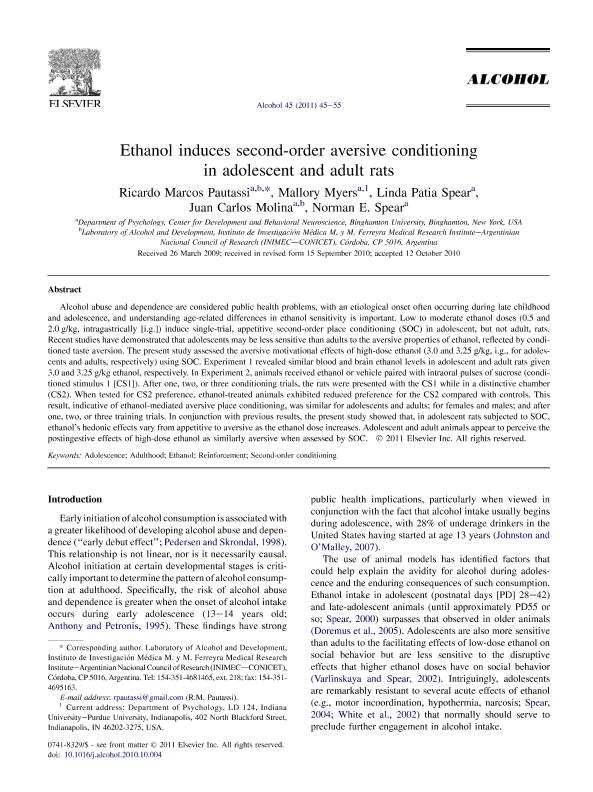
Alcohol abuse and dependence are considered public health problems, with an etiological onset often occurring during late childhood and adolescence, and understanding age-related differences in ethanol sensitivity is important. Low to moderate ethanol doses (0.5 and 2.0 g/kg, intragastrically [i.g.]) induce single-trial, appetitive second-order place conditioning (SOC) in adolescent, but not adult, rats. Recent studies have demonstrated that adolescents may be less sensitive than adults to the aversive properties of ethanol, reflected by conditioned taste aversion. The present study assessed the aversive motivational effects of high-dose ethanol (3.0 and 3.25 g/kg, i.g., for adolescents and adults, respectively) using SOC. Experiment 1 revealed similar blood and brain ethanol levels in adolescent and adult rats given 3.0 and 3.25 g/kg ethanol, respectively. In Experiment 2, animals received ethanol or vehicle paired with intraoral pulses of sucrose (conditioned stimulus 1 [CS1]). After one, two, or three conditioning trials, the rats were presented with the CS1 while in a distinctive chamber (CS2). When tested for CS2 preference, ethanol-treated animals exhibited reduced preference for the CS2 compared with controls. This result, indicative of ethanol-mediated aversive place conditioning, was similar for adolescents and adults; for females and males; and after one, two, or three training trials. In conjunction with previous results, the present study showed that, in adolescent rats subjected to SOC, ethanol´s hedonic effects vary from appetitive to aversive as the ethanol dose increases. Adolescent and adult animals appear to perceive the postingestive effects of high-dose ethanol as similarly aversive when assessed by SOC.
Palabras clave:
Adolescence
,
Adulthood
,
Ethanol
,
Reinforcement
Archivos asociados

Tamaño:
437.9Kb
Formato:
PDF
Licencia
 Excepto donde se diga explícitamente, este item se publica bajo la siguiente descripción:
Creative Commons Attribution-NonCommercial-ShareAlike 2.5 Unported (CC BY-NC-SA 2.5)
Excepto donde se diga explícitamente, este item se publica bajo la siguiente descripción:
Creative Commons Attribution-NonCommercial-ShareAlike 2.5 Unported (CC BY-NC-SA 2.5)
Identificadores
Colecciones
Articulos(INIMEC - CONICET)
Articulos de INSTITUTO DE INV. MEDICAS MERCEDES Y MARTIN FERREYRA
Articulos de INSTITUTO DE INV. MEDICAS MERCEDES Y MARTIN FERREYRA
Citación
Pautassi, Ricardo Marcos; Myers, Mallory; Spear, Linda Patia; Molina, Juan Carlos; Spear, Norman E.; Ethanol induces second-order aversive conditioning in adolescent and adult rats; Elsevier Science Inc.; Alcohol; 45; 1; 2-2011; 45-55
Compartir


Altmétricas