Mostrar el registro sencillo del ítem
dc.contributor.author
Sanz Sagué, Beatriz
dc.contributor.author
Sáenz Hernández, Amaia
dc.contributor.author
Moreno Maldonado, Ana C.
dc.contributor.author
Fuentes García, Jesús A.
dc.contributor.author
Nuñez, Jorge Martín
dc.contributor.author
Zegura, Bojana
dc.contributor.author
Stern, Alja
dc.contributor.author
Kolosa, Katja
dc.contributor.author
Rozman, Iza
dc.contributor.author
Torres Molina, Teobaldo Enrique
dc.contributor.author
Goya, Gerardo F.
dc.date.available
2025-07-29T10:00:23Z
dc.date.issued
2024-05
dc.identifier.citation
Sanz Sagué, Beatriz; Sáenz Hernández, Amaia; Moreno Maldonado, Ana C.; Fuentes García, Jesús A.; Nuñez, Jorge Martín; et al.; Genotoxicity and heating Performance of VxFe3-xO4 nanoparticles in Health applications; Elsevier Ireland; Chemico-biological Interactions; 394; 5-2024; 1-13
dc.identifier.issn
0009-2797
dc.identifier.uri
http://hdl.handle.net/11336/267329
dc.description.abstract
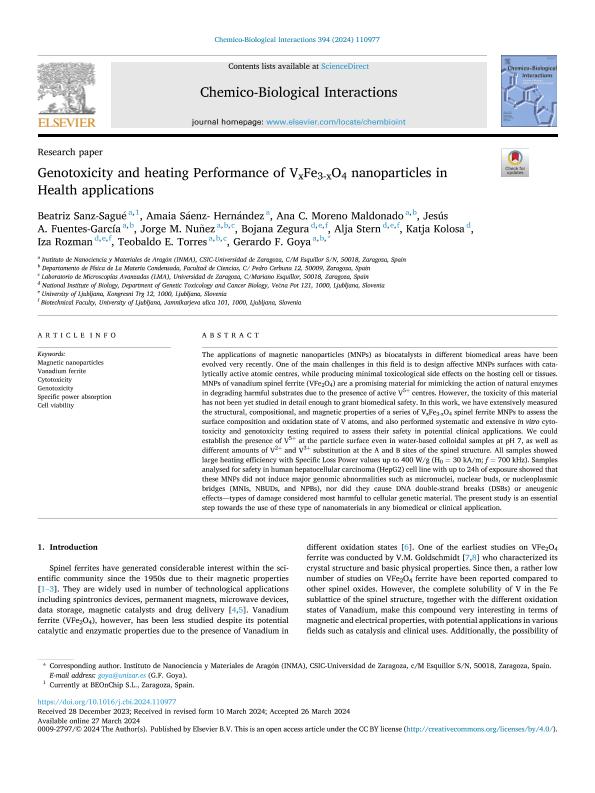
The applications of magnetic nanoparticles (MNPs) as biocatalysts in different biomedical areas have been evolved very recently. One of the main challenges in this field is to design affective MNPs surfaces with catalytically active atomic centres, while producing minimal toxicological side effects on the hosting cell or tissues. MNPs of vanadium spinel ferrite (VFe2O4) are a promising material for mimicking the action of natural enzymes in degrading harmful substrates due to the presence of active V5+ centres. However, the toxicity of this material has not been yet studied in detail enough to grant biomedical safety. In this work, we have extensively measured the structural, compositional, and magnetic properties of a series of VxFe3-xO4 spinel ferrite MNPs to assess the surface composition and oxidation state of V atoms, and also performed systematic and extensive in vitro cytotoxicity and genotoxicity testing required to assess their safety in potential clinical applications. We could establish the presence of V5+ at the particle surface even in water-based colloidal samples at pH 7, as well as different amounts of V2+ and V3+ substitution at the A and B sites of the spinel structure. All samples showed large heating efficiency with Specific Loss Power values up to 400 W/g (H0 = 30 kA/m; f = 700 kHz). Samples analysed for safety in human hepatocellular carcinoma (HepG2) cell line with up to 24h of exposure showed that these MNPs did not induce major genomic abnormalities such as micronuclei, nuclear buds, or nucleoplasmic bridges (MNIs, NBUDs, and NPBs), nor did they cause DNA double-strand breaks (DSBs) or aneugenic effects—types of damage considered most harmful to cellular genetic material. The present study is an essential step towards the use of these type of nanomaterials in any biomedical or clinical application.
dc.format
application/pdf
dc.language.iso
eng
dc.publisher
Elsevier Ireland
dc.rights
info:eu-repo/semantics/openAccess
dc.rights.uri
https://creativecommons.org/licenses/by/2.5/ar/
dc.subject
Magnetica nanoparticles
dc.subject
Vanadium ferrite
dc.subject
Cytotoxicity
dc.subject
Genotoxicity
dc.subject.classification
Físico-Química, Ciencia de los Polímeros, Electroquímica
dc.subject.classification
Ciencias Químicas
dc.subject.classification
CIENCIAS NATURALES Y EXACTAS
dc.title
Genotoxicity and heating Performance of VxFe3-xO4 nanoparticles in Health applications
dc.type
info:eu-repo/semantics/article
dc.type
info:ar-repo/semantics/artículo
dc.type
info:eu-repo/semantics/publishedVersion
dc.date.updated
2025-07-28T12:22:28Z
dc.journal.volume
394
dc.journal.pagination
1-13
dc.journal.pais
Irlanda
dc.description.fil
Fil: Sanz Sagué, Beatriz. Universidad de Zaragoza. Facultad de Ciencias; España
dc.description.fil
Fil: Sáenz Hernández, Amaia. Universidad de Zaragoza. Facultad de Ciencias; España
dc.description.fil
Fil: Moreno Maldonado, Ana C.. Universidad de Zaragoza. Facultad de Ciencias; España
dc.description.fil
Fil: Fuentes García, Jesús A.. Universidad de Zaragoza. Facultad de Ciencias; España
dc.description.fil
Fil: Nuñez, Jorge Martín. Consejo Nacional de Investigaciones Cientificas y Tecnicas. Oficina de Coordinacion Administrativa Ciudad Universitaria. Unidad Ejecutora Instituto de Nanociencia y Nanotecnologia. Unidad Ejecutora Instituto de Nanociencia y Nanotecnologia - Nodo Bariloche | Comision Nacional de Energia Atomica. Unidad Ejecutora Instituto de Nanociencia y Nanotecnologia. Unidad Ejecutora Instituto de Nanociencia y Nanotecnologia - Nodo Bariloche.; Argentina. Universidad de Zaragoza. Facultad de Ciencias; España
dc.description.fil
Fil: Zegura, Bojana. University of Ljubljana; Eslovenia
dc.description.fil
Fil: Stern, Alja. University of Ljubljana; Eslovenia
dc.description.fil
Fil: Kolosa, Katja. No especifíca;
dc.description.fil
Fil: Rozman, Iza. University of Ljubljana; Eslovenia
dc.description.fil
Fil: Torres Molina, Teobaldo Enrique. Consejo Nacional de Investigaciones Cientificas y Tecnicas. Oficina de Coordinacion Administrativa Ciudad Universitaria. Unidad Ejecutora Instituto de Nanociencia y Nanotecnologia. Unidad Ejecutora Instituto de Nanociencia y Nanotecnologia - Nodo Bariloche | Comision Nacional de Energia Atomica. Unidad Ejecutora Instituto de Nanociencia y Nanotecnologia. Unidad Ejecutora Instituto de Nanociencia y Nanotecnologia - Nodo Bariloche.; Argentina. Universidad de Zaragoza. Facultad de Ciencias; España
dc.description.fil
Fil: Goya, Gerardo F.. Universidad de Zaragoza. Facultad de Ciencias; España
dc.journal.title
Chemico-biological Interactions
dc.relation.alternativeid
info:eu-repo/semantics/altIdentifier/url/https://linkinghub.elsevier.com/retrieve/pii/S0009279724001236
dc.relation.alternativeid
info:eu-repo/semantics/altIdentifier/doi/http://dx.doi.org/10.1016/j.cbi.2024.110977
Archivos asociados

Tamaño:
8.909Mb
Formato:
PDF