Mostrar el registro sencillo del ítem
dc.contributor.author
Pisano, Juan Ignacio
dc.date.available
2025-07-24T11:38:34Z
dc.date.issued
2025-03
dc.identifier.citation
Pisano, Juan Ignacio; Ante lo gauchesco, apariciones éxtimas: Intimidad, negritud y voz femenina; Universidad de Buenos Aires. Facultad de Filosofía y Letras; Exlibris; 14; 3-2025; 16-30
dc.identifier.issn
2314-3894
dc.identifier.uri
http://hdl.handle.net/11336/267026
dc.description.abstract
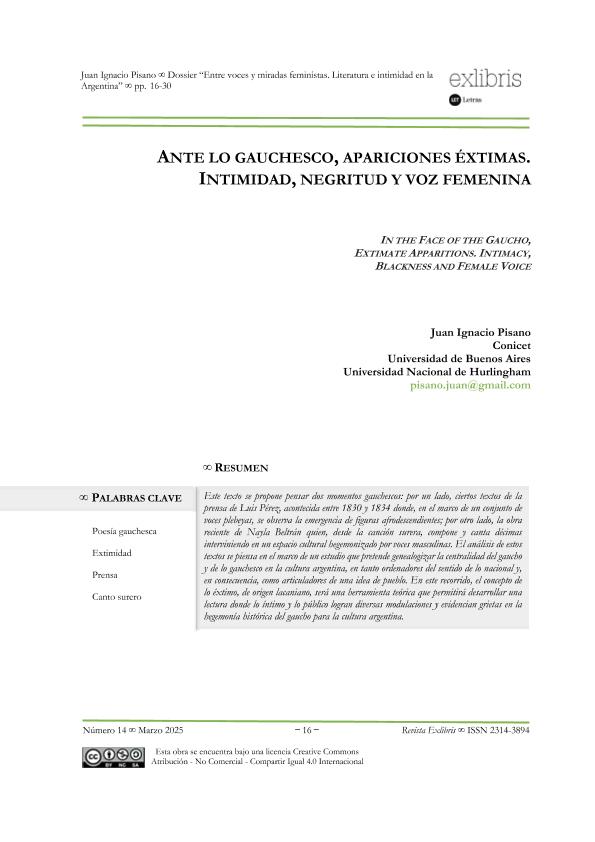
Este texto se propone pensar dos momentos gauchescos: por un lado, ciertos textos de la prensa de Luis Pérez, acontecida entre 1830 y 1834 donde, en el marco de un conjunto de voces plebeyas, se observa la emergencia de figuras afrodescendientes; por otro lado, la obra reciente de Nayla Beltrán quien, desde la canción surera, compone y canta décimas interviniendo en un espacio cultural hegemonizado por voces masculinas. El análisis de estos textos se piensa en el marco de un estudio que pretende genealogizar la centralidad del gaucho y de lo gauchesco en la cultura argentina, en tanto ordenadores del sentido de lo nacional y, en consecuencia, como articuladores de una idea de pueblo. En este recorrido, el concepto de lo éxtimo, de origen lacaniano, será una herramienta teórica que permitirá desarrollar una lectura donde lo íntimo y lo público logran diversas modulaciones y evidencian grietas en la hegemonía histórica del gaucho para la cultura argentina.
dc.description.abstract
This text aims to think about two gaucho moments: on the one hand, certain texts from the press of Luis Pérez, which occurred between 1830 and 1834 where, within the framework of a set of plebeian voices, the emergence of Afro-descendant figures is observed; On the other hand, the recent work of Nayla Beltrán who, from the southern song, composes and sings décimas, thus intervening in a cultural space hegemonized by male voices. The analysis of these texts is thought within the framework of a study that aims to genealogize the centrality of the gaucho and lo gauchesco in Argentine culture, as organizers of the sense of the national and, consequently, as articulators of an idea of the people. In this journey, the concept of the éxtimo, of Lacanian origin, will be a theoretical tool that will allow the development of a reading where the intimate and the public achieve various modulations and evidence for the historical hegemony of the gaucho in Argentine culture.
dc.format
application/pdf
dc.language.iso
spa
dc.publisher
Universidad de Buenos Aires. Facultad de Filosofía y Letras
dc.rights
info:eu-repo/semantics/openAccess
dc.rights.uri
https://creativecommons.org/licenses/by-nc-sa/2.5/ar/
dc.subject
Poesía gauchesca
dc.subject
Negritud
dc.subject
Literatura argentina
dc.subject
Feminidades
dc.subject.classification
Literaturas Específicas
dc.subject.classification
Lengua y Literatura
dc.subject.classification
HUMANIDADES
dc.title
Ante lo gauchesco, apariciones éxtimas: Intimidad, negritud y voz femenina
dc.title
In the face of the gaucho, extimate apparitions: Intimacy, blackness and female voice
dc.type
info:eu-repo/semantics/article
dc.type
info:ar-repo/semantics/artículo
dc.type
info:eu-repo/semantics/publishedVersion
dc.date.updated
2025-07-24T11:02:03Z
dc.journal.number
14
dc.journal.pagination
16-30
dc.journal.pais
Argentina
dc.journal.ciudad
Ciudad Autónoma de Buenos Aires
dc.description.fil
Fil: Pisano, Juan Ignacio. Consejo Nacional de Investigaciones Científicas y Técnicas; Argentina. Universidad de Buenos Aires. Facultad de Filosofía y Letras. Instituto de Literatura Hispanoamericana; Argentina
dc.journal.title
Exlibris
dc.relation.alternativeid
info:eu-repo/semantics/altIdentifier/url/http://revistas.filo.uba.ar/index.php/exlibris/article/view/4498
dc.relation.alternativeid
info:eu-repo/semantics/altIdentifier/url/https://dialnet.unirioja.es/servlet/articulo?codigo=10134640
Archivos asociados

Tamaño:
278.8Kb
Formato:
PDF