Artículo
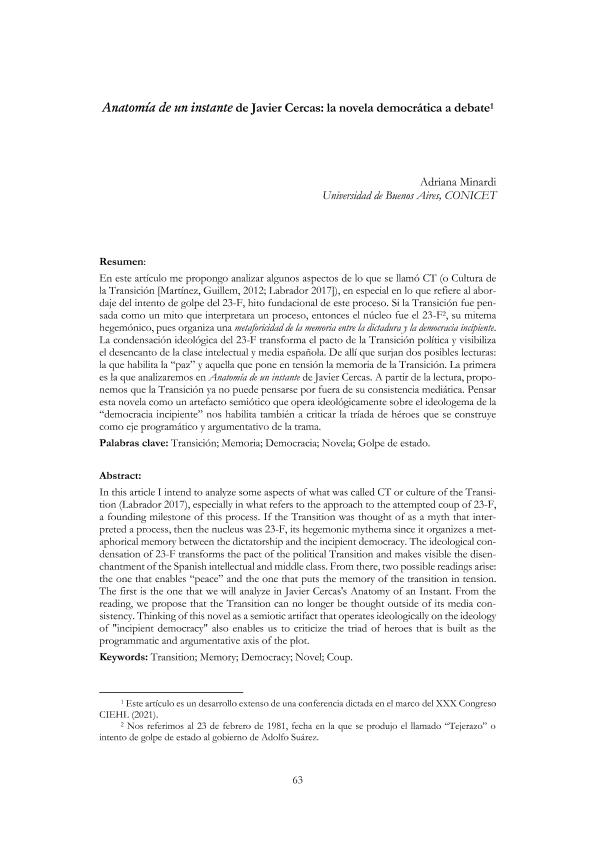
En este artículo me propongo analizar algunos aspectos de lo que se llamó CT (o Cultura de la Transición [Martínez, Guillem, 2012; Labrador 2017]), en especial en lo que refiere al abordaje del intento de golpe del 23-F, hito fundacional de este proceso. Si la Transición fue pensada como un mito que interpretara un proceso, entonces el núcleo fue el 23-F2 , su mitema hegemónico, pues organiza una metaforicidad de la memoria entre la dictadura y la democracia incipiente. La condensación ideológica del 23-F transforma el pacto de la Transición política y visibiliza el desencanto de la clase intelectual y media española. De allí que surjan dos posibles lecturas: la que habilita la “paz” y aquella que pone en tensión la memoria de la Transición. La primera es la que analizaremos en Anatomía de un instante de Javier Cercas. A partir de la lectura, proponemos que la Transición ya no puede pensarse por fuera de su consistencia mediática. Pensar esta novela como un artefacto semiótico que opera ideológicamente sobre el ideologema de la “democracia incipiente” nos habilita también a criticar la tríada de héroes que se construye como eje programático y argumentativo de la trama. In this article I intend to analyze some aspects of what was called CT or culture of the Transition (Labrador 2017), especially in what refers to the approach to the attempted coup of 23-F, a founding milestone of this process. If the Transition was thought of as a myth that interpreted a process, then the nucleus was 23-F, its hegemonic mythema since it organizes a metaphorical memory between the dictatorship and the incipient democracy. The ideological condensation of 23-F transforms the pact of the political Transition and makes visible the disenchantment of the Spanish intellectual and middle class. From there, two possible readings arise: the one that enables “peace” and the one that puts the memory of the transition in tension. The first is the one that we will analyze in Javier Cercas's Anatomy of an Instant. From the reading, we propose that the Transition can no longer be thought outside of its media consistency. Thinking of this novel as a semiotic artifact that operates ideologically on the ideology of "incipient democracy" also enables us to criticize the triad of heroes that is built as the programmatic and argumentative axis of the plot.
Anatomía de un instante de Javier Cercas: La novela democrática a debate

Fecha de publicación:
08/2024
Editorial:
Universidad de Oslo
Revista:
Memoria y Narración
e-ISSN:
2535-597X
Idioma:
Español
Tipo de recurso:
Artículo publicado
Clasificación temática:
Resumen
Palabras clave:
TRANSICIÓN
,
MEMORIA
,
DEMOCRACIA
,
NOVELA
Archivos asociados

Tamaño:
453.7Kb
Formato:
PDF
Licencia
 Excepto donde se diga explícitamente, este item se publica bajo la siguiente descripción:
Creative Commons Attribution 2.5 Unported (CC BY 2.5)
Excepto donde se diga explícitamente, este item se publica bajo la siguiente descripción:
Creative Commons Attribution 2.5 Unported (CC BY 2.5)
Identificadores
Colecciones
Articulos(SEDE CENTRAL)
Articulos de SEDE CENTRAL
Articulos de SEDE CENTRAL
Citación
Minardi, Adriana Elizabeth; Anatomía de un instante de Javier Cercas: La novela democrática a debate; Universidad de Oslo; Memoria y Narración; 4; 8-2024; 63-78
Compartir


Altmétricas