Artículo
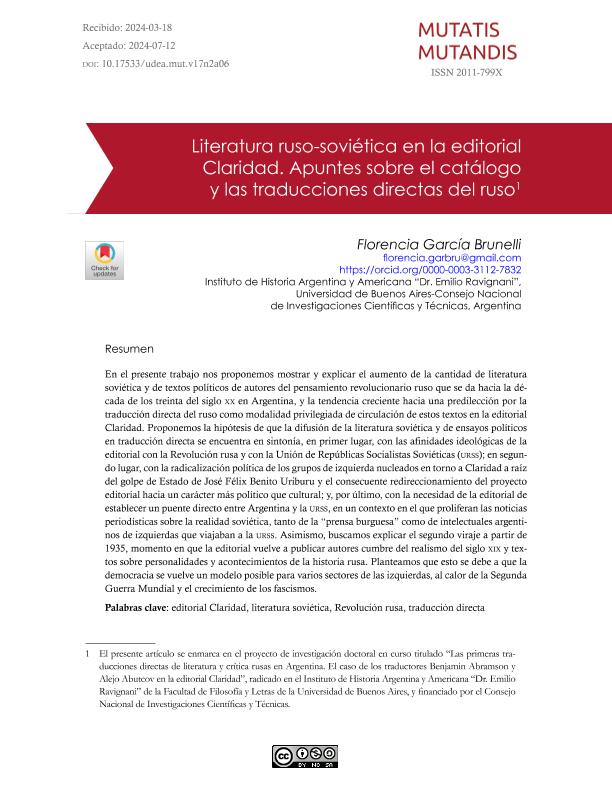
En el presente trabajo nos proponemos mostrar y explicar el aumento de la cantidad de literatura soviética y de textos políticos de autores del pensamiento revolucionario ruso hacia la década de 1930 en Argentina, y la tendencia creciente hacia una predilección por la traducción directa del ruso como modalidad privilegiada de circulación de estos textos en la editorial Claridad. Proponemos la hipótesis de que la difusión de literatura soviética y ensayos políticos en traducción directa se encuentra en sintonía, en primer lugar, con las afinidades ideológicas de la editorial con la Revolución rusa y con la URSS; en segundo lugar, con la radicalización política de los grupos de izquierda nucleados en torno a Claridad a raíz del golpe de Estado de Uriburu y el consecuente redireccionamiento del proyecto editorial hacia un carácter más político que cultural; y, por último, con la necesidad de la editorial de establecer un puente directo entre Argentina y la URSS, en un contexto en el que proliferan las noticias periodísticas sobre la realidad soviética, tanto de la “prensa burguesa” como de intelectuales argentinos de izquierdas que viajaban a la URSS. Asimismo, intentamos explicar el segundo viraje a partir de 1935, momento en que la editorial vuelve a publicar autores cumbre del realismo del siglo XIX y textos sobre personalidades y acontecimientos de la historia rusa. Planteamos que esto se debe a que la democracia se vuelve un modelo posible para varios sectores de las izquierdas, al calor de la Segunda Guerra Mundial y el crecimiento de los fascismos. In this paper, we show and explain the increasing volume of Soviet literature and political texts by authors of the Russian revolutionary school, which entered Argentina during the 1930s, and the growing trend towards a predilection for direct translation from Russian as a privileged modality of circulation of these texts at publishing house Claridad. We propose the hypothesis that the dissemination of Soviet literature and political essays in direct translation is in tune, firstly, with the ideological affinities of the publishing house with the Russian Revolution and the Union of Soviet Socialist Republics (ussr); secondly, with the political radicalization of the leftist groups nucleated around Claridad following the coup d’état of José Félix Benito Uriburu and the consequent redirection of the editorial project towards a more political than cultural character; and, finally, with the need of the publishing house to establish a direct bridge between Argentina and the ussr, in a context in which there was a proliferation of journalistic news about the Soviet reality, both from the “bourgeois press” and from Argentine left-wing intellectuals who traveled to the ussr. We also seek to explain the second shift after 1935, when the publishing house returned to publishing authors at the height of 19th century realism and texts on personalities and events in Russian history. We propose that this is due to the fact that democracy becomes a possible model for several sectors of the left, in the heat of World War ii and the advance of fascism.
La literatura ruso-soviética en la editorial Claridad: apuntes sobre el catálogo y las traducciones directas del ruso
Título:
Russian-Soviet Literature at Claridad Publishing House: Notes on the Catalog and Direct Translations from the Russian Language

Fecha de publicación:
08/2024
Editorial:
Universidad de Antioquia
Revista:
Mutatis Mutandis
e-ISSN:
2011-799X
Idioma:
Español
Tipo de recurso:
Artículo publicado
Clasificación temática:
Resumen
Archivos asociados

Tamaño:
1.794Mb
Formato:
PDF
Licencia
 Excepto donde se diga explícitamente, este item se publica bajo la siguiente descripción:
Creative Commons Attribution-NonCommercial-ShareAlike 2.5 Unported (CC BY-NC-SA 2.5)
Excepto donde se diga explícitamente, este item se publica bajo la siguiente descripción:
Creative Commons Attribution-NonCommercial-ShareAlike 2.5 Unported (CC BY-NC-SA 2.5)
Identificadores
Colecciones
Articulos(INSTITUTO "DR. E.RAVIGNANI")
Articulos de INST. DE HISTORIA ARGENTINA Y AMERICANA "DR. EMILIO RAVIGNANI"
Articulos de INST. DE HISTORIA ARGENTINA Y AMERICANA "DR. EMILIO RAVIGNANI"
Citación
García Brunelli, Florencia; La literatura ruso-soviética en la editorial Claridad: apuntes sobre el catálogo y las traducciones directas del ruso; Universidad de Antioquia; Mutatis Mutandis; 17; 2; 8-2024; 346-368
Compartir


Altmétricas