Artículo
Macrophages excite muscle spindles with glutamate to bolster locomotion
Yan, Yuyang; Antolin, Nuria; Zhou, Luming; Xu, Luyang; Vargas, Irene Lisa; Gomez Martinez, Carlos Daniel ; Kong, Guiping; Palmisano, Ilaria; Yang, Yi; Chadwick, Jessica; Müller, Franziska; Bull, Anthony M. J.; Lo Celso, Cristina; Primiano, Guido; Servidei, Serenella; Perrier, Jean François; Bellardita, Carmelo; Di Giovanni, Simone
; Kong, Guiping; Palmisano, Ilaria; Yang, Yi; Chadwick, Jessica; Müller, Franziska; Bull, Anthony M. J.; Lo Celso, Cristina; Primiano, Guido; Servidei, Serenella; Perrier, Jean François; Bellardita, Carmelo; Di Giovanni, Simone
Fecha de publicación:
12/2024
Editorial:
Nature Publishing Group
Revista:
Nature
ISSN:
0028-0836
Idioma:
Inglés
Tipo de recurso:
Artículo publicado
Clasificación temática:
Resumen
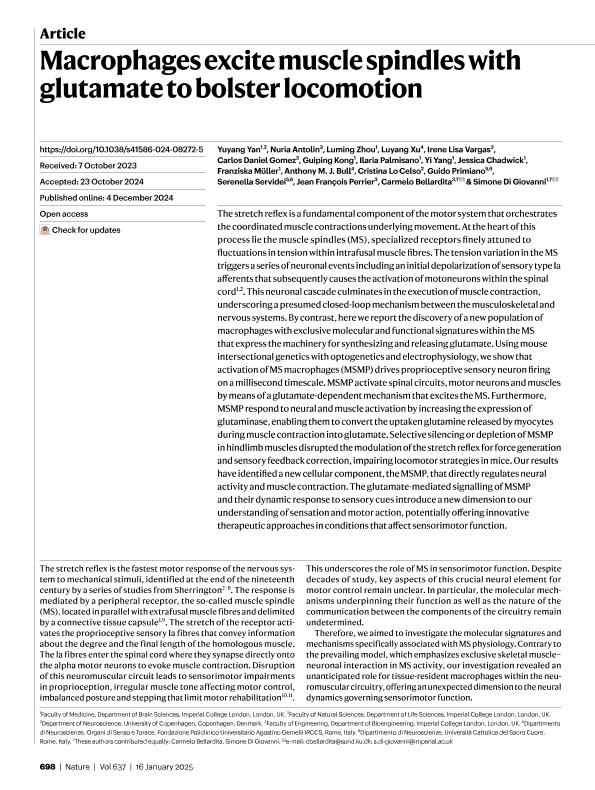
The stretch reflex is a fundamental component of the motor system that orchestrates the coordinated muscle contractions underlying movement. At the heart of this process lie the muscle spindles (MS), specialized receptors finely attuned to fluctuations in tension within intrafusal muscle fibres. The tension variation in the MS triggers a series of neuronal events including an initial depolarization of sensory type Ia afferents that subsequently causes the activation of motoneurons within the spinal cord1,2. This neuronal cascade culminates in the execution of muscle contraction, underscoring a presumed closed-loop mechanism between the musculoskeletal and nervous systems. By contrast, here we report the discovery of a new population of macrophages with exclusive molecular and functional signatures within the MS that express the machinery for synthesizing and releasing glutamate. Using mouse intersectional genetics with optogenetics and electrophysiology, we show that activation of MS macrophages (MSMP) drives proprioceptive sensory neuron firing on a millisecond timescale. MSMP activate spinal circuits, motor neurons and muscles by means of a glutamate-dependent mechanism that excites the MS. Furthermore, MSMP respond to neural and muscle activation by increasing the expression of glutaminase, enabling them to convert the uptaken glutamine released by myocytes during muscle contraction into glutamate. Selective silencing or depletion of MSMP in hindlimb muscles disrupted the modulation of the stretch reflex for force generation and sensory feedback correction, impairing locomotor strategies in mice. Our results have identified a new cellular component, the MSMP, that directly regulates neural activity and muscle contraction. The glutamate-mediated signalling of MSMP and their dynamic response to sensory cues introduce a new dimension to our understanding of sensation and motor action, potentially offering innovative therapeutic approaches in conditions that affect sensorimotor function.
Palabras clave:
Motoneurons
,
Glutamate
,
Electrophysiology
,
Muscle-spindles
Archivos asociados

Tamaño:
14.59Mb
Formato:
PDF
Licencia
 Excepto donde se diga explícitamente, este item se publica bajo la siguiente descripción:
Creative Commons Attribution 2.5 Unported (CC BY 2.5)
Excepto donde se diga explícitamente, este item se publica bajo la siguiente descripción:
Creative Commons Attribution 2.5 Unported (CC BY 2.5)
Identificadores
Colecciones
Articulos(INIBIOLP)
Articulos de INST.DE INVEST.BIOQUIMICAS DE LA PLATA
Articulos de INST.DE INVEST.BIOQUIMICAS DE LA PLATA
Citación
Yan, Yuyang; Antolin, Nuria; Zhou, Luming; Xu, Luyang; Vargas, Irene Lisa; et al.; Macrophages excite muscle spindles with glutamate to bolster locomotion; Nature Publishing Group; Nature; 637; 8046; 12-2024; 698-707
Compartir


Altmétricas