Mostrar el registro sencillo del ítem
dc.contributor.author
Fernandez Da Lama, Rocio Giselle
dc.contributor.author
Brenlla, María Elena
dc.date.available
2025-07-18T14:07:25Z
dc.date.issued
2024-01
dc.identifier.citation
Fernandez Da Lama, Rocio Giselle; Brenlla, María Elena; Why people think they procrastinate? A study on adults from Buenos Aires with the General Procrastination Scale; Sapienza University; Psychology Hub; 41; 1; 1-2024; 5-13
dc.identifier.issn
2724-2943
dc.identifier.uri
http://hdl.handle.net/11336/266593
dc.description.abstract
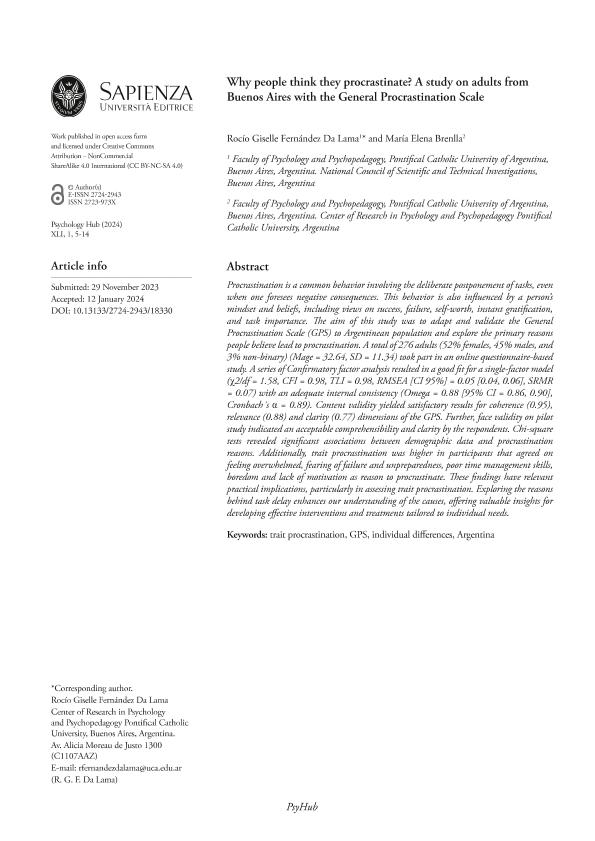
Procrastination is a common behavior involving the deliberate postponement of tasks, even when one foresees negative consequences. This behavior is also influenced by a person’s mindset and beliefs, including views on success, failure, self-worth, instant gratification, and task importance. The aim of this study was to adapt and validate the General Procrastination Scale (GPS) to Argentinean population and explore the primary reasons people believe lead to procrastination. A total of 276 adults (52% females, 45% males, and 3% non-binary) (Mage = 32.64, SD = 11.34) took part in an online questionnaire-based study. A series of Confirmatory factor analysis resulted in a good fit for a single-factor model (χ2/df = 1.58, CFI = 0.98, TLI = 0.98, RMSEA [CI 95%] = 0.05 [0.04, 0.06], SRMR = 0.07) with an adequate internal consistency (Omega = 0.88 [95% CI = 0.86, 0.90], Cronbach´s α = 0.89). Content validity yielded satisfactory results for coherence (0.95), relevance (0.88) and clarity (0.77) dimensions of the GPS. Further, face validity on pilot study indicated an acceptable comprehensibility and clarity by the respondents. Chi-square tests revealed significant associations between demographic data and procrastination reasons. Additionally, trait procrastination was higher in participants that agreed on feeling overwhelmed, fearing of failure and unpreparedness, poor time management skills, boredom and lack of motivation as reason to procrastinate. These findings have relevant practical implications, particularly in assessing trait procrastination. Exploring the reasons behind task delay enhances our understanding of the causes, offering valuable insights for developing effective interventions and treatments tailored to individual needs.
dc.format
application/pdf
dc.language.iso
eng
dc.publisher
Sapienza University
dc.rights
info:eu-repo/semantics/openAccess
dc.rights.uri
https://creativecommons.org/licenses/by-nc-sa/2.5/ar/
dc.subject
PROCRASTINACION
dc.subject
ARGENTINA
dc.subject
VALIDACION
dc.subject.classification
Psicología
dc.subject.classification
Psicología
dc.subject.classification
CIENCIAS SOCIALES
dc.title
Why people think they procrastinate? A study on adults from Buenos Aires with the General Procrastination Scale
dc.type
info:eu-repo/semantics/article
dc.type
info:ar-repo/semantics/artículo
dc.type
info:eu-repo/semantics/publishedVersion
dc.date.updated
2025-07-14T10:36:50Z
dc.journal.volume
41
dc.journal.number
1
dc.journal.pagination
5-13
dc.journal.pais
Italia
dc.description.fil
Fil: Fernandez Da Lama, Rocio Giselle. Consejo Nacional de Investigaciones Científicas y Técnicas; Argentina. Pontificia Universidad Católica Argentina "Santa María de los Buenos Aires". Facultad de Psicología y Psicopedagogía. Centro de Investigaciones en Psicología y Psicopedagogía; Argentina
dc.description.fil
Fil: Brenlla, María Elena. Pontificia Universidad Católica Argentina "Santa María de los Buenos Aires". Facultad de Psicología y Psicopedagogía. Centro de Investigaciones en Psicología y Psicopedagogía; Argentina
dc.journal.title
Psychology Hub
dc.relation.alternativeid
info:eu-repo/semantics/altIdentifier/doi/http://dx.doi.org/10.13133/2724-2943/18330
Archivos asociados

Tamaño:
314.6Kb
Formato:
PDF