Mostrar el registro sencillo del ítem
dc.contributor.author
Rosain, Diego Hernán
dc.date.available
2025-07-18T11:45:29Z
dc.date.issued
2025-04
dc.identifier.citation
Rosain, Diego Hernán; El texto los amontona: formas de lo colectivo en la poética de Héctor Libertella; Universidad de Buenos Aires. Facultad de Filosofía y Letras; Exlibris; 14; 4-2025; 268-282
dc.identifier.issn
2314-3894
dc.identifier.uri
http://hdl.handle.net/11336/266555
dc.description.abstract
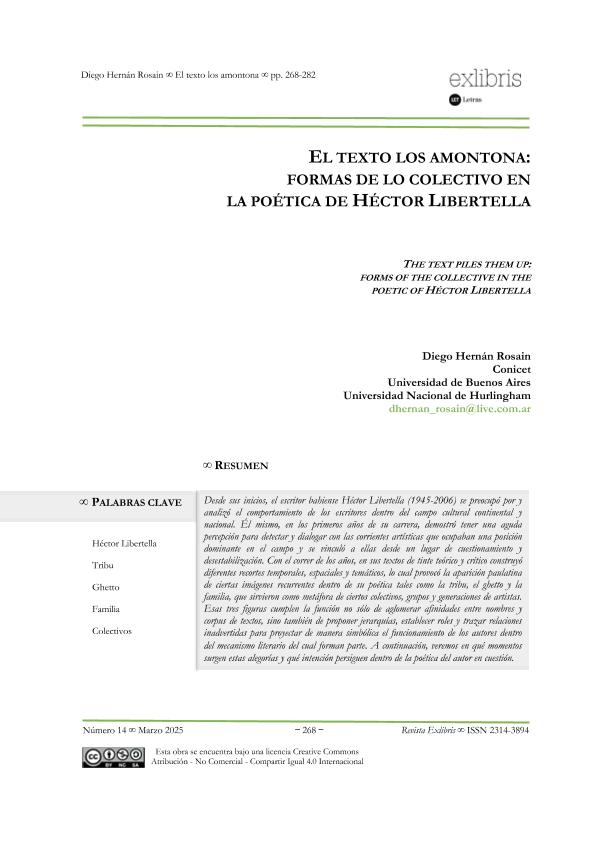
Desde sus inicios, el escritor bahiense Héctor Libertella (1945-2006) se preocupó y analizó el comportamiento de los escritores dentro del campo cultural continental y nacional. Él mismo, en los primeros años de su carrera, demostró tener una aguda percepción para detectar y dialogar con las corrientes artísticas que ocupaban una posición dominante en el campo para vincularse a ellas desde un lugar de cuestionamiento y desestabilización. Con el correr de los años, en sus textos de tinte teórico y crítico construyó diferentes recortes temporales, espaciales y temáticos, lo cual provocó la aparición paulatina de ciertas imágenes recurrentes dentro de su poética tales como la tribu, el ghetto y la familia que sirvieran como metáfora de ciertos colectivos, grupos y generaciones de artistas. Esas tres figuras cumplen la función no sólo de aglomerar afinidades entre nombres y corpus de textos, sino también de proponer jerarquías, establecer roles y trazar relaciones inadvertidas para proyectar de manera simbólica el funcionamiento de los autores dentro del mecanismo literario del cual forman parte. A continuación, veremos en qué momentos surgen estas alegorías y qué intención persiguen dentro de la poética del autor en cuestión.
dc.description.abstract
From its beginnings, the bahiense writer Héctor Libertella (1945-2006) was concerned and analyzed the behavior of writers within the continental and national cultural field. He himself, in the early years of his career, demonstrated to have an acute perception to detect and dialogue with the artistic currents that occupied a dominant position in the field to be linked to them from a place of questioning and destabilization. Over the years, in his theoretical and critical texts he constructed different temporary, spatial and thematic cuts, which caused the gradual appearance of certain recurring images within his poetics such as the tribe, the ghetto and the family that served as a metaphor for certain collectives, groups and generations of artists. These three figures fulfill the function not only of agglomerating affinities between names and corpus of texts, but also of proposing hierarchies, establishing roles and drawing inadvertent relationships to symbolically project the functioning of the authors within the literary mechanism of which they are a part. Next, we will see at what moments these allegories arise and what intention they pursue within the poetics of the author in question.
dc.format
application/pdf
dc.language.iso
spa
dc.publisher
Universidad de Buenos Aires. Facultad de Filosofía y Letras
dc.rights
info:eu-repo/semantics/openAccess
dc.rights.uri
https://creativecommons.org/licenses/by/2.5/ar/
dc.subject
Héctor Libertella
dc.subject
Tribu
dc.subject
Ghetto
dc.subject
Familia
dc.subject.classification
Literaturas Específicas
dc.subject.classification
Lengua y Literatura
dc.subject.classification
HUMANIDADES
dc.title
El texto los amontona: formas de lo colectivo en la poética de Héctor Libertella
dc.title
The text piles them up: forms of the collective in the poetic of Héctor Libertella
dc.type
info:eu-repo/semantics/article
dc.type
info:ar-repo/semantics/artículo
dc.type
info:eu-repo/semantics/publishedVersion
dc.date.updated
2025-07-16T13:41:50Z
dc.journal.number
14
dc.journal.pagination
268-282
dc.journal.pais
Argentina
dc.journal.ciudad
Ciudad Autónoma de la Provincia de Buenos Aires
dc.description.fil
Fil: Rosain, Diego Hernán. Consejo Nacional de Investigaciones Científicas y Técnicas; Argentina. Universidad de Buenos Aires. Facultad de Filosofía y Letras; Argentina. Universidad Nacional de Hurlingham. Instituto de Educacion.; Argentina
dc.journal.title
Exlibris
dc.relation.alternativeid
info:eu-repo/semantics/altIdentifier/url/http://revistas.filo.uba.ar/index.php/exlibris/article/view/4491
Archivos asociados

Tamaño:
263.8Kb
Formato:
PDF