Artículo
Population pharmacokinetic analysis of teicoplanin in paediatric patients, including those receiving continuous kidney replacement therapy: a prospective cohort study
Butragueño Laiseca, Laura; García Orueta, Gastón; Riva, Natalia ; Trocóniz, Iñaki F.; Fernández, Sarah N.; Camacho Vicente, Verónica; Padilla, Belén; Slöcker, María; Santiago, María José
; Trocóniz, Iñaki F.; Fernández, Sarah N.; Camacho Vicente, Verónica; Padilla, Belén; Slöcker, María; Santiago, María José
Fecha de publicación:
03/2025
Editorial:
Oxford University Press
Revista:
Journal of Antimicrobial Chemotherapy
ISSN:
0305-7453
Idioma:
Inglés
Tipo de recurso:
Artículo publicado
Clasificación temática:
Resumen
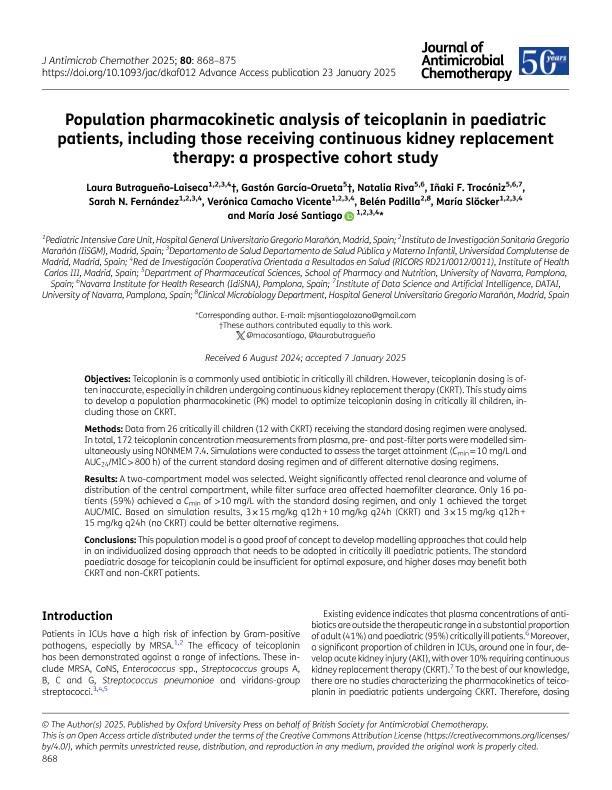
Objectives: Teicoplanin is a commonly used antibiotic in critically ill children. However, teicoplanin dosing is ofteninaccurate, especially in children undergoing continuous kidney replacement therapy (CKRT). This study aimsto develop a population pharmacokinetic (PK) model to optimize teicoplanin dosing in critically ill children, includingthose on CKRT.Methods: Data from 26 critically ill children (12 with CKRT) receiving the standard dosing regimen were analysed.In total, 172 teicoplanin concentration measurements from plasma, pre- and post-filter ports were modelled simultaneouslyusing NONMEM 7.4. Simulations were conducted to assess the target attainment (Cmin = 10 mg/L andAUC24/MIC > 800 h) of the current standard dosing regimen and of different alternative dosing regimens.Results: A two-compartment model was selected. Weight significantly affected renal clearance and volume ofdistribution of the central compartment, while filter surface area affected haemofilter clearance. Only 16 patients(59%) achieved a Cmin of >10 mg/L with the standard dosing regimen, and only 1 achieved the targetAUC/MIC. Based on simulation results, 3 × 15 mg/kg q12h + 10 mg/kg q24h (CKRT) and 3 × 15 mg/kg q12h +15 mg/kg q24h (no CKRT) could be better alternative regimens.Conclusions: This population model is a good proof of concept to develop modelling approaches that could helpin an individualized dosing approach that needs to be adopted in critically ill paediatric patients. The standardpaediatric dosage for teicoplanin could be insufficient for optimal exposure, and higher doses may benefit bothCKRT and non-CKRT patients.
Palabras clave:
PEDIATRICS
,
TEICOPLANIN
Archivos asociados

Tamaño:
822.3Kb
Formato:
PDF
Licencia
 Excepto donde se diga explícitamente, este item se publica bajo la siguiente descripción:
Creative Commons Attribution-NonCommercial-ShareAlike 2.5 Unported (CC BY-NC-SA 2.5)
Excepto donde se diga explícitamente, este item se publica bajo la siguiente descripción:
Creative Commons Attribution-NonCommercial-ShareAlike 2.5 Unported (CC BY-NC-SA 2.5)
Identificadores
Colecciones
Articulos(SEDE CENTRAL)
Articulos de SEDE CENTRAL
Articulos de SEDE CENTRAL
Citación
Butragueño Laiseca, Laura; García Orueta, Gastón; Riva, Natalia; Trocóniz, Iñaki F.; Fernández, Sarah N.; et al.; Population pharmacokinetic analysis of teicoplanin in paediatric patients, including those receiving continuous kidney replacement therapy: a prospective cohort study; Oxford University Press; Journal of Antimicrobial Chemotherapy; 80; 3; 3-2025; 868-875
Compartir


Altmétricas