Artículo
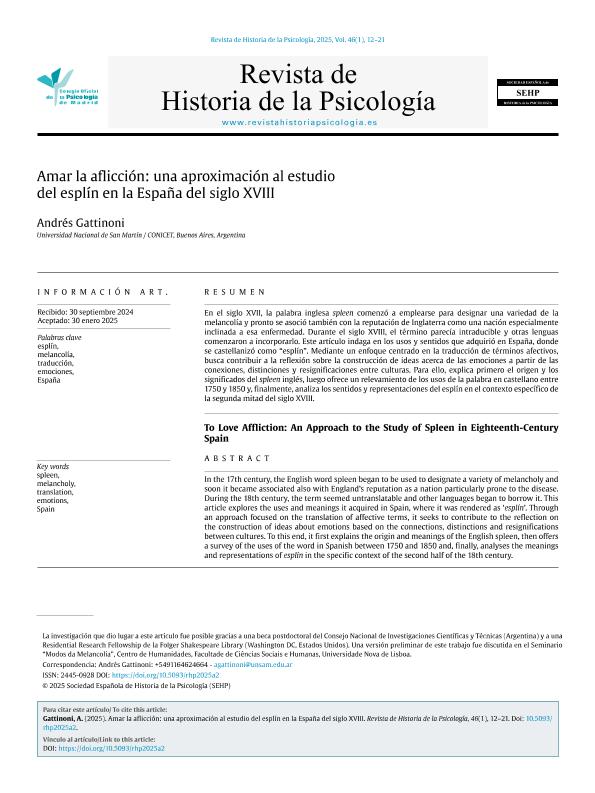
En el siglo XVII, la palabra inglesa spleen comenzó a emplearse para designar una variedad de la melancolía y pronto se asoció también con la reputación de Inglaterra como una nación especialmente inclinada a esa enfermedad. Durante el siglo XVIII, el término parecía intraducible y otras lenguas comenzaron a incorporarlo. Este artículo indaga en los usos y sentidos que adquirió en España, donde se castellanizó como “esplín”. Mediante un enfoque centrado en la traducción de términos afectivos, busca contribuir a la reflexión sobre la construcción de ideas acerca de las emociones a partir de las conexiones, distinciones y resignificaciones entre culturas. Para ello, explica primero el origen y los significados del spleen inglés, luego ofrece un relevamiento de los usos de la palabra en castellano entre 1750 y 1850 y, finalmente, analiza los sentidos y representaciones del esplín en el contexto específico de la segunda mitad del siglo XVIII. n the 17th century, the English word spleen began to be used to designate a variety of melancholy and soon it became associated also with England’s reputation as a nation particularly prone to the disease. During the 18th century, the term seemed untranslatable and other languages began to borrow it. This article explores the uses and meanings it acquired in Spain, where it was rendered as ‘esplín’. Through an approach focused on the translation of affective terms, it seeks to contribute to the reflection on the construction of ideas about emotions based on the connections, distinctions and resignifications between cultures. To this end, it first explains the origin and meanings of the English spleen, then offers a survey of the uses of the word in Spanish between 1750 and 1850 and, finally, analyses the meanings and representations of esplín in the specific context of the second half of the 18th century.
Amar la Aflicción: una Aproximación al Estudio del Esplín en la España del Siglo XVIII
Título:
To Love Affliction: An Approach to the Study of Spleen in Eighteenth-Century Spain

Fecha de publicación:
03/2025
Editorial:
Sociedad Española de Historia de la Psicología
Revista:
Revista de Historia de la Psicología
ISSN:
2445-0928
Idioma:
Español
Tipo de recurso:
Artículo publicado
Clasificación temática:
Resumen
Palabras clave:
esplín
,
melancolía
,
traducción
,
emociones
Archivos asociados

Tamaño:
217.3Kb
Formato:
PDF
Licencia
 Excepto donde se diga explícitamente, este item se publica bajo la siguiente descripción:
Atribución-NoComercial-SinDerivadas 2.5 Argentina (CC BY-NC-ND 2.5 AR)
Excepto donde se diga explícitamente, este item se publica bajo la siguiente descripción:
Atribución-NoComercial-SinDerivadas 2.5 Argentina (CC BY-NC-ND 2.5 AR)
Identificadores
Colecciones
Articulos(SEDE CENTRAL)
Articulos de SEDE CENTRAL
Articulos de SEDE CENTRAL
Citación
Gattinoni, Andrés Juan; Amar la Aflicción: una Aproximación al Estudio del Esplín en la España del Siglo XVIII; Sociedad Española de Historia de la Psicología; Revista de Historia de la Psicología; 46; 1; 3-2025; 12-21
Compartir


Altmétricas