Mostrar el registro sencillo del ítem
dc.contributor.author
Fang, Qiliang
dc.contributor.author
Moriya, Takashi J.
dc.contributor.author
Ferrari, Lucía
dc.contributor.author
Maeda, Keiichi
dc.contributor.author
Folatelli, Gaston
dc.contributor.author
Ertini, Keila Yael
dc.contributor.author
Kuncarayakti, Hanindyo
dc.contributor.author
Andrews, Jennifer E.
dc.contributor.author
Matsumoto, Tatsuya
dc.date.available
2025-07-16T12:49:32Z
dc.date.issued
2024-12
dc.identifier.citation
Fang, Qiliang; Moriya, Takashi J.; Ferrari, Lucía; Maeda, Keiichi; Folatelli, Gaston; et al.; Diversity in Hydrogen-rich Envelope Mass of Type II Supernovae. II. SN 2023ixf as Explosion of Partially Stripped Intermediate Massive Star; IOP Publishing; Astrophysical Journal; 978; 1; 12-2024; 1-10
dc.identifier.issn
0004-637X
dc.identifier.uri
http://hdl.handle.net/11336/266245
dc.description.abstract
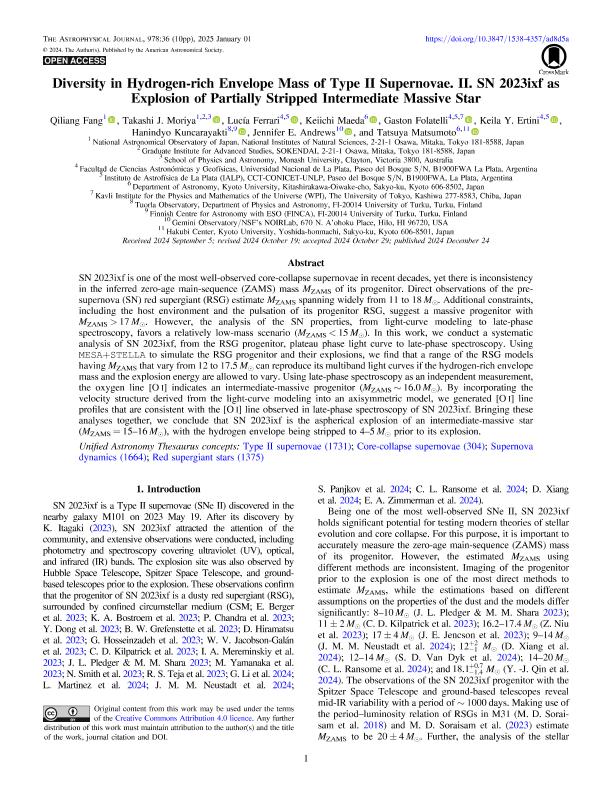
SN 2023ixf is one of the most well-observed core-collapse supernovae in recent decades, yet there is inconsistencyin the inferred zero-age main-sequence (ZAMS) mass MZAMS of its progenitor. Direct observations of the pre-supernova (SN) red supergiant (RSG) estimate MZAMS spanning widely from 11 to 18 Me. Additional constraints,including the host environment and the pulsation of its progenitor RSG, suggest a massive progenitor withMZAMS > 17 Me. However, the analysis of the SN properties, from light-curve modeling to late-phasespectroscopy, favors a relatively low-mass scenario (MZAMS < 15 Me). In this work, we conduct a systematicanalysis of SN 2023ixf, from the RSG progenitor, plateau phase light curve to late-phase spectroscopy. UsingMESA+STELLA to simulate the RSG progenitor and their explosions, we find that a range of the RSG modelshaving MZAMS that vary from 12 to 17.5 Me can reproduce its multiband light curves if the hydrogen-rich envelopemass and the explosion energy are allowed to vary. Using late-phase spectroscopy as an independent measurement,the oxygen line [O I] indicates an intermediate-massive progenitor (MZAMS ∼ 16.0 Me). By incorporating thevelocity structure derived from the light-curve modeling into an axisymmetric model, we generated [O I] lineprofiles that are consistent with the [O I] line observed in late-phase spectroscopy of SN 2023ixf. Bringing theseanalyses together, we conclude that SN 2023ixf is the aspherical explosion of an intermediate-massive star(MZAMS = 15–16 Me), with the hydrogen envelope being stripped to 4–5 Me prior to its explosion.
dc.format
application/pdf
dc.language.iso
eng
dc.publisher
IOP Publishing
dc.rights
info:eu-repo/semantics/openAccess
dc.rights.uri
https://creativecommons.org/licenses/by-nc-sa/2.5/ar/
dc.subject
Supernovae:general
dc.subject
Supernovae:Individual:SN2023ixf
dc.subject.classification
Astronomía
dc.subject.classification
Ciencias Físicas
dc.subject.classification
CIENCIAS NATURALES Y EXACTAS
dc.title
Diversity in Hydrogen-rich Envelope Mass of Type II Supernovae. II. SN 2023ixf as Explosion of Partially Stripped Intermediate Massive Star
dc.type
info:eu-repo/semantics/article
dc.type
info:ar-repo/semantics/artículo
dc.type
info:eu-repo/semantics/publishedVersion
dc.date.updated
2025-07-14T10:40:29Z
dc.journal.volume
978
dc.journal.number
1
dc.journal.pagination
1-10
dc.journal.pais
Reino Unido
dc.journal.ciudad
Londres
dc.description.fil
Fil: Fang, Qiliang. National Institutes of Natural Sciences; Japón
dc.description.fil
Fil: Moriya, Takashi J.. National Institutes of Natural Sciences; Japón
dc.description.fil
Fil: Ferrari, Lucía. Consejo Nacional de Investigaciones Científicas y Técnicas. Centro Científico Tecnológico Conicet - La Plata. Instituto de Astrofísica La Plata. Universidad Nacional de La Plata. Facultad de Ciencias Astronómicas y Geofísicas. Instituto de Astrofísica La Plata; Argentina
dc.description.fil
Fil: Maeda, Keiichi. National Institutes of Natural Sciences; Japón
dc.description.fil
Fil: Folatelli, Gaston. Consejo Nacional de Investigaciones Científicas y Técnicas. Centro Científico Tecnológico Conicet - La Plata. Instituto de Astrofísica La Plata. Universidad Nacional de La Plata. Facultad de Ciencias Astronómicas y Geofísicas. Instituto de Astrofísica La Plata; Argentina
dc.description.fil
Fil: Ertini, Keila Yael. Consejo Nacional de Investigaciones Científicas y Técnicas. Centro Científico Tecnológico Conicet - La Plata. Instituto de Astrofísica La Plata. Universidad Nacional de La Plata. Facultad de Ciencias Astronómicas y Geofísicas. Instituto de Astrofísica La Plata; Argentina
dc.description.fil
Fil: Kuncarayakti, Hanindyo. University of Turku; Finlandia
dc.description.fil
Fil: Andrews, Jennifer E.. No especifíca;
dc.description.fil
Fil: Matsumoto, Tatsuya. Kyoto University; Japón
dc.journal.title
Astrophysical Journal
dc.relation.alternativeid
info:eu-repo/semantics/altIdentifier/url/https://iopscience.iop.org/article/10.3847/1538-4357/ad8d5a
dc.relation.alternativeid
info:eu-repo/semantics/altIdentifier/doi/http://dx.doi.org/10.3847/1538-4357/ad8d5a
Archivos asociados

Tamaño:
1.046Mb
Formato:
PDF