Mostrar el registro sencillo del ítem
dc.contributor.author
Balman, Sölen
dc.contributor.author
Orio, Marina
dc.contributor.author
Luna, Gerardo Juan Manuel
dc.date.available
2025-06-30T15:37:32Z
dc.date.issued
2025-03
dc.identifier.citation
Balman, Sölen; Orio, Marina; Luna, Gerardo Juan Manuel; Broad Observational Perspectives Achieved by the Accreting White Dwarf Sciences in the XMM-Newton and Chandra Eras; MDPI; Universe; 11; 4; 3-2025; 1-52
dc.identifier.issn
2218-1997
dc.identifier.uri
http://hdl.handle.net/11336/264788
dc.description.abstract
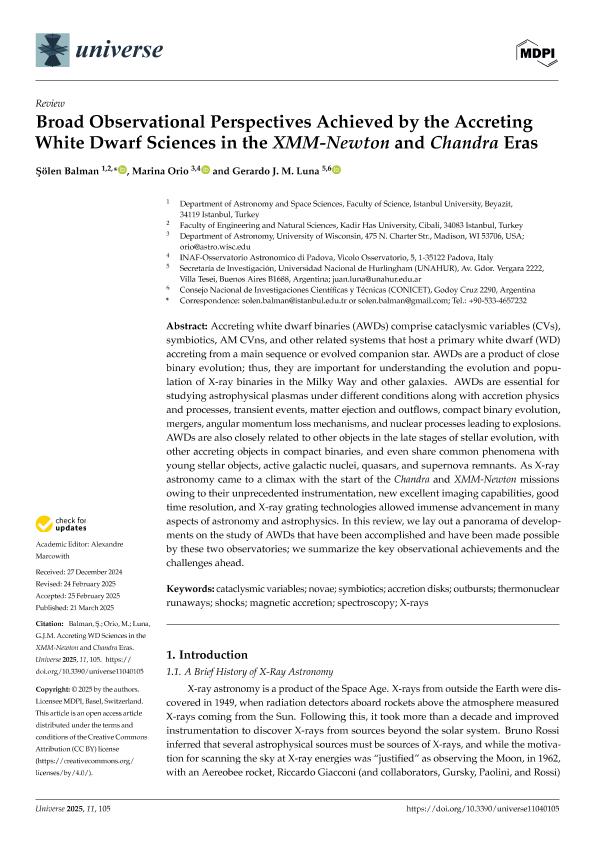
Accreting white dwarf binaries (AWDs) comprise cataclysmic variables (CVs), symbiotics, AM CVns, and other related systems that host a primary white dwarf (WD) accreting from a main sequence or evolved companion star. AWDs are a product of close binary evolution; thus, they are important for understanding the evolution and population of X-ray binaries in the Milky Way and other galaxies. AWDs are essential for studying astrophysical plasmas under different conditions along with accretion physics and processes, transient events, matter ejection and outflows, compact binary evolution, mergers, angular momentum loss mechanisms, and nuclear processes leading to explosions. AWDs are also closely related to other objects in the late stages of stellar evolution, with other accreting objects in compact binaries, and even share common phenomena with young stellar objects, active galactic nuclei, quasars, and supernova remnants. As X-ray astronomy came to a climax with the start of the Chandra and XMM-Newton missions owing to their unprecedented instrumentation, new excellent imaging capabilities, good time resolution, and X-ray grating technologies allowed immense advancement in many aspects of astronomy and astrophysics. In this review, we lay out a panorama of developments on the study of AWDs that have been accomplished and have been made possible by these two observatories; we summarize the key observational achievements and the challenges ahead.
dc.format
application/pdf
dc.language.iso
eng
dc.publisher
MDPI
dc.rights
info:eu-repo/semantics/openAccess
dc.rights.uri
https://creativecommons.org/licenses/by/2.5/ar/
dc.subject
cataclysmic variables
dc.subject
nova
dc.subject
symbiotics
dc.subject
accretion disk
dc.subject.classification
Astronomía
dc.subject.classification
Ciencias Físicas
dc.subject.classification
CIENCIAS NATURALES Y EXACTAS
dc.title
Broad Observational Perspectives Achieved by the Accreting White Dwarf Sciences in the XMM-Newton and Chandra Eras
dc.type
info:eu-repo/semantics/article
dc.type
info:ar-repo/semantics/artículo
dc.type
info:eu-repo/semantics/publishedVersion
dc.date.updated
2025-06-30T15:09:12Z
dc.journal.volume
11
dc.journal.number
4
dc.journal.pagination
1-52
dc.journal.pais
Estados Unidos
dc.description.fil
Fil: Balman, Sölen. Kadir Has University; Turquía. Istanbul University; Turquía
dc.description.fil
Fil: Orio, Marina. Istituto Nazionale di Astrofisica; Italia
dc.description.fil
Fil: Luna, Gerardo Juan Manuel. Universidad Nacional de Hurlingham.; Argentina. Consejo Nacional de Investigaciones Científicas y Técnicas; Argentina
dc.journal.title
Universe
dc.relation.alternativeid
info:eu-repo/semantics/altIdentifier/url/https://www.mdpi.com/2218-1997/11/4/105
dc.relation.alternativeid
info:eu-repo/semantics/altIdentifier/doi/http://dx.doi.org/10.3390/universe11040105
Archivos asociados

Tamaño:
9.950Mb
Formato:
PDF