Mostrar el registro sencillo del ítem
dc.contributor.author
Soler, Paula
dc.contributor.author
Gurevitz, Juan Manuel
dc.contributor.author
Morales, Juan Manuel
dc.contributor.author
Larroza, Marcela Patricia
dc.date.available
2025-06-26T13:14:20Z
dc.date.issued
2024-12
dc.identifier.citation
Soler, Paula; Gurevitz, Juan Manuel; Morales, Juan Manuel; Larroza, Marcela Patricia; Modeling the effects of water temperature on the population dynamics of Galba viatrix and infection by Fasciola hepatica : a two-year survey in Andean Patagonia, Argentina; Taylor & Francis; PeerJ; 12; 12-2024; 1-25
dc.identifier.issn
2167-8359
dc.identifier.uri
http://hdl.handle.net/11336/264668
dc.description.abstract
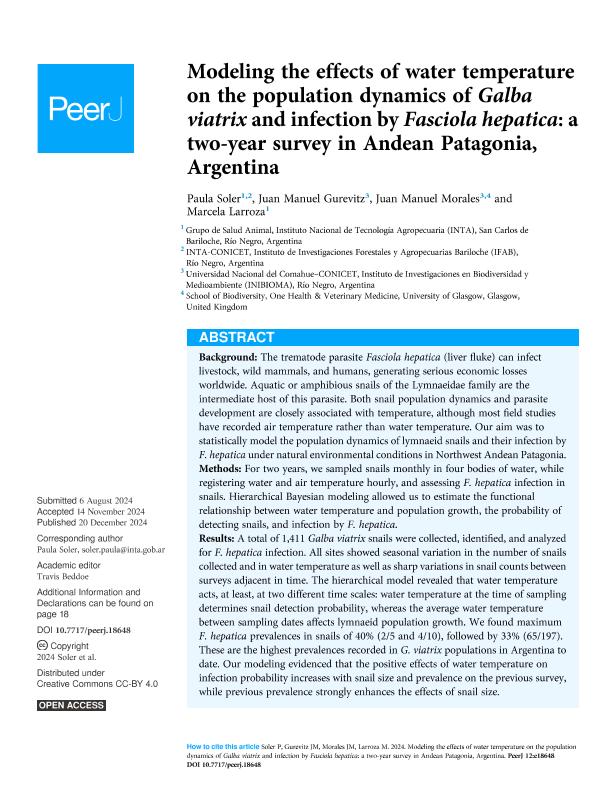
Background: The trematode parasite Fasciola hepatica (liver fluke) can infect livestock, wild mammals, and humans, generating serious economic losses worldwide. Aquatic or amphibious snails of the Lymnaeidae family are the intermediate host of this parasite. Both snail population dynamics and parasite development are closely associated with temperature, although most field studies have recorded air temperature rather than water temperature. Our aim was to statistically model the population dynamics of lymnaeid snails and their infection by F. hepatica under natural environmental conditions in Northwest Andean Patagonia. Methods: For two years, we sampled snails monthly in four bodies of water, while registering water and air temperature hourly, and assessing F. hepatica infection in snails. Hierarchical Bayesian modeling allowed us to estimate the functional relationship between water temperature and population growth, the probability of detecting snails, and infection by F. hepatica. Results: A total of 1,411 Galba viatrix snails were collected, identified, and analyzed for F. hepatica infection. All sites showed seasonal variation in the number of snails collected and in water temperature as well as sharp variations in snail counts between surveys adjacent in time. The hierarchical model revealed that water temperature acts, at least, at two different time scales: water temperature at the time of sampling determines snail detection probability, whereas the average water temperature between sampling dates affects lymnaeid population growth. We found maximum F. hepatica prevalences in snails of 40% (2/5 and 4/10), followed by 33% (65/197). These are the highest prevalences recorded in G. viatrix populations in Argentina to date. Our modeling evidenced that the positive effects of water temperature on infection probability increases with snail size and prevalence on the previous survey, while previous prevalence strongly enhances the effects of snail size.
dc.format
application/pdf
dc.language.iso
eng
dc.publisher
Taylor & Francis
dc.rights
info:eu-repo/semantics/openAccess
dc.rights.uri
https://creativecommons.org/licenses/by-nc-sa/2.5/ar/
dc.subject
Hierarchical model
dc.subject
Fasciola hepatica
dc.subject
Lymnaeid snail
dc.subject
population dynamics
dc.subject.classification
Biología
dc.subject.classification
Ciencias Biológicas
dc.subject.classification
CIENCIAS NATURALES Y EXACTAS
dc.title
Modeling the effects of water temperature on the population dynamics of Galba viatrix and infection by Fasciola hepatica : a two-year survey in Andean Patagonia, Argentina
dc.type
info:eu-repo/semantics/article
dc.type
info:ar-repo/semantics/artículo
dc.type
info:eu-repo/semantics/publishedVersion
dc.date.updated
2025-06-23T13:04:07Z
dc.journal.volume
12
dc.journal.pagination
1-25
dc.journal.pais
Reino Unido
dc.journal.ciudad
Oxfordshire
dc.description.fil
Fil: Soler, Paula. Instituto Nacional de Tecnología Agropecuaria. Centro Regional Patagonia Norte. Estación Experimental Agropecuaria San Carlos de Bariloche. Instituto de Investigaciones Forestales y Agropecuarias Bariloche. - Consejo Nacional de Investigaciones Científicas y Técnicas. Centro Científico Tecnológico Conicet - Patagonia Norte. Instituto de Investigaciones Forestales y Agropecuarias Bariloche; Argentina
dc.description.fil
Fil: Gurevitz, Juan Manuel. Consejo Nacional de Investigaciones Científicas y Técnicas. Centro Científico Tecnológico Conicet - Patagonia Norte. Instituto de Investigaciones en Biodiversidad y Medioambiente. Universidad Nacional del Comahue. Centro Regional Universidad Bariloche. Instituto de Investigaciones en Biodiversidad y Medioambiente; Argentina
dc.description.fil
Fil: Morales, Juan Manuel. Consejo Nacional de Investigaciones Científicas y Técnicas. Centro Científico Tecnológico Conicet - Patagonia Norte. Instituto de Investigaciones en Biodiversidad y Medioambiente. Universidad Nacional del Comahue. Centro Regional Universidad Bariloche. Instituto de Investigaciones en Biodiversidad y Medioambiente; Argentina
dc.description.fil
Fil: Larroza, Marcela Patricia. Instituto Nacional de Tecnología Agropecuaria; Argentina
dc.journal.title
PeerJ
dc.relation.alternativeid
info:eu-repo/semantics/altIdentifier/url/https://peerj.com/articles/18648
dc.relation.alternativeid
info:eu-repo/semantics/altIdentifier/doi/http://dx.doi.org/10.7717/peerj.18648
Archivos asociados

Tamaño:
25.81Mb
Formato:
PDF