Mostrar el registro sencillo del ítem
dc.contributor.author
Cassol, Ignacio
dc.contributor.author
Ibañez, Mauro
dc.contributor.author
Bustamante, Juan Pablo
dc.date.available
2025-06-06T12:32:15Z
dc.date.issued
2025-01
dc.identifier.citation
Cassol, Ignacio; Ibañez, Mauro; Bustamante, Juan Pablo; Key features and guidelines for the application of microbial alpha diversity metrics; Springer; Scientific Reports; 15; 1; 1-2025; 1-13
dc.identifier.issn
2045-2322
dc.identifier.uri
http://hdl.handle.net/11336/263618
dc.description.abstract
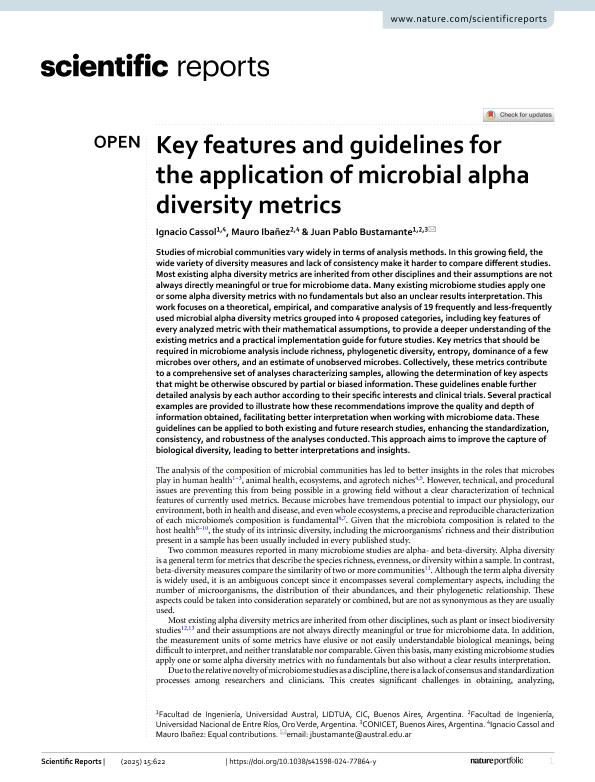
Studies of microbial communities vary widely in terms of analysis methods. In this growing field, the wide variety of diversity measures and lack of consistency make it harder to compare different studies. Most existing alpha diversity metrics are inherited from other disciplines and their assumptions are not always directly meaningful or true for microbiome data. Many existing microbiome studies apply one or some alpha diversity metrics with no fundamentals but also an unclear results interpretation. This work focuses on a theoretical, empirical, and comparative analysis of 19 frequently and less-frequently used microbial alpha diversity metrics grouped into 4 proposed categories, including key features of every analyzed metric with their mathematical assumptions, to provide a deeper understanding of the existing metrics and a practical implementation guide for future studies. Key metrics that should be required in microbiome analysis include richness, phylogenetic diversity, entropy, dominance of a few microbes over others, and an estimate of unobserved microbes. Collectively, these metrics contribute to a comprehensive set of analyses characterizing samples, allowing the determination of key aspects that might be otherwise obscured by partial or biased information. These guidelines enable further detailed analysis by each author according to their specific interests and clinical trials. Several practical examples are provided to illustrate how these recommendations improve the quality and depth of information obtained, facilitating better interpretation when working with microbiome data. These guidelines can be applied to both existing and future research studies, enhancing the standardization, consistency, and robustness of the analyses conducted. This approach aims to improve the capture of biological diversity, leading to better interpretations and insights.
dc.format
application/pdf
dc.language.iso
eng
dc.publisher
Springer
dc.rights
info:eu-repo/semantics/openAccess
dc.rights.uri
https://creativecommons.org/licenses/by/2.5/ar/
dc.subject
MICROBIOME
dc.subject
MICROBIAL DIVERSITY
dc.subject.classification
Otras Ciencias Naturales y Exactas
dc.subject.classification
Otras Ciencias Naturales y Exactas
dc.subject.classification
CIENCIAS NATURALES Y EXACTAS
dc.title
Key features and guidelines for the application of microbial alpha diversity metrics
dc.type
info:eu-repo/semantics/article
dc.type
info:ar-repo/semantics/artículo
dc.type
info:eu-repo/semantics/publishedVersion
dc.date.updated
2025-06-05T12:46:03Z
dc.journal.volume
15
dc.journal.number
1
dc.journal.pagination
1-13
dc.journal.pais
Alemania
dc.description.fil
Fil: Cassol, Ignacio. Universidad Austral. Facultad de Ingeniería; Argentina
dc.description.fil
Fil: Ibañez, Mauro. Universidad Nacional de Entre Ríos. Facultad de Ingeniería; Argentina
dc.description.fil
Fil: Bustamante, Juan Pablo. Universidad Austral. Facultad de Ingeniería; Argentina. Universidad Nacional de Entre Ríos. Facultad de Ingeniería; Argentina. Consejo Nacional de Investigaciones Científicas y Técnicas; Argentina
dc.journal.title
Scientific Reports
dc.relation.alternativeid
info:eu-repo/semantics/altIdentifier/url/https://www.nature.com/articles/s41598-024-77864-y
dc.relation.alternativeid
info:eu-repo/semantics/altIdentifier/doi/http://dx.doi.org/10.1038/s41598-024-77864-y
Archivos asociados

Tamaño:
2.155Mb
Formato:
PDF