Artículo
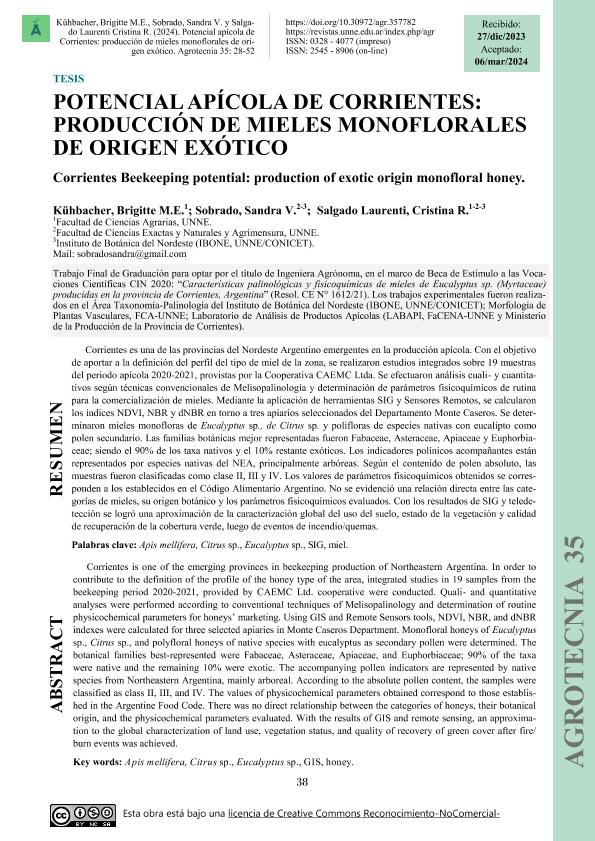
Corrientes es una de las provincias del Nordeste Argentino emergentes en la producción apícola. Con el objetivo de aportar a la definición del perfil del tipo de miel de la zona, se realizaron estudios integrados sobre 19 muestras del periodo apícola 2020-2021, provistas por la Cooperativa CAEMC Ltda. Se efectuaron análisis cuali- y cuantitativos según técnicas convencionales de Melisopalinología y determinación de parámetros fisicoquímicos de rutina para la comercialización de mieles. Mediante la aplicación de herramientas SIG y Sensores Remotos, se calcularon los índices NDVI, NBR y dNBR en torno a tres apiarios seleccionados del Departamento Monte Caseros. Se determinaron mieles monofloras de Eucalyptus sp., de Citrus sp. y polifloras de especies nativas con eucalipto como polen secundario. Las familias botánicas mejor representadas fueron Fabaceae, Asteraceae, Apiaceae y Euphorbiaceae; siendo el 90% de los taxa nativos y el 10% restante exóticos. Los indicadores polínicos acompañantes están representados por especies nativas del NEA, principalmente arbóreas. Según el contenido de polen absoluto, las muestras fueron clasificadas como clase II, III y IV. Los valores de parámetros fisicoquímicos obtenidos se corresponden a los establecidos en el Código Alimentario Argentino. No se evidenció una relación directa entre las categorías de mieles, su origen botánico y los parámetros fisicoquímicos evaluados. Con los resultados de SIG y teledetección se logró una aproximación de la caracterización global del uso del suelo, estado de la vegetación y calidad de recuperación de la cobertura verde, luego de eventos de incendio/quemas. Corrientes is one of the emerging provinces in beekeeping production of Northeastern Argentina. In order to contribute to the definition of the profile of the honey type of the area, integrated studies in 19 samples from the beekeeping period 2020-2021, provided by CAEMC Ltd. cooperative were conducted. Quali- and quantitative analyses were performed according to conventional techniques of Melisopalinology and determination of routine physicochemical parameters for honeys’ marketing. Using GIS and Remote Sensors tools, NDVI, NBR, and dNBR indexes were calculated for three selected apiaries in Monte Caseros Department. Monofloral honeys of Eucalyptus sp., Citrus sp., and polyfloral honeys of native species with eucalyptus as secondary pollen were determined. The botanical families best-represented were Fabaceae, Asteraceae, Apiaceae, and Euphorbiaceae; 90% of the taxa were native and the remaining 10% were exotic. The accompanying pollen indicators are represented by native species from Northeastern Argentina, mainly arboreal. According to the absolute pollen content, the samples were classified as class II, III, and IV. The values of physicochemical parameters obtained correspond to those established in the Argentine Food Code. There was no direct relationship between the categories of honeys, their botanical origin, and the physicochemical parameters evaluated. With the results of GIS and remote sensing, an approximation to the global characterization of land use, vegetation status, and quality of recovery of green cover after fire/ burn events was achieved
Potencial apícola de Corrientes: producción de mieles monoflorales de origen exótico
Título:
Corrientes Beekeeping potential: production of exotic origin monofloral honey.

Fecha de publicación:
09/2024
Editorial:
Universidad Nacional del Nordeste. Facultad de Ciencias Agrarias. Instituto Agrotécnico "Pedro M. Fuentes Godo"
Revista:
Agrotecnia
ISSN:
0328-4077
Idioma:
Español
Tipo de recurso:
Artículo publicado
Clasificación temática:
Resumen
Palabras clave:
Apis mellifera
,
Citrus sp.
,
Eucalyptus sp.
,
SIG
,
miel
Archivos asociados

Tamaño:
3.081Mb
Formato:
PDF
Licencia
 Excepto donde se diga explícitamente, este item se publica bajo la siguiente descripción:
Creative Commons Attribution-NonCommercial 2.5 Unported (CC BY-NC 2.5)
Excepto donde se diga explícitamente, este item se publica bajo la siguiente descripción:
Creative Commons Attribution-NonCommercial 2.5 Unported (CC BY-NC 2.5)
Identificadores
Colecciones
Articulos(IBONE)
Articulos de INST.DE BOTANICA DEL NORDESTE (I)
Articulos de INST.DE BOTANICA DEL NORDESTE (I)
Citación
Kühbacher, Brigitte M. E.; Sobrado, Sandra Virginia; Salgado Laurenti, Cristina Renee; Potencial apícola de Corrientes: producción de mieles monoflorales de origen exótico; Universidad Nacional del Nordeste. Facultad de Ciencias Agrarias. Instituto Agrotécnico "Pedro M. Fuentes Godo"; Agrotecnia; 35; 9-2024; 38-62
Compartir

