Mostrar el registro sencillo del ítem
dc.contributor.author
Cheng, Yunxin
dc.contributor.author
Zhang, Ling
dc.contributor.author
Hu, Ailan
dc.contributor.author
Morita, Shigeru
dc.contributor.author
Zhang, Wenmin
dc.contributor.author
Zhou, Chengxi
dc.contributor.author
Mitnik, Dario Marcelo
dc.contributor.author
Zhang, Fengling
dc.contributor.author
Ma, Jiuyang
dc.contributor.author
Li, Zhengwei
dc.contributor.author
Cao, Yiming
dc.contributor.author
Liu, Haiqing
dc.date.available
2025-06-02T11:10:24Z
dc.date.issued
2024-12
dc.identifier.citation
Cheng, Yunxin; Zhang, Ling; Hu, Ailan; Morita, Shigeru; Zhang, Wenmin; et al.; Experimental study on metallic impurity behavior with boronization wall conditioning in EAST tokamak; Elsevier; Nuclear Materials and Energy; 41; 12-2024; 1-8
dc.identifier.issn
2352-1791
dc.identifier.uri
http://hdl.handle.net/11336/263139
dc.description.abstract
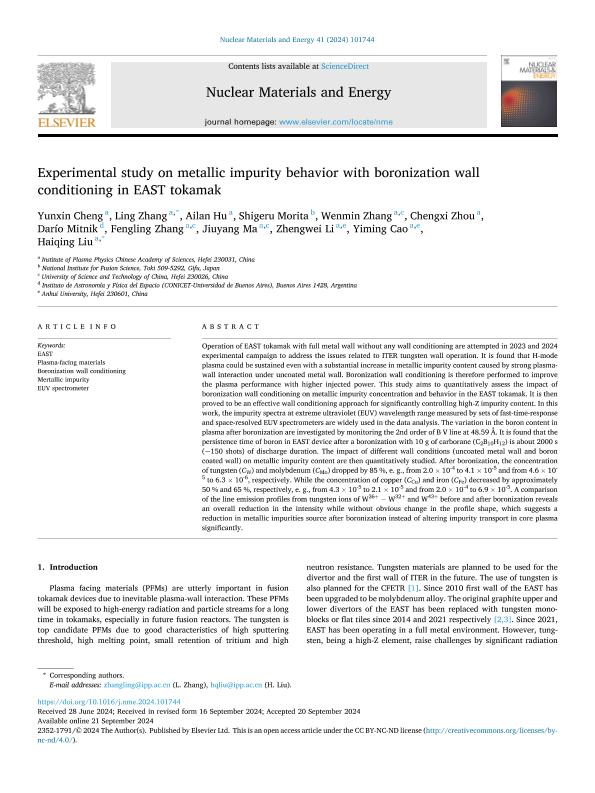
Operation of EAST tokamak with full metal wall without any wall conditioning are attempted in 2023 and 2024 experimental campaign to address the issues related to ITER tungsten wall operation. It is found that H-mode plasma could be sustained even with a substantial increase in metallic impurity content caused by strong plasmawall interaction under uncoated metal wall. Boronization wall conditioning is therefore performed to improve the plasma performance with higher injected power. This study aims to quantitatively assess the impact of boronization wall conditioning on metallic impurity concentration and behavior in the EAST tokamak. It is then proved to be an effective wall conditioning approach for significantly controlling high-Z impurity content. In this work, the impurity spectra at extreme ultraviolet (EUV) wavelength range measured by sets of fast-time-response and space-resolved EUV spectrometers are widely used in the data analysis. The variation in the boron content in plasma after boronization are investigated by monitoring the 2nd order of B V line at 48.59 Å. It is found that the persistence time of boron in EAST device after a boronization with 10 g of carborane (C2B10H12) is about 2000 s (~150 shots) of discharge duration. The impact of different wall conditions (uncoated metal wall and boron coated wall) on metallic impurity content are then quantitatively studied. After boronization, the concentration of tungsten (CW) and molybdenum (CMo) dropped by 85 %, e. g., from 2.0 × 10⁻⁴ to 4.1 × 10⁻⁵ and from 4.6 × 10- 5 to 6.3 × 10⁻⁶, respectively. While the concentration of copper (CCu) and iron (CFe) decreased by approximately 50 % and 65 %, respectively, e. g., from 4.3 × 10⁻⁵ to 2.1 × 10⁻⁵ and from 2.0 × 10⁻⁴ to 6.9 × 10⁻⁵. A comparison of the line emission profiles from tungsten ions of W26+ − W32+ and W43+ before and after boronization reveals an overall reduction in the intensity while without obvious change in the profile shape, which suggests a reduction in metallic impurities source after boronization instead of altering impurity transport in core plasma significantly.
dc.format
application/pdf
dc.language.iso
eng
dc.publisher
Elsevier
dc.rights
info:eu-repo/semantics/openAccess
dc.rights.uri
https://creativecommons.org/licenses/by-nc-nd/2.5/ar/
dc.subject
EAST Tokamak
dc.subject
Plasma-facing materials
dc.subject
Boronization wall conditioning
dc.subject
metalic impurities spectroscopy
dc.subject.classification
Física de los Fluidos y Plasma
dc.subject.classification
Ciencias Físicas
dc.subject.classification
CIENCIAS NATURALES Y EXACTAS
dc.title
Experimental study on metallic impurity behavior with boronization wall conditioning in EAST tokamak
dc.type
info:eu-repo/semantics/article
dc.type
info:ar-repo/semantics/artículo
dc.type
info:eu-repo/semantics/publishedVersion
dc.date.updated
2025-05-30T13:28:41Z
dc.journal.volume
41
dc.journal.pagination
1-8
dc.journal.pais
Países Bajos
dc.journal.ciudad
Amsterdam
dc.description.fil
Fil: Cheng, Yunxin. Chinese Academy of Sciences; República de China
dc.description.fil
Fil: Zhang, Ling. Chinese Academy of Sciences; República de China
dc.description.fil
Fil: Hu, Ailan. Chinese Academy of Sciences; República de China
dc.description.fil
Fil: Morita, Shigeru. National Institute for Fusion Science; Japón
dc.description.fil
Fil: Zhang, Wenmin. Chinese Academy of Sciences; República de China
dc.description.fil
Fil: Zhou, Chengxi. Chinese Academy of Sciences; República de China
dc.description.fil
Fil: Mitnik, Dario Marcelo. Consejo Nacional de Investigaciones Científicas y Técnicas. Oficina de Coordinación Administrativa Ciudad Universitaria. Instituto de Astronomía y Física del Espacio. - Universidad de Buenos Aires. Facultad de Ciencias Exactas y Naturales. Instituto de Astronomía y Física del Espacio; Argentina
dc.description.fil
Fil: Zhang, Fengling. Chinese Academy of Sciences; República de China
dc.description.fil
Fil: Ma, Jiuyang. Chinese Academy of Sciences; República de China
dc.description.fil
Fil: Li, Zhengwei. Chinese Academy of Sciences; República de China
dc.description.fil
Fil: Cao, Yiming. Chinese Academy of Sciences; República de China
dc.description.fil
Fil: Liu, Haiqing. Chinese Academy of Sciences; República de China
dc.journal.title
Nuclear Materials and Energy
dc.relation.alternativeid
info:eu-repo/semantics/altIdentifier/url/https://linkinghub.elsevier.com/retrieve/pii/S2352179124001674
dc.relation.alternativeid
info:eu-repo/semantics/altIdentifier/doi/http://dx.doi.org/10.1016/j.nme.2024.101744
Archivos asociados

Tamaño:
5.947Mb
Formato:
PDF