Artículo
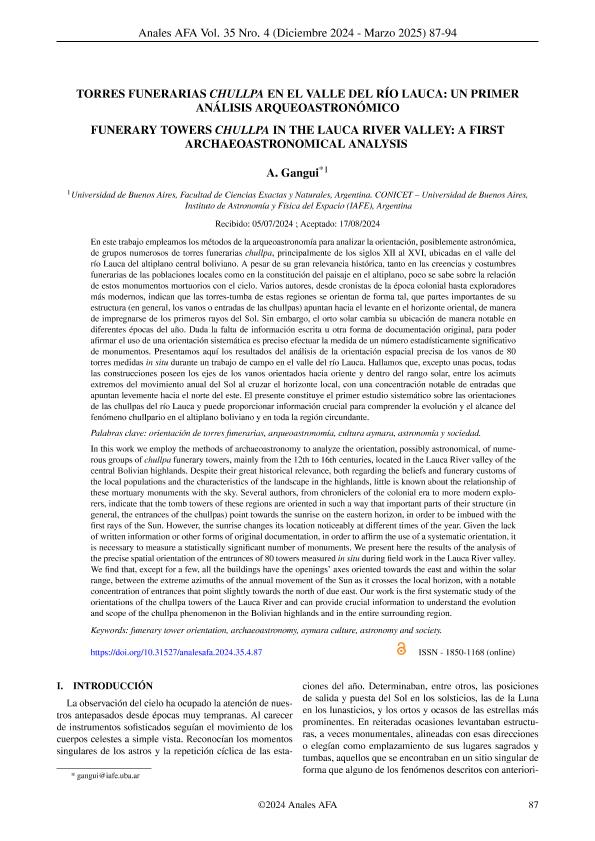
En este trabajo empleamos los métodos de la arqueoastronomía para analizar la orientación, posiblemente astronómica, de grupos numerosos de torres funerarias chullpa, principalmente de los siglos XII al XVI, ubicadas en el valle del río Lauca del altiplano central boliviano. A pesar de su gran relevancia histórica, tanto en las creencias y costumbres funerarias de las poblaciones locales como en la constitución del paisaje en el altiplano, poco se sabe sobre la relación de estos monumentos mortuorios con el cielo. Varios autores, desde cronistas de la época colonial hasta exploradores más modernos, indican que las torres-tumba de estas regiones se orientan de forma tal, que partes importantes de su estructura (en general, los vanos o entradas de las chullpas) apuntan hacia el levante en el horizonte oriental, de manera de impregnarse de los primeros rayos del Sol. Sin embargo, el orto solar cambia su ubicación de manera notable en diferentes épocas del año. Dada la falta de información escrita u otra forma de documentación original, para poder afirmar el uso de una orientación sistemática es preciso efectuar la medida de un número estadísticamente significativo de monumentos. Presentamos aquí los resultados del análisis de la orientación espacial precisa de los vanos de 80 torres medidas in situ durante un trabajo de campo en el valle del río Lauca. Hallamos que, excepto unas pocas, todas las construcciones poseen los ejes de los vanos orientados hacia oriente y dentro del rango solar, entre los acimuts extremos del movimiento anual del Sol al cruzar el horizonte local, con una concentración notable de entradas que apuntan levemente hacia el norte del este. El presente constituye el primer estudio sistemático sobre las orientaciones de las chullpas del río Lauca y puede proporcionar información crucial para comprender la evolución y el alcance del fenómeno chullpario en el altiplano boliviano y en toda la región circundante. In this work we employ the methods of archaeoastronomy to analyze the orientation, possibly astronomical, of numerous groups of chullpa funerary towers, mainly from the 12th to 16th centuries, located in the Lauca River valley of the central Bolivian highlands. Despite their great historical relevance, both regarding the beliefs and funerary customs of the local populations and the characteristics of the landscape in the highlands, little is known about the relationship of these mortuary monuments with the sky. Several authors, from chroniclers of the colonial era to more modern explorers, indicate that the tomb towers of these regions are oriented in such a way that important parts of their structure (in general, the entrances of the chullpas) point towards the sunrise on the eastern horizon, in order to be imbued with the first rays of the Sun. However, the sunrise changes its location noticeably at different times of the year. Given the lack of written information or other forms of original documentation, in order to affirm the use of a systematic orientation, it is necessary to measure a statistically significant number of monuments. We present here the results of the analysis of the precise spatial orientation of the entrances of 80 towers measured in situ during field work in the Lauca River valley. We find that, except for a few, all the buildings have the openings’ axes oriented towards the east and within the solar range, between the extreme azimuths of the annual movement of the Sun as it crosses the local horizon, with a notable concentration of entrances that point slightly towards the north of due east. Our work is the first systematic study of the orientations of the chullpa towers of the Lauca River and can provide crucial information to understand the evolution and scope of the chullpa phenomenon in the Bolivian highlands and in the entire surrounding region.
Torres funerarias chullpa en el valle del río Lauca: un primer análisis arqueoastronómico
Título:
Funerary towers chullpa in the lauca river valley: a first archaeoastronomical analysis

Fecha de publicación:
12/2024
Editorial:
Asociación Física Argentina
Revista:
Anales AFA
ISSN:
0327-358X
e-ISSN:
1850-1168
Idioma:
Español
Tipo de recurso:
Artículo publicado
Clasificación temática:
Resumen
Archivos asociados

Tamaño:
4.680Mb
Formato:
PDF
Licencia
 Excepto donde se diga explícitamente, este item se publica bajo la siguiente descripción:
Creative Commons Attribution-NonCommercial 2.5 Unported (CC BY-NC 2.5)
Excepto donde se diga explícitamente, este item se publica bajo la siguiente descripción:
Creative Commons Attribution-NonCommercial 2.5 Unported (CC BY-NC 2.5)
Identificadores
Colecciones
Articulos(IAFE)
Articulos de INST.DE ASTRONOMIA Y FISICA DEL ESPACIO(I)
Articulos de INST.DE ASTRONOMIA Y FISICA DEL ESPACIO(I)
Citación
Gangui, Alejandro; Torres funerarias chullpa en el valle del río Lauca: un primer análisis arqueoastronómico; Asociación Física Argentina; Anales AFA; 35; 4; 12-2024; 87-94
Compartir

