Mostrar el registro sencillo del ítem
dc.contributor.author
Tiribelli, Florencia
dc.contributor.author
Paritsis, Juan
dc.contributor.author
Barberá, Iván
dc.contributor.author
Kitzberger, Thomas
dc.date.available
2025-05-30T10:07:34Z
dc.date.issued
2024-02
dc.identifier.citation
Tiribelli, Florencia; Paritsis, Juan; Barberá, Iván; Kitzberger, Thomas; Spatial and temporal opportunities for forest resilience promoted by burn severity attenuation across a productivity gradient in north western Patagonia; Csiro Publishing; International Journal Of Wildland Fire; 33; 2; 2-2024; 1-13
dc.identifier.issn
1049-8001
dc.identifier.uri
http://hdl.handle.net/11336/262977
dc.description.abstract
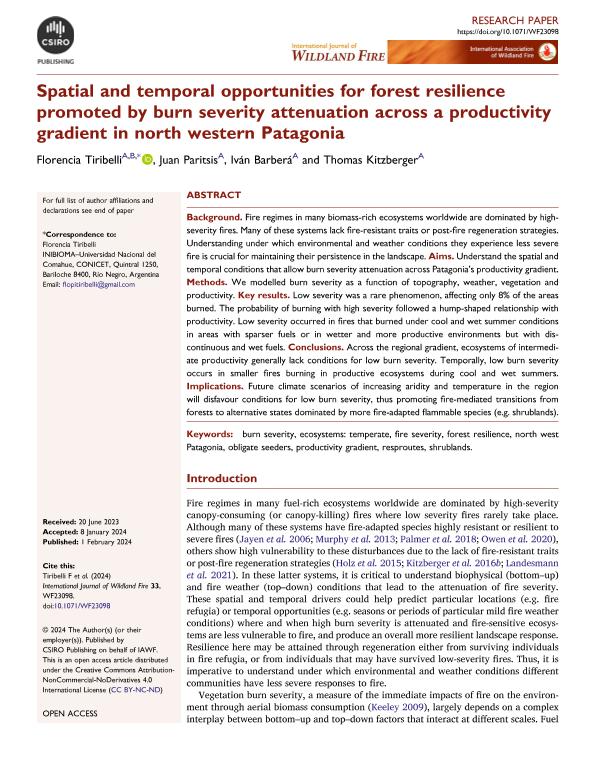
BackgroundFire regimes in many biomass-rich ecosystems worldwide are dominated by high-severity fires. Many of these systems lack fire-resistant traits or post-fire regeneration strategies. Understanding under which environmental and weather conditions they experience less severe fire is crucial for maintaining their persistence in the landscape.AimsUnderstand the spatial and temporal conditions that allow burn severity attenuation across Patagonia?s productivity gradient.MethodsWe modelled burn severity as a function of topography, weather, vegetation and productivity.Key resultsLow severity was a rare phenomenon, affecting only 8% of the areas burned. The probability of burning with high severity followed a hump-shaped relationship with productivity. Low severity occurred in fires that burned under cool and wet summer conditions in areas with sparser fuels or in wetter and more productive environments but with discontinuous and wet fuels.ConclusionsAcross the regional gradient, ecosystems of intermediate productivity generally lack conditions for low burn severity. Temporally, low burn severity occurs in smaller fires burning in productive ecosystems during cool and wet summers.ImplicationsFuture climate scenarios of increasing aridity and temperature in the region will disfavour conditions for low burn severity, thus promoting fire-mediated transitions from forests to alternative states dominated by more fire-adapted flammable species (e.g. shrublands).
dc.description.abstract
Background. Fire regimes in many biomass-rich ecosystems worldwide are dominated by highseverity fires. Many of these systems lack fire-resistant traits or post-fire regeneration strategies. Understanding under which environmental and weather conditions they experience less severe fire is crucial for maintaining their persistence in the landscape. Aims. Understand the spatial and temporal conditions that allow burn severity attenuation across Patagonia’s productivity gradient. Methods. We modelled burn severity as a function of topography, weather, vegetation and productivity. Key results. Low severity was a rare phenomenon, affecting only 8% of the areas burned. The probability of burning with high severity followed a hump-shaped relationship with productivity. Low severity occurred in fires that burned under cool and wet summer conditions in areas with sparser fuels or in wetter and more productive environments but with discontinuous and wet fuels. Conclusions. Across the regional gradient, ecosystems of intermediate productivity generally lack conditions for low burn severity. Temporally, low burn severity occurs in smaller fires burning in productive ecosystems during cool and wet summers. Implications. Future climate scenarios of increasing aridity and temperature in the region will disfavour conditions for low burn severity, thus promoting fire-mediated transitions from forests to alternative states dominated by more fire-adapted flammable species (e.g. shrublands).
dc.format
application/pdf
dc.language.iso
eng
dc.publisher
Csiro Publishing
dc.rights
info:eu-repo/semantics/openAccess
dc.rights.uri
https://creativecommons.org/licenses/by-nc-sa/2.5/ar/
dc.subject
BURN SEVERITY
dc.subject
FOREST RESILIENCE
dc.subject
NORTH WEST PATAGONIA
dc.subject
OBLIGATE SEEDERS
dc.subject.classification
Ecología
dc.subject.classification
Ciencias Biológicas
dc.subject.classification
CIENCIAS NATURALES Y EXACTAS
dc.title
Spatial and temporal opportunities for forest resilience promoted by burn severity attenuation across a productivity gradient in north western Patagonia
dc.type
info:eu-repo/semantics/article
dc.type
info:ar-repo/semantics/artículo
dc.type
info:eu-repo/semantics/publishedVersion
dc.date.updated
2025-05-28T12:02:44Z
dc.journal.volume
33
dc.journal.number
2
dc.journal.pagination
1-13
dc.journal.pais
Australia
dc.description.fil
Fil: Tiribelli, Florencia. Consejo Nacional de Investigaciones Científicas y Técnicas. Centro Científico Tecnológico Conicet - Patagonia Norte. Instituto de Investigaciones en Biodiversidad y Medioambiente. Universidad Nacional del Comahue. Centro Regional Universidad Bariloche. Instituto de Investigaciones en Biodiversidad y Medioambiente; Argentina
dc.description.fil
Fil: Paritsis, Juan. Consejo Nacional de Investigaciones Científicas y Técnicas. Centro Científico Tecnológico Conicet - Patagonia Norte. Instituto de Investigaciones en Biodiversidad y Medioambiente. Universidad Nacional del Comahue. Centro Regional Universidad Bariloche. Instituto de Investigaciones en Biodiversidad y Medioambiente; Argentina
dc.description.fil
Fil: Barberá, Iván. Consejo Nacional de Investigaciones Científicas y Técnicas. Centro Científico Tecnológico Conicet - Patagonia Norte. Instituto de Investigaciones en Biodiversidad y Medioambiente. Universidad Nacional del Comahue. Centro Regional Universidad Bariloche. Instituto de Investigaciones en Biodiversidad y Medioambiente; Argentina
dc.description.fil
Fil: Kitzberger, Thomas. Consejo Nacional de Investigaciones Científicas y Técnicas. Centro Científico Tecnológico Conicet - Patagonia Norte. Instituto de Investigaciones en Biodiversidad y Medioambiente. Universidad Nacional del Comahue. Centro Regional Universidad Bariloche. Instituto de Investigaciones en Biodiversidad y Medioambiente; Argentina
dc.journal.title
International Journal Of Wildland Fire
dc.relation.alternativeid
info:eu-repo/semantics/altIdentifier/url/https://www.publish.csiro.au/WF/WF23098
dc.relation.alternativeid
info:eu-repo/semantics/altIdentifier/doi/http://dx.doi.org/10.1071/WF23098
Archivos asociados

Tamaño:
2.922Mb
Formato:
PDF