Mostrar el registro sencillo del ítem
dc.contributor.author
Wulff, Juan Pedro
dc.contributor.author
Traverso, Lucila María
dc.contributor.author
Latorre Estivalis, Jose Manuel
dc.contributor.author
Segura, Diego Fernando
dc.contributor.author
Lanzavecchia, Silvia Beatriz
dc.date.available
2025-05-23T12:50:22Z
dc.date.issued
2024-02
dc.identifier.citation
Wulff, Juan Pedro; Traverso, Lucila María; Latorre Estivalis, Jose Manuel; Segura, Diego Fernando; Lanzavecchia, Silvia Beatriz; Identification of candidate genes associated with host-seeking behavior in the parasitoid wasp Diachasmimorpha longicaudata; BioMed Central; BMC Genomics; 25; 1; 2-2024; 1-17
dc.identifier.issn
1471-2164
dc.identifier.uri
http://hdl.handle.net/11336/262457
dc.description.abstract
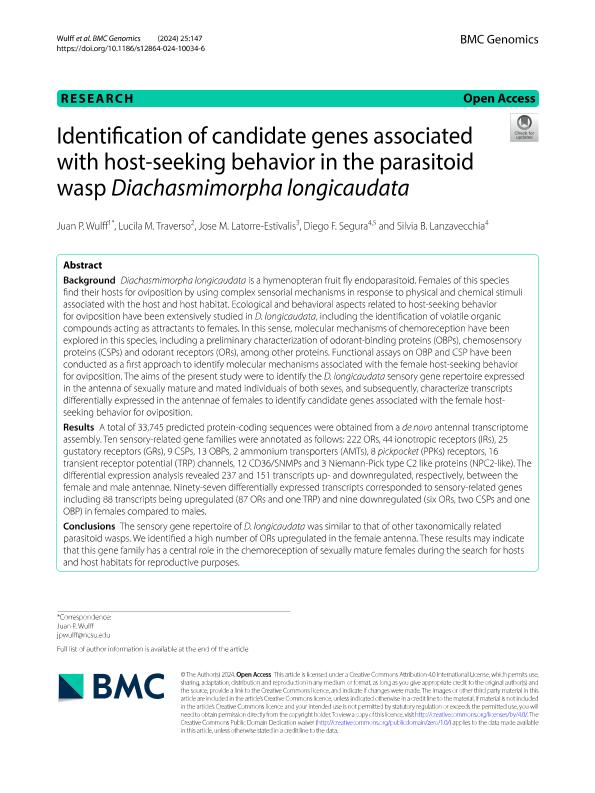
Background Diachasmimorpha longicaudata is a hymenopteran fruit fly endoparasitoid. Females of this species find their hosts for oviposition by using complex sensorial mechanisms in response to physical and chemical stimuli associated with the host and host habitat. Ecological and behavioral aspects related to host-seeking behavior for oviposition have been extensively studied in D. longicaudata, including the identification of volatile organic compounds acting as attractants to females. In this sense, molecular mechanisms of chemoreception have been explored in this species, including a preliminary characterization of odorant-binding proteins (OBPs), chemosensory proteins (CSPs) and odorant receptors (ORs), among other proteins. Functional assays on OBP and CSP have been conducted as a first approach to identify molecular mechanisms associated with the female host-seeking behavior for oviposition. The aims of the present study were to identify the D. longicaudata sensory gene repertoire expressed in the antenna of sexually mature and mated individuals of both sexes, and subsequently, characterize transcripts differentially expressed in the antennae of females to identify candidate genes associated with the female host-seeking behavior for oviposition. Results A total of 33,745 predicted protein-coding sequences were obtained from a de novo antennal transcriptome assembly. Ten sensory-related gene families were annotated as follows: 222 ORs, 44 ionotropic receptors (IRs), 25 gustatory receptors (GRs), 9 CSPs, 13 OBPs, 2 ammonium transporters (AMTs), 8 pickpocket (PPKs) receptors, 16 transient receptor potential (TRP) channels, 12 CD36/SNMPs and 3 Niemann-Pick type C2 like proteins (NPC2-like). The differential expression analysis revealed 237 and 151 transcripts up- and downregulated, respectively, between the female and male antennae. Ninety-seven differentially expressed transcripts corresponded to sensory-related genes including 88 transcripts being upregulated (87 ORs and one TRP) and nine downregulated (six ORs, two CSPs and one OBP) in females compared to males. Conclusions The sensory gene repertoire of D. longicaudata was similar to that of other taxonomically related parasitoid wasps. We identified a high number of ORs upregulated in the female antenna. These results may indicate that this gene family has a central role in the chemoreception of sexually mature females during the search for hosts and host habitats for reproductive purposes.
dc.format
application/pdf
dc.language.iso
eng
dc.publisher
BioMed Central
dc.rights
info:eu-repo/semantics/openAccess
dc.rights.uri
https://creativecommons.org/licenses/by-nc-sa/2.5/ar/
dc.subject
CHEMORECEPTOR
dc.subject
DIFFERENTIAL GENE EXPRESSION (DGE) ANALYSIS
dc.subject
FEMALE HOST-SEEKING BEHAVIOR
dc.subject
FRUIT FLY PARASITOID
dc.subject
MECHANORECEPTOR
dc.subject
MEMBRANE RECEPTOR
dc.subject
PARASITOID WASP
dc.subject
RNA-SEQ
dc.subject
SENSORY-RELATED GENES
dc.subject
SOLUBLE RECEPTOR
dc.subject.classification
Genética y Herencia
dc.subject.classification
Ciencias Biológicas
dc.subject.classification
CIENCIAS NATURALES Y EXACTAS
dc.title
Identification of candidate genes associated with host-seeking behavior in the parasitoid wasp Diachasmimorpha longicaudata
dc.type
info:eu-repo/semantics/article
dc.type
info:ar-repo/semantics/artículo
dc.type
info:eu-repo/semantics/publishedVersion
dc.date.updated
2025-05-15T14:36:24Z
dc.journal.volume
25
dc.journal.number
1
dc.journal.pagination
1-17
dc.journal.pais
Reino Unido
dc.journal.ciudad
Londres
dc.description.fil
Fil: Wulff, Juan Pedro. Consejo Nacional de Investigaciones Científicas y Técnicas; Argentina. North Carolina State University; Estados Unidos
dc.description.fil
Fil: Traverso, Lucila María. Consejo Nacional de Investigaciones Científicas y Técnicas. Centro Científico Tecnológico Conicet - La Plata. Centro de Endocrinología Experimental y Aplicada. Universidad Nacional de La Plata. Facultad de Ciencias Médicas. Centro de Endocrinología Experimental y Aplicada; Argentina
dc.description.fil
Fil: Latorre Estivalis, Jose Manuel. Consejo Nacional de Investigaciones Científicas y Técnicas. Oficina de Coordinación Administrativa Ciudad Universitaria. Instituto de Fisiología, Biología Molecular y Neurociencias. Universidad de Buenos Aires. Facultad de Ciencias Exactas y Naturales. Instituto de Fisiología, Biología Molecular y Neurociencias; Argentina
dc.description.fil
Fil: Segura, Diego Fernando. Instituto Nacional de Tecnología Agropecuaria. Centro de Investigación en Ciencias Veterinarias y Agronómicas. Instituto de Agrobiotecnología y Biología Molecular. Consejo Nacional de Investigaciones Científicas y Técnicas. Oficina de Coordinación Administrativa Parque Centenario. Instituto de Agrobiotecnología y Biología Molecular; Argentina
dc.description.fil
Fil: Lanzavecchia, Silvia Beatriz. Instituto Nacional de Tecnología Agropecuaria. Centro de Investigación en Ciencias Veterinarias y Agronómicas. Instituto de Agrobiotecnología y Biología Molecular. Consejo Nacional de Investigaciones Científicas y Técnicas. Oficina de Coordinación Administrativa Parque Centenario. Instituto de Agrobiotecnología y Biología Molecular; Argentina. Universidad del Salvador; Argentina
dc.journal.title
BMC Genomics
dc.relation.alternativeid
info:eu-repo/semantics/altIdentifier/doi/https://doi.org/10.1186/s12864-024-10034-6
dc.relation.alternativeid
info:eu-repo/semantics/altIdentifier/url/https://bmcgenomics.biomedcentral.com/articles/10.1186/s12864-024-10034-6
Archivos asociados

Tamaño:
4.025Mb
Formato:
PDF