Mostrar el registro sencillo del ítem
dc.contributor.author
Snoll, Brooke
dc.contributor.author
Ivanovic, Ruza
dc.contributor.author
Gregoire, Lauren
dc.contributor.author
Sherriff Tadano, Sam
dc.contributor.author
Menviel, Laurie
dc.contributor.author
Obase, Takashi
dc.contributor.author
Abe-Ouchi, Ayako
dc.contributor.author
Bouttes, Nathaelle
dc.contributor.author
He, Chengfei
dc.contributor.author
He, Feng
dc.contributor.author
Kapsch, Marie
dc.contributor.author
Mikolajewicz, Uwe
dc.contributor.author
Muglia, Juan
dc.contributor.author
Valdes, Paul
dc.date.available
2025-05-20T11:36:52Z
dc.date.issued
2024-04
dc.identifier.citation
Snoll, Brooke; Ivanovic, Ruza; Gregoire, Lauren; Sherriff Tadano, Sam; Menviel, Laurie; et al.; A multi-model assessment of the early last deglaciation (PMIP4 LDv1): a meltwater perspective; Copernicus Publications; Climate of the Past; 20; 4; 4-2024; 789-815
dc.identifier.uri
http://hdl.handle.net/11336/262066
dc.description.abstract
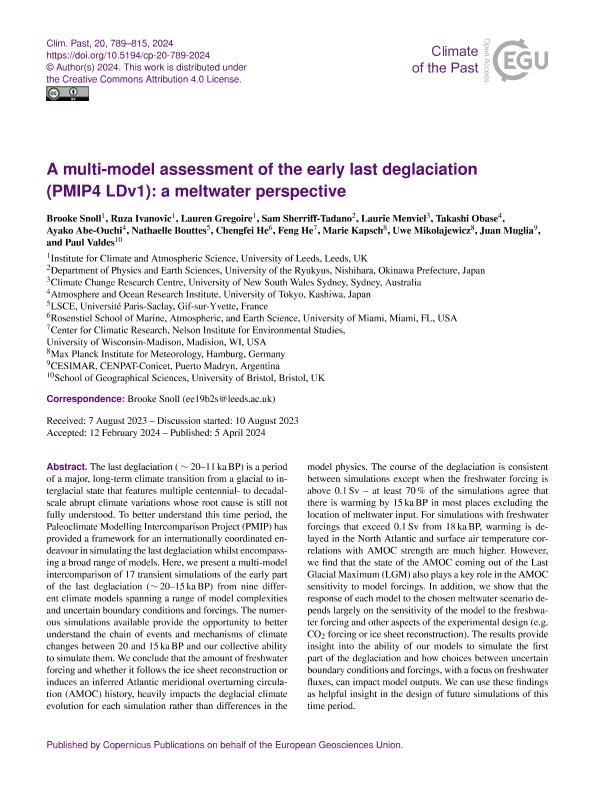
The last deglaciation (∼20–11 ka BP) is a period of a major, long-term climate transition from a glacial to interglacial state that features multiple centennial- to decadal-scale abrupt climate variations whose root cause is still not fully understood. To better understand this time period, the Paleoclimate Modelling Intercomparison Project (PMIP) has provided a framework for an internationally coordinated endeavour in simulating the last deglaciation whilst encompassing a broad range of models. Here, we present a multi-model intercomparison of 17 transient simulations of the early part of the last deglaciation (∼20–15 ka BP) from nine different climate models spanning a range of model complexities and uncertain boundary conditions and forcings. The numerous simulations available provide the opportunity to better understand the chain of events and mechanisms of climate changes between 20 and 15 ka BP and our collective ability to simulate them. We conclude that the amount of freshwater forcing and whether it follows the ice sheet reconstruction or induces an inferred Atlantic meridional overturning circulation (AMOC) history, heavily impacts the deglacial climate evolution for each simulation rather than differences in the model physics. The course of the deglaciation is consistent between simulations except when the freshwater forcing is above 0.1 Sv – at least 70 % of the simulations agree that there is warming by 15 ka BP in most places excluding the location of meltwater input. For simulations with freshwater forcings that exceed 0.1 Sv from 18 ka BP, warming is delayed in the North Atlantic and surface air temperature correlations with AMOC strength are much higher. However, we find that the state of the AMOC coming out of the Last Glacial Maximum (LGM) also plays a key role in the AMOC sensitivity to model forcings. In addition, we show that the response of each model to the chosen meltwater scenario depends largely on the sensitivity of the model to the freshwater forcing and other aspects of the experimental design (e.g. CO2 forcing or ice sheet reconstruction). The results provide insight into the ability of our models to simulate the first part of the deglaciation and how choices between uncertain boundary conditions and forcings, with a focus on freshwater fluxes, can impact model outputs. We can use these findings as helpful insight in the design of future simulations of this time period.
dc.format
application/pdf
dc.language.iso
eng
dc.publisher
Copernicus Publications
dc.rights
info:eu-repo/semantics/openAccess
dc.rights.uri
https://creativecommons.org/licenses/by/2.5/ar/
dc.subject
DEGLACIATION
dc.subject
FRESHWATER FORCING
dc.subject
AMOC
dc.subject.classification
Oceanografía, Hidrología, Recursos Hídricos
dc.subject.classification
Ciencias de la Tierra y relacionadas con el Medio Ambiente
dc.subject.classification
CIENCIAS NATURALES Y EXACTAS
dc.title
A multi-model assessment of the early last deglaciation (PMIP4 LDv1): a meltwater perspective
dc.type
info:eu-repo/semantics/article
dc.type
info:ar-repo/semantics/artículo
dc.type
info:eu-repo/semantics/publishedVersion
dc.date.updated
2025-05-13T11:51:45Z
dc.identifier.eissn
1814-9332
dc.journal.volume
20
dc.journal.number
4
dc.journal.pagination
789-815
dc.journal.pais
Alemania
dc.journal.ciudad
Gottingen
dc.description.fil
Fil: Snoll, Brooke. University Of Leeds.; Reino Unido
dc.description.fil
Fil: Ivanovic, Ruza. University Of Leeds.; Reino Unido
dc.description.fil
Fil: Gregoire, Lauren. University Of Leeds.; Reino Unido
dc.description.fil
Fil: Sherriff Tadano, Sam. University Of The Ryukyu; Japón
dc.description.fil
Fil: Menviel, Laurie. University of New South Wales; Australia
dc.description.fil
Fil: Obase, Takashi. The University Of Tokyo; Japón
dc.description.fil
Fil: Abe-Ouchi, Ayako. The University Of Tokyo; Japón
dc.description.fil
Fil: Bouttes, Nathaelle. Universite Paris-saclay (universite Paris-saclay);
dc.description.fil
Fil: He, Chengfei. University Of Miami. Rosenstiel School Of Marine Atmospheric Science; Estados Unidos
dc.description.fil
Fil: He, Feng. University of Wisconsin; Estados Unidos
dc.description.fil
Fil: Kapsch, Marie. Max Planck Institute For Meteorology; Alemania
dc.description.fil
Fil: Mikolajewicz, Uwe. Max Planck Institute For Meteorology; Alemania
dc.description.fil
Fil: Muglia, Juan. Consejo Nacional de Investigaciones Científicas y Técnicas. Centro Científico Tecnológico Conicet - Centro Nacional Patagónico. Centro para el Estudio de Sistemas Marinos; Argentina
dc.description.fil
Fil: Valdes, Paul. University Of Bristol;
dc.journal.title
Climate of the Past
dc.relation.alternativeid
info:eu-repo/semantics/altIdentifier/url/https://cp.copernicus.org/articles/20/789/2024/
dc.relation.alternativeid
info:eu-repo/semantics/altIdentifier/doi/http://dx.doi.org/10.5194/cp-20-789-2024
Archivos asociados

Tamaño:
11.00Mb
Formato:
PDF