Mostrar el registro sencillo del ítem
dc.contributor.author
Rose, Miranda Brooke
dc.contributor.author
Velazco, Santiago José Elías
dc.contributor.author
Regan, Helen M.
dc.contributor.author
Flint, Alan L.
dc.contributor.author
Flint, Lorraine E.
dc.contributor.author
Thorne, James H.
dc.contributor.author
Franklin, Janet
dc.date.available
2025-05-20T09:06:48Z
dc.date.issued
2024-06
dc.identifier.citation
Rose, Miranda Brooke; Velazco, Santiago José Elías; Regan, Helen M.; Flint, Alan L.; Flint, Lorraine E.; et al.; Uncertainty in consensus predictions of plant species' vulnerability to climate change; Wiley Blackwell Publishing, Inc; Diversity and Distributions; 30; 8; 6-2024; 1-16
dc.identifier.issn
1366-9516
dc.identifier.uri
http://hdl.handle.net/11336/262033
dc.description.abstract
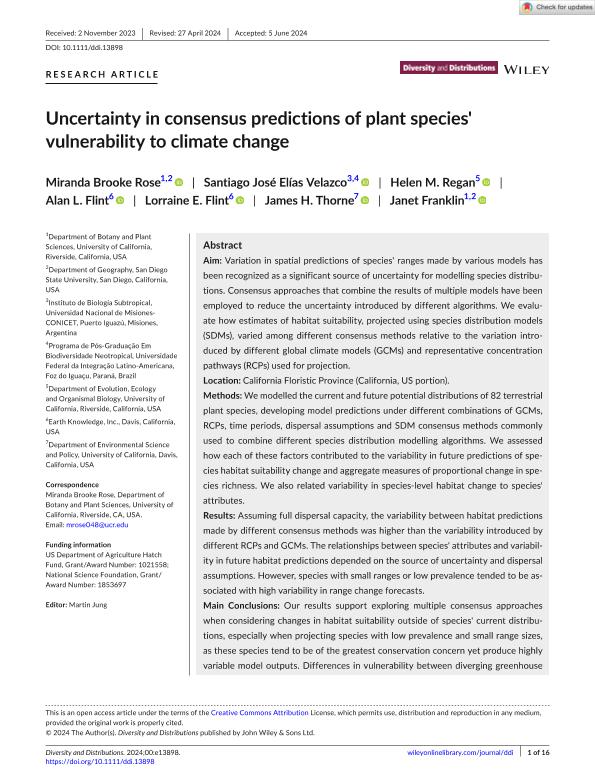
Aim: Variation in spatial predictions of species' ranges made by various models has been recognized as a significant source of uncertainty for modelling species distributions. Consensus approaches that combine the results of multiple models have been employed to reduce the uncertainty introduced by different algorithms. We evaluate how estimates of habitat suitability, projected using species distribution models (SDMs), varied among different consensus methods relative to the variation introduced by different global climate models (GCMs) and representative concentration pathways (RCPs) used for projection. Location: California Floristic Province (California, US portion). Methods: We modelled the current and future potential distributions of 82 terrestrial plant species, developing model predictions under different combinations of GCMs, RCPs, time periods, dispersal assumptions and SDM consensus methods commonly used to combine different species distribution modelling algorithms. We assessed how each of these factors contributed to the variability in future predictions of species habitat suitability change and aggregate measures of proportional change in species richness. We also related variability in species-level habitat change to species' attributes. Results: Assuming full dispersal capacity, the variability between habitat predictions made by different consensus methods was higher than the variability introduced by different RCPs and GCMs. The relationships between species' attributes and variability in future habitat predictions depended on the source of uncertainty and dispersal assumptions. However, species with small ranges or low prevalence tended to be associated with high variability in range change forecasts. Main Conclusions: Our results support exploring multiple consensus approaches when considering changes in habitat suitability outside of species' current distributions, especially when projecting species with low prevalence and small range sizes, as these species tend to be of the greatest conservation concern yet produce highly variable model outputs. Differences in vulnerability between diverging greenhouse gas concentration scenarios are most readily observed for end-of-century time periods and within species' currently occupied habitats (no dispersal).
dc.format
application/pdf
dc.language.iso
eng
dc.publisher
Wiley Blackwell Publishing, Inc
dc.rights
info:eu-repo/semantics/openAccess
dc.rights.uri
https://creativecommons.org/licenses/by/2.5/ar/
dc.subject
climate change
dc.subject
ensemble
dc.subject
species distribution modelling
dc.subject
uncertainty
dc.subject.classification
Conservación de la Biodiversidad
dc.subject.classification
Ciencias Biológicas
dc.subject.classification
CIENCIAS NATURALES Y EXACTAS
dc.title
Uncertainty in consensus predictions of plant species' vulnerability to climate change
dc.type
info:eu-repo/semantics/article
dc.type
info:ar-repo/semantics/artículo
dc.type
info:eu-repo/semantics/publishedVersion
dc.date.updated
2025-05-19T12:30:47Z
dc.journal.volume
30
dc.journal.number
8
dc.journal.pagination
1-16
dc.journal.pais
Reino Unido
dc.journal.ciudad
Londres
dc.description.fil
Fil: Rose, Miranda Brooke. San Diego State University; Estados Unidos
dc.description.fil
Fil: Velazco, Santiago José Elías. Consejo Nacional de Investigaciones Científicas y Técnicas. Centro Científico Tecnológico Conicet - Nordeste. Instituto de Biología Subtropical. Instituto de Biología Subtropical - Nodo Puerto Iguazú | Universidad Nacional de Misiones. Instituto de Biología Subtropical. Instituto de Biología Subtropical - Nodo Puerto Iguazú; Argentina
dc.description.fil
Fil: Regan, Helen M.. University of California; Estados Unidos
dc.description.fil
Fil: Flint, Alan L.. No especifíca;
dc.description.fil
Fil: Flint, Lorraine E.. No especifíca;
dc.description.fil
Fil: Thorne, James H.. University of California at Davis; Estados Unidos
dc.description.fil
Fil: Franklin, Janet. San Diego State University; Estados Unidos
dc.journal.title
Diversity and Distributions
dc.relation.alternativeid
info:eu-repo/semantics/altIdentifier/url/https://onlinelibrary.wiley.com/doi/10.1111/ddi.13898
dc.relation.alternativeid
info:eu-repo/semantics/altIdentifier/doi/http://dx.doi.org/10.1111/ddi.13898
Archivos asociados

Tamaño:
13.47Mb
Formato:
PDF