Mostrar el registro sencillo del ítem
dc.contributor.author
Antileo Mellado, Silvia
dc.contributor.author
Muñoz, Cristina
dc.contributor.author
Sánchez Hernández, Juan Carlos
dc.contributor.author
Ginebra Aguilar, Milagros
dc.contributor.author
Sandoval, Marco
dc.date.available
2025-05-19T13:09:03Z
dc.date.issued
2024-03
dc.identifier.citation
Antileo Mellado, Silvia; Muñoz, Cristina; Sánchez Hernández, Juan Carlos; Ginebra Aguilar, Milagros; Sandoval, Marco; Effect of Biochar on Vermicompost Production: Chemical, Biochemical, and Biological Properties; Multidisciplinary Digital Publishing Institute; Agronomy; 14; 3; 3-2024; 1-13
dc.identifier.uri
http://hdl.handle.net/11336/261981
dc.description.abstract
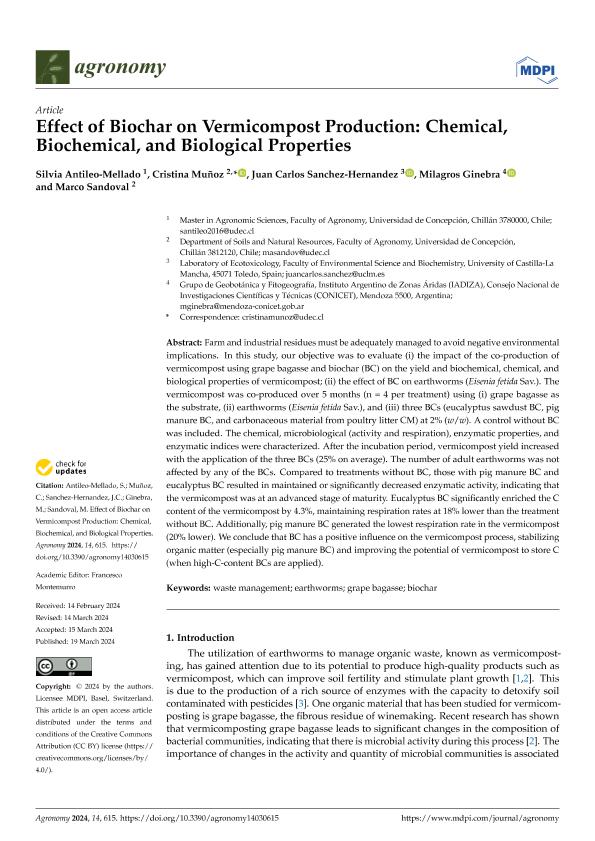
Farm and industrial residues must be adequately managed to avoid negative environmentalimplications. In this study, our objective was to evaluate (i) the impact of the co-production ofvermicompost using grape bagasse and biochar (BC) on the yield and biochemical, chemical, andbiological properties of vermicompost; (ii) the effect of BC on earthworms (Eisenia fetida Sav.). Thevermicompost was co-produced over 5 months (n = 4 per treatment) using (i) grape bagasse asthe substrate, (ii) earthworms (Eisenia fetida Sav.), and (iii) three BCs (eucalyptus sawdust BC, pigmanure BC, and carbonaceous material from poultry litter CM) at 2% (w/w). A control without BCwas included. The chemical, microbiological (activity and respiration), enzymatic properties, andenzymatic indices were characterized. After the incubation period, vermicompost yield increasedwith the application of the three BCs (25% on average). The number of adult earthworms was notaffected by any of the BCs. Compared to treatments without BC, those with pig manure BC andeucalyptus BC resulted in maintained or significantly decreased enzymatic activity, indicating thatthe vermicompost was at an advanced stage of maturity. Eucalyptus BC significantly enriched the Ccontent of the vermicompost by 4.3%, maintaining respiration rates at 18% lower than the treatmentwithout BC. Additionally, pig manure BC generated the lowest respiration rate in the vermicompost(20% lower). We conclude that BC has a positive influence on the vermicompost process, stabilizingorganic matter (especially pig manure BC) and improving the potential of vermicompost to store C(when high-C-content BCs are applied).
dc.format
application/pdf
dc.language.iso
eng
dc.publisher
Multidisciplinary Digital Publishing Institute
dc.rights
info:eu-repo/semantics/openAccess
dc.rights.uri
https://creativecommons.org/licenses/by/2.5/ar/
dc.subject
Waste management
dc.subject
Earthworms
dc.subject
Grape bagasse
dc.subject
Biochar
dc.subject.classification
Otras Ciencias de la Tierra y relacionadas con el Medio Ambiente
dc.subject.classification
Ciencias de la Tierra y relacionadas con el Medio Ambiente
dc.subject.classification
CIENCIAS NATURALES Y EXACTAS
dc.title
Effect of Biochar on Vermicompost Production: Chemical, Biochemical, and Biological Properties
dc.type
info:eu-repo/semantics/article
dc.type
info:ar-repo/semantics/artículo
dc.type
info:eu-repo/semantics/publishedVersion
dc.date.updated
2025-05-16T13:20:23Z
dc.identifier.eissn
2073-4395
dc.journal.volume
14
dc.journal.number
3
dc.journal.pagination
1-13
dc.journal.pais
Suiza
dc.journal.ciudad
Basilea
dc.description.fil
Fil: Antileo Mellado, Silvia. Universidad de Concepción; Chile
dc.description.fil
Fil: Muñoz, Cristina. Universidad de Concepción; Chile
dc.description.fil
Fil: Sánchez Hernández, Juan Carlos. Universidad de Castilla-La Mancha; España
dc.description.fil
Fil: Ginebra Aguilar, Milagros. Consejo Nacional de Investigaciones Científicas y Técnicas. Centro Científico Tecnológico Conicet - Mendoza. Instituto Argentino de Investigaciones de las Zonas Áridas. Provincia de Mendoza. Instituto Argentino de Investigaciones de las Zonas Áridas. Universidad Nacional de Cuyo. Instituto Argentino de Investigaciones de las Zonas Áridas; Argentina
dc.description.fil
Fil: Sandoval, Marco. Universidad de Concepción; Chile
dc.journal.title
Agronomy
dc.relation.alternativeid
info:eu-repo/semantics/altIdentifier/url/https://www.mdpi.com/2073-4395/14/3/615
dc.relation.alternativeid
info:eu-repo/semantics/altIdentifier/doi/http://dx.doi.org/10.3390/agronomy14030615
Archivos asociados

Tamaño:
895.6Kb
Formato:
PDF