Mostrar el registro sencillo del ítem
dc.contributor.author
Fettweis, Gregory
dc.contributor.author
Johnson, Thomas A.
dc.contributor.author
Almeida Prieto, Brian
dc.contributor.author
Weller Pérez, Julián
dc.contributor.author
Presman, Diego Martin
dc.contributor.author
Hager, Gordon L.
dc.contributor.author
Alvarez de la Rosa, Diego
dc.date.available
2025-05-12T09:22:10Z
dc.date.issued
2024-02
dc.identifier.citation
Fettweis, Gregory; Johnson, Thomas A.; Almeida Prieto, Brian; Weller Pérez, Julián; Presman, Diego Martin; et al.; The mineralocorticoid receptor forms higher order oligomers upon DNA binding; John Wiley & Sons; Protein Science; 33; 3; 2-2024; 1-16
dc.identifier.issn
0961-8368
dc.identifier.uri
http://hdl.handle.net/11336/260972
dc.description.abstract
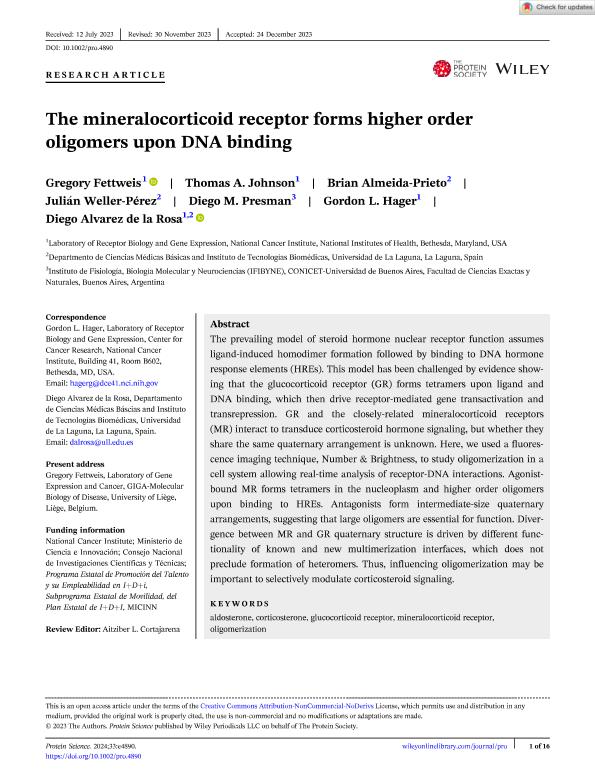
The prevailing model of steroid hormone nuclear receptor function assumes ligand-induced homodimer formation followed by binding to DNA hormone response elements (HREs). This model has been challenged by evidence showing that the glucocorticoid receptor (GR) forms tetramers upon ligand and DNA binding, which then drive receptor-mediated gene transactivation and transrepression. GR and the closely-related mineralocorticoid receptors (MR) interact to transduce corticosteroid hormone signaling, but whether they share the same quaternary arrangement is unknown. Here, we used a fluorescence imaging technique, Number & Brightness, to study oligomerization in a cell system allowing real-time analysis of receptor-DNA interactions. Agonist-bound MR forms tetramers in the nucleoplasm and higher order oligomers upon binding to HREs. Antagonists form intermediate-size quaternary arrangements, suggesting that large oligomers are essential for function. Divergence between MR and GR quaternary structure is driven by different functionality of known and new multimerization interfaces, which does not preclude formation of heteromers. Thus, influencing oligomerization may be important to selectively modulate corticosteroid signaling.
dc.format
application/pdf
dc.language.iso
eng
dc.publisher
John Wiley & Sons
dc.rights
info:eu-repo/semantics/openAccess
dc.rights.uri
https://creativecommons.org/licenses/by-nc-nd/2.5/ar/
dc.subject
MINERALOCORTICOID RECEPTOR
dc.subject
GLUCOCORTICOID RECEPTOR
dc.subject
OLIGOMERIZATION
dc.subject
NUMBER AND BRIGHTNESS
dc.subject.classification
Biofísica
dc.subject.classification
Ciencias Biológicas
dc.subject.classification
CIENCIAS NATURALES Y EXACTAS
dc.title
The mineralocorticoid receptor forms higher order oligomers upon DNA binding
dc.type
info:eu-repo/semantics/article
dc.type
info:ar-repo/semantics/artículo
dc.type
info:eu-repo/semantics/publishedVersion
dc.date.updated
2025-05-09T16:24:18Z
dc.journal.volume
33
dc.journal.number
3
dc.journal.pagination
1-16
dc.journal.pais
Estados Unidos
dc.description.fil
Fil: Fettweis, Gregory. National Institutes of Health; Estados Unidos
dc.description.fil
Fil: Johnson, Thomas A.. National Institutes of Health; Estados Unidos
dc.description.fil
Fil: Almeida Prieto, Brian. Universidad de La Laguna; España
dc.description.fil
Fil: Weller Pérez, Julián. Universidad de La Laguna; España
dc.description.fil
Fil: Presman, Diego Martin. Consejo Nacional de Investigaciones Científicas y Técnicas. Oficina de Coordinación Administrativa Ciudad Universitaria. Instituto de Fisiología, Biología Molecular y Neurociencias. Universidad de Buenos Aires. Facultad de Ciencias Exactas y Naturales. Instituto de Fisiología, Biología Molecular y Neurociencias; Argentina
dc.description.fil
Fil: Hager, Gordon L.. National Institutes of Health; Estados Unidos
dc.description.fil
Fil: Alvarez de la Rosa, Diego. Universidad de La Laguna; España
dc.journal.title
Protein Science
dc.relation.alternativeid
info:eu-repo/semantics/altIdentifier/url/https://onlinelibrary.wiley.com/doi/10.1002/pro.4890
dc.relation.alternativeid
info:eu-repo/semantics/altIdentifier/doi/http://dx.doi.org/10.1002/pro.4890
Archivos asociados

Tamaño:
7.075Mb
Formato:
PDF