Mostrar el registro sencillo del ítem
dc.contributor.author
Huber, Maria Paula
dc.contributor.author
De Angelis, Daniele
dc.contributor.author
Sarmento, Hugo
dc.contributor.author
Metz, Sebastian
dc.contributor.author
Giner, Caterina R.
dc.contributor.author
De Vargas, Colomban
dc.contributor.author
Maiorano, Luigi
dc.contributor.author
Massana, Ramon
dc.contributor.author
Logares, Ramiro
dc.date.available
2025-05-07T09:33:39Z
dc.date.issued
2024-09
dc.identifier.citation
Huber, Maria Paula; De Angelis, Daniele; Sarmento, Hugo; Metz, Sebastian; Giner, Caterina R.; et al.; Global distribution, diversity, and ecological niche of Picozoa, a widespread and enigmatic marine protist lineage; Springer; Microbiome; 12; 1; 9-2024; 1-18
dc.identifier.issn
2049-2618
dc.identifier.uri
http://hdl.handle.net/11336/260489
dc.description.abstract
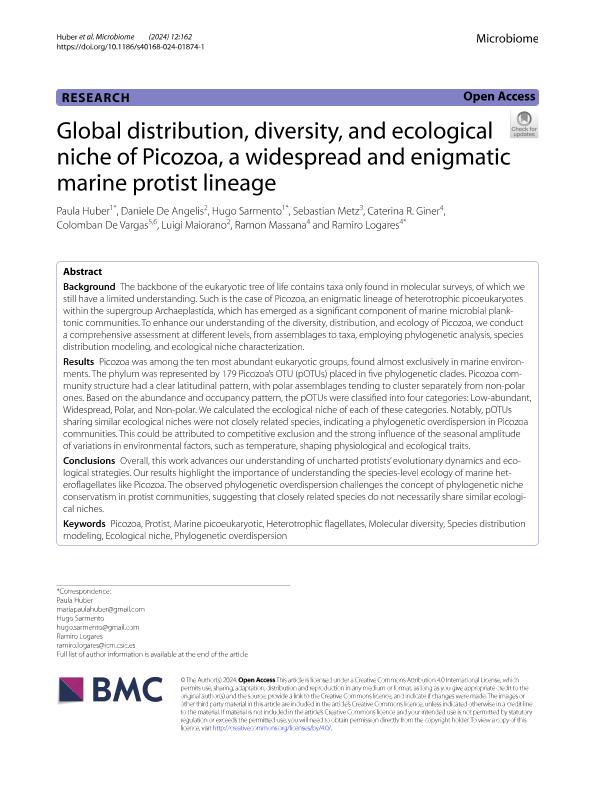
Background The backbone of the eukaryotic tree of life contains taxa only found in molecular surveys, of which we still have a limited understanding. Such is the case of Picozoa, an enigmatic lineage of heterotrophic picoeukaryotes within the supergroup Archaeplastida, which has emerged as a signifcant component of marine microbial planktonic communities. To enhance our understanding of the diversity, distribution, and ecology of Picozoa, we conduct a comprehensive assessment at diferent levels, from assemblages to taxa, employing phylogenetic analysis, species distribution modeling, and ecological niche characterization. Results Picozoa was among the ten most abundant eukaryotic groups, found almost exclusively in marine environments. The phylum was represented by 179 Picozoa’s OTU (pOTUs) placed in fve phylogenetic clades. Picozoa community structure had a clear latitudinal pattern, with polar assemblages tending to cluster separately from non-polar ones. Based on the abundance and occupancy pattern, the pOTUs were classifed into four categories: Low-abundant, Widespread, Polar, and Non-polar. We calculated the ecological niche of each of these categories. Notably, pOTUs sharing similar ecological niches were not closely related species, indicating a phylogenetic overdispersion in Picozoa communities. This could be attributed to competitive exclusion and the strong infuence of the seasonal amplitude of variations in environmental factors, such as temperature, shaping physiological and ecological traits. Conclusions Overall, this work advances our understanding of uncharted protists’ evolutionary dynamics and ecological strategies. Our results highlight the importance of understanding the species-level ecology of marine heterofagellates like Picozoa. The observed phylogenetic overdispersion challenges the concept of phylogenetic niche conservatism in protist communities, suggesting that closely related species do not necessarily share similar ecological niches.
dc.format
application/pdf
dc.language.iso
eng
dc.publisher
Springer
dc.rights
info:eu-repo/semantics/openAccess
dc.rights.uri
https://creativecommons.org/licenses/by/2.5/ar/
dc.subject
Picozoa
dc.subject
Protist
dc.subject
Marine picoeukaryotic
dc.subject
Heterotrophic fagellates
dc.subject
Molecular diversity
dc.subject
Species distribution modeling
dc.subject
Ecological niche
dc.subject.classification
Biología Marina, Limnología
dc.subject.classification
Ciencias Biológicas
dc.subject.classification
CIENCIAS NATURALES Y EXACTAS
dc.title
Global distribution, diversity, and ecological niche of Picozoa, a widespread and enigmatic marine protist lineage
dc.type
info:eu-repo/semantics/article
dc.type
info:ar-repo/semantics/artículo
dc.type
info:eu-repo/semantics/publishedVersion
dc.date.updated
2025-05-06T13:31:29Z
dc.journal.volume
12
dc.journal.number
1
dc.journal.pagination
1-18
dc.journal.pais
Estados Unidos
dc.description.fil
Fil: Huber, Maria Paula. Universidade Federal do São Carlos; Brasil. Consejo Nacional de Investigaciones Científicas y Técnicas. Centro Científico Tecnológico Conicet - La Plata. Instituto de Limnología "Dr. Raúl A. Ringuelet". Universidad Nacional de La Plata. Facultad de Ciencias Naturales y Museo. Instituto de Limnología; Argentina
dc.description.fil
Fil: De Angelis, Daniele. Università degli Studi di Roma "La Sapienza"; Italia
dc.description.fil
Fil: Sarmento, Hugo. Departamento de Hydrobiologia, Universidade Federal de; Brasil
dc.description.fil
Fil: Metz, Sebastian. University of York; Reino Unido
dc.description.fil
Fil: Giner, Caterina R.. Consejo Superior de Investigaciones Científicas. Instituto de Ciencias del Mar; España
dc.description.fil
Fil: De Vargas, Colomban. Sorbonne University; Francia
dc.description.fil
Fil: Maiorano, Luigi. Università degli Studi di Roma "La Sapienza"; Italia
dc.description.fil
Fil: Massana, Ramon. Consejo Superior de Investigaciones Científicas. Instituto de Ciencias del Mar; España
dc.description.fil
Fil: Logares, Ramiro. Consejo Superior de Investigaciones Científicas. Instituto de Ciencias del Mar; España
dc.journal.title
Microbiome
dc.relation.alternativeid
info:eu-repo/semantics/altIdentifier/url/https://microbiomejournal.biomedcentral.com/articles/10.1186/s40168-024-01874-1
dc.relation.alternativeid
info:eu-repo/semantics/altIdentifier/doi/http://dx.doi.org/10.1186/s40168-024-01874-1
Archivos asociados

Tamaño:
7.845Mb
Formato:
PDF