Artículo
The importance of geography in forecasting future fire patterns under climate change
Syphard, Alexandra D.; Velazco, Santiago José Elías ; Rose, Miranda Brooke; Franklin, Janet; Regan, Helen M.
; Rose, Miranda Brooke; Franklin, Janet; Regan, Helen M.
Fecha de publicación:
29/07/2024
Editorial:
National Academy of Sciences
Revista:
Proceedings of the National Academy of Sciences of The United States of America
ISSN:
0027-8424
Idioma:
Inglés
Tipo de recurso:
Artículo publicado
Clasificación temática:
Resumen
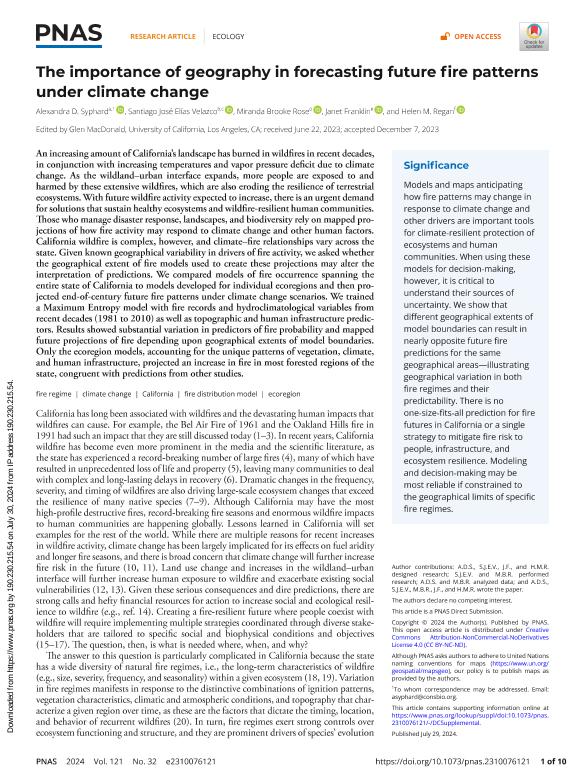
An increasing amount of California’s landscape has burned in wildfires in recent decades, in conjunction with increasing temperatures and vapor pressure deficit due to climate change. As the wildland–urban interface expands, more people are exposed to and harmed by these extensive wildfires, which are also eroding the resilience of terrestrial ecosystems. With future wildfire activity expected to increase, there is an urgent demand for solutions that sustain healthy ecosystems and wildfire-resilient human communities. Those who manage disaster response, landscapes, and biodiversity rely on mapped projections of how fire activity may respond to climate change and other human factors. California wildfire is complex, however, and climate–fire relationships vary across the state. Given known geographical variability in drivers of fire activity, we asked whether the geographical extent of fire models used to create these projections may alter the interpretation of predictions. We compared models of fire occurrence spanning the entire state of California to models developed for individual ecoregions and then projected end-of-century future fire patterns under climate change scenarios. We trained a Maximum Entropy model with fire records and hydroclimatological variables from recent decades (1981 to 2010) as well as topographic and human infrastructure predictors. Results showed substantial variation in predictors of fire probability and mapped future projections of fire depending upon geographical extents of model boundaries. Only the ecoregion models, accounting for the unique patterns of vegetation, climate, and human infrastructure, projected an increase in fire in most forested regions of the state, congruent with predictions from other studies.
Palabras clave:
FIRE REGIME
,
CLIMATE CHANGE
,
CALIFORNIA
,
FIRE DISTRIBUTION MODEL
,
ECOREGION
Archivos asociados

Tamaño:
5.621Mb
Formato:
PDF
Licencia
 Excepto donde se diga explícitamente, este item se publica bajo la siguiente descripción:
Atribución-NoComercial-SinDerivadas 2.5 Argentina (CC BY-NC-ND 2.5 AR)
Excepto donde se diga explícitamente, este item se publica bajo la siguiente descripción:
Atribución-NoComercial-SinDerivadas 2.5 Argentina (CC BY-NC-ND 2.5 AR)
Identificadores
Colecciones
Articulos(IBS)
Articulos de INSTITUTO DE BIOLOGIA SUBTROPICAL
Articulos de INSTITUTO DE BIOLOGIA SUBTROPICAL
Citación
Syphard, Alexandra D.; Velazco, Santiago José Elías; Rose, Miranda Brooke; Franklin, Janet; Regan, Helen M.; The importance of geography in forecasting future fire patterns under climate change; National Academy of Sciences; Proceedings of the National Academy of Sciences of The United States of America; 121; 32; 29-7-2024; 1-10
Compartir


Altmétricas