Artículo
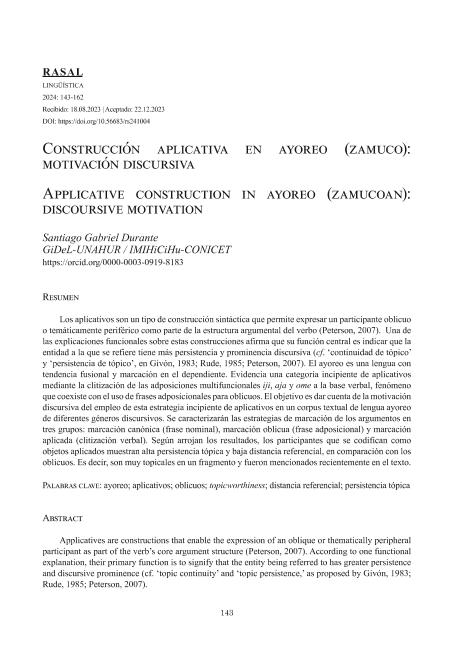
Los aplicativos son medios que permiten expresar un participante oblicuo o temáticamente periférico como parte de la estructura argumental del verbo (Peterson, 2007). Una de las explicaciones funcionales sobre estas construcciones afirma que su función central es indicar que la entidad a la que se refiere tiene más persistencia y prominencia discursiva (cf. ‘continuidad de tópico’ y ‘persistencia de tópico’, en Givón, 1983; Rude, 1985; Peterson, 2007). El ayoreo es una lengua con tendencia fusional y marcación en el dependiente. Evidencia una categoría incipiente de aplicativos mediante la clitización de las adposiciones multifuncionales iji, aja y ome a la base verbal, fenómeno que coexiste con el uso de frases adposicionales para oblicuos. El objetivo es dar cuenta de la motivación discursiva del empleo de esta estrategia incipiente de aplicativos en un corpus textual de lengua ayoreo de diferentes géneros discursivos. Se caracterizarán las estrategias de marcación de los argumentos en tres grupos: marcación canónica (frase nominal), marcación oblicua (frase adposicional) y marcación aplicada (clitización verbal). Según arrojan los resultados, las entidades aplicadas muestran alta persistencia tópica y baja distancia referencial, en comparación con oblicuos. Es decir, son muy topicales en un fragmento y fueron mencionados recientemente en el texto. Applicatives are constructions that enable the expression of an oblique or thematically peripheral participant as part of the verb’s core argument structure (Peterson, 2007). According to one functional explanation, their primary function is to signify that the entity being referred to has greater persistence and discursive prominence (cf. ‘topic continuity’ and ‘topic persistence,’ as proposed by Givón, 1983; Rude, 1985; Peterson, 2007). Ayoreo exhibits characteristics of a fusional language with traits of a dependent-marking system. It demonstrates an emerging category of applicatives through the cliticization of multifunctional adpositions such as iji, aja, and ome to the verbal base. This phenomenon coexists with the use of adpositional phrases to represent oblique arguments. Our objective is to elucidate the discursive motivation of applicatives in Ayoreo, based on a textual corpus that encompasses various genres. Non-subject argument-marking strategies are categorized into three types: canonical marking (expressed through nominal phrases), oblique marking (utilizing adpositional phrases), and applied marking (accomplished through verb cliticization). The results indicate that applied constructions exhibit higher topic persistence and lower referential distance compared to oblique participants. In other words, they maintain a high level of topicality across discourse sequences, despite being activated in the minds of the speaker or the hearer, given their recent mention.
Construcción aplicativa en ayoreo (zamuco): motivación discursiva
Título:
Applicative construction in ayoreo (zamucoan): discoursive motivation

Fecha de publicación:
03/2024
Editorial:
Sociedad Argentina de Estudios Lingüísticos
Revista:
RASAL Lingüística
ISSN:
2250-7353
e-ISSN:
2618-3455
Idioma:
Español
Tipo de recurso:
Artículo publicado
Clasificación temática:
Resumen
Palabras clave:
AYOREO
,
ZAMUCO
,
APLICATIVOS
,
MOTIVACIÓN DISCURSIVA
Archivos asociados

Tamaño:
383.2Kb
Formato:
PDF
Licencia
 Excepto donde se diga explícitamente, este item se publica bajo la siguiente descripción:
Creative Commons Attribution-NonCommercial 2.5 Unported (CC BY-NC 2.5)
Excepto donde se diga explícitamente, este item se publica bajo la siguiente descripción:
Creative Commons Attribution-NonCommercial 2.5 Unported (CC BY-NC 2.5)
Identificadores
Colecciones
Articulos(IMHICIHU)
Articulos de INST.MULTIDISCIP.DE HISTORIA Y CS.HUMANAS
Articulos de INST.MULTIDISCIP.DE HISTORIA Y CS.HUMANAS
Citación
Durante, Santiago Gabriel; Construcción aplicativa en ayoreo (zamuco): motivación discursiva; Sociedad Argentina de Estudios Lingüísticos; RASAL Lingüística; 1; 3-2024; 143-162
Compartir


Altmétricas