Mostrar el registro sencillo del ítem
dc.contributor.author
Vilar, Mariano Alejandro
dc.date.available
2025-04-24T14:28:48Z
dc.date.issued
2024-12
dc.identifier.citation
Vilar, Mariano Alejandro; La estructura dialógica del De professione religiosorum de Lorenzo Valla; Universidad Autónoma de Barcelona; Studia Aurea; 18; 12-2024; 373-394
dc.identifier.uri
http://hdl.handle.net/11336/259537
dc.description.abstract
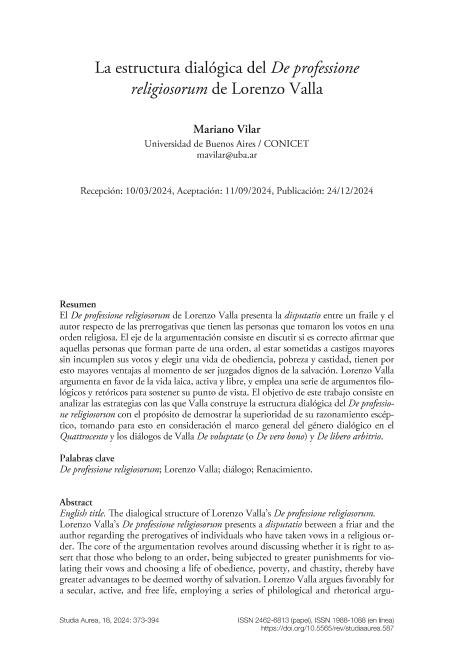
El De professione religiosorum de Lorenzo Valla presenta la disputatio entre un fraile y el autor respecto de las prerrogativas que tienen las personas que tomaron los votos en una orden religiosa. El eje de la argumentación consiste en discutir si es correcto afirmar que aquellas personas que forman parte de una orden, al estar sometidas a castigos mayores sin incumplen sus votos y elegir una vida de obediencia, pobreza y castidad, tienen por esto mayores ventajas al momento de ser juzgados dignos de la salvación. Lorenzo Valla argumenta en favor de la vida laica, activa y libre, y emplea una serie de argumentos filológicos y retóricos para sostener su punto de vista. El objetivo de este trabajo consiste en analizar las estrategias con las que Valla construye la estructura dialógica del De professione religiosorum con el propósito de demostrar la superioridad de su razonamiento escéptico, tomando para esto en consideración el marco general del género dialógico en el Quattrocento y los diálogos de Valla De voluptate (o De vero bono) y De libero arbitrio.
dc.description.abstract
Lorenzo Valla’s De professione religiosorum presents a disputatio between a friar and the author regarding the prerogatives of individuals who have taken vows in a religious order. The core of the argumentation revolves around discussing whether it is right to assert that those who belong to an order, being subjected to greater punishments for violating their vows and choosing a life of obedience, poverty, and chastity, thereby have greater advantages to be deemed worthy of salvation. Lorenzo Valla argues favorably for a secular, active, and free life, employing a series of philological and rhetorical arguments to support his perspective. The purpose of this paper is to analyze the strategies through which Valla constructs the dialogical structure of De professione religiosorum to demonstrate the superiority of his skeptical reasoning, considering the general framework of the dialogical genre in the Quattrocento and Valla’s dialogues De voluptate (or De vero bono) and De libero arbitrio.
dc.format
application/pdf
dc.language.iso
spa
dc.publisher
Universidad Autónoma de Barcelona
dc.rights
info:eu-repo/semantics/openAccess
dc.rights.uri
https://creativecommons.org/licenses/by-nc-sa/2.5/ar/
dc.subject
De professione religiosorum
dc.subject
Lorenzo Valla
dc.subject
Diálogo
dc.subject
Renacimiento
dc.subject.classification
Literaturas Específicas
dc.subject.classification
Lengua y Literatura
dc.subject.classification
HUMANIDADES
dc.title
La estructura dialógica del De professione religiosorum de Lorenzo Valla
dc.title
The dialogical structure of Lorenzo Valla’s De professione religiosorum
dc.type
info:eu-repo/semantics/article
dc.type
info:ar-repo/semantics/artículo
dc.type
info:eu-repo/semantics/publishedVersion
dc.date.updated
2025-04-23T09:08:16Z
dc.identifier.eissn
1988-1088
dc.journal.volume
18
dc.journal.pagination
373-394
dc.journal.pais
España
dc.description.fil
Fil: Vilar, Mariano Alejandro. Universidad de Buenos Aires. Facultad de Filosofía y Letras. Instituto de Filología y Literatura Hispánica "Dr. Amado Alonso"; Argentina. Consejo Nacional de Investigaciones Científicas y Técnicas; Argentina
dc.journal.title
Studia Aurea
dc.relation.alternativeid
info:eu-repo/semantics/altIdentifier/url/https://studiaaurea.com/article/view/v18-vilar
dc.relation.alternativeid
info:eu-repo/semantics/altIdentifier/doi/http://dx.doi.org/10.5565/rev/studiaaurea.587
Archivos asociados

Tamaño:
2.882Mb
Formato:
PDF