Mostrar el registro sencillo del ítem
dc.contributor.author
Dos Santos Mendez, Gonzalo Joaquín
dc.contributor.author
Urbassek, Herbert M.
dc.contributor.author
Bringa, Eduardo Marcial
dc.date.available
2025-04-22T13:19:07Z
dc.date.issued
2024-09
dc.identifier.citation
Dos Santos Mendez, Gonzalo Joaquín; Urbassek, Herbert M.; Bringa, Eduardo Marcial; Size-dependent Curie temperature of Ni nanoparticles from spin-lattice dynamics simulations; Nature; Scientific Reports; 14; 1; 9-2024; 1-12
dc.identifier.uri
http://hdl.handle.net/11336/259230
dc.description.abstract
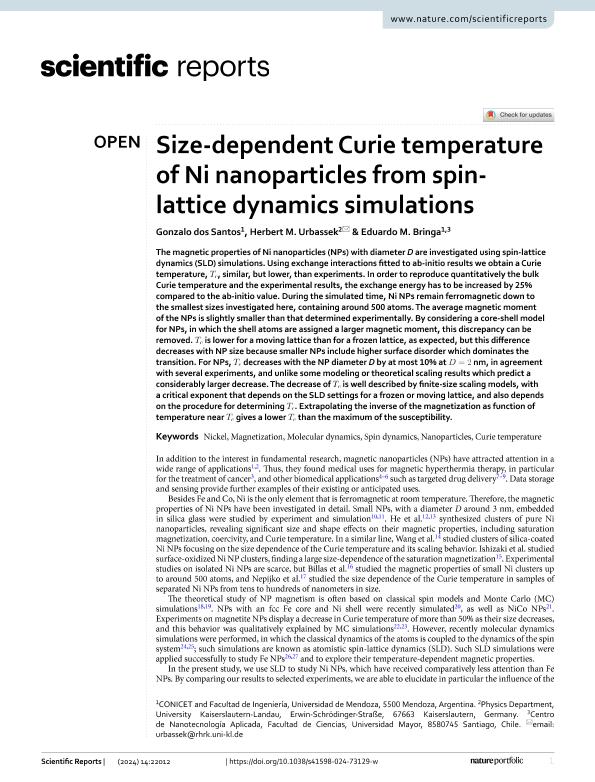
The magnetic properties of Ni nanoparticles (NPs) with diameter D are investigated using spin-lattice dynamics (SLD) simulations. Using exchange interactions fitted to ab-initio results we obtain a Curie temperature, Tc, similar, but lower, than experiments. In order to reproduce quantitatively the bulk Curie temperature and the experimental results, the exchange energy has to be increased by 25% compared to the ab-initio value. During the simulated time, Ni NPs remain ferromagnetic down to the smallest sizes investigated here, containing around 500 atoms. The average magnetic moment of the NPs is slightly smaller than that determined experimentally. By considering a core-shell model for NPs, in which the shell atoms are assigned a larger magnetic moment, this discrepancy can be removed. Tc is lower for a moving lattice than for a frozen lattice, as expected, but this difference decreases with NP size because smaller NPs include higher surface disorder which dominates the transition. For NPs, Tc decreases with the NP diameter D by at most 10% at D = 2 nm, in agreement with several experiments, and unlike some modeling or theoretical scaling results which predict a considerably larger decrease. The decrease of Tc is well described by finite-size scaling models, with a critical exponent that depends on the SLD settings for a frozen or moving lattice, and also depends on the procedure for determining Tc. Extrapolating the inverse of the magnetization as function of temperature near Tc gives a lower Tc than the maximum of the susceptibility.
dc.format
application/pdf
dc.language.iso
eng
dc.publisher
Nature
dc.rights
info:eu-repo/semantics/openAccess
dc.rights.uri
https://creativecommons.org/licenses/by/2.5/ar/
dc.subject
NICKEL
dc.subject
MAGNETIZATION
dc.subject
MOLECULAR DYNAMICS
dc.subject
SPIN DYNAMICS
dc.subject
NANOPARTICLES
dc.subject
CURIE TEMPERATURE
dc.subject.classification
Física de los Materiales Condensados
dc.subject.classification
Ciencias Físicas
dc.subject.classification
CIENCIAS NATURALES Y EXACTAS
dc.title
Size-dependent Curie temperature of Ni nanoparticles from spin-lattice dynamics simulations
dc.type
info:eu-repo/semantics/article
dc.type
info:ar-repo/semantics/artículo
dc.type
info:eu-repo/semantics/publishedVersion
dc.date.updated
2025-04-21T13:47:47Z
dc.identifier.eissn
2045-2322
dc.journal.volume
14
dc.journal.number
1
dc.journal.pagination
1-12
dc.journal.pais
Reino Unido
dc.journal.ciudad
Londres
dc.description.fil
Fil: Dos Santos Mendez, Gonzalo Joaquín. Consejo Nacional de Investigaciones Científicas y Técnicas. Centro Científico Tecnológico Conicet - Mendoza; Argentina. Universidad de Mendoza. Facultad de Ingenieria; Argentina
dc.description.fil
Fil: Urbassek, Herbert M.. University of Kaiserslautern; Alemania
dc.description.fil
Fil: Bringa, Eduardo Marcial. Consejo Nacional de Investigaciones Científicas y Técnicas. Centro Científico Tecnológico Conicet - Mendoza; Argentina. Universidad de Mendoza. Facultad de Ingenieria; Argentina. Universidad Mayor; Chile
dc.journal.title
Scientific Reports
dc.relation.alternativeid
info:eu-repo/semantics/altIdentifier/url/https://www.nature.com/articles/s41598-024-73129-w
dc.relation.alternativeid
info:eu-repo/semantics/altIdentifier/doi/http://dx.doi.org/10.1038/s41598-024-73129-w
Archivos asociados

Tamaño:
4.260Mb
Formato:
PDF