Artículo
Emotions behind bars: the regulation of mothering a child in Argentine jails

Fecha de publicación:
09/2013
Editorial:
University of Chicago Press
Revista:
Signs
ISSN:
0097-9740
Idioma:
Inglés
Tipo de recurso:
Artículo publicado
Clasificación temática:
Resumen
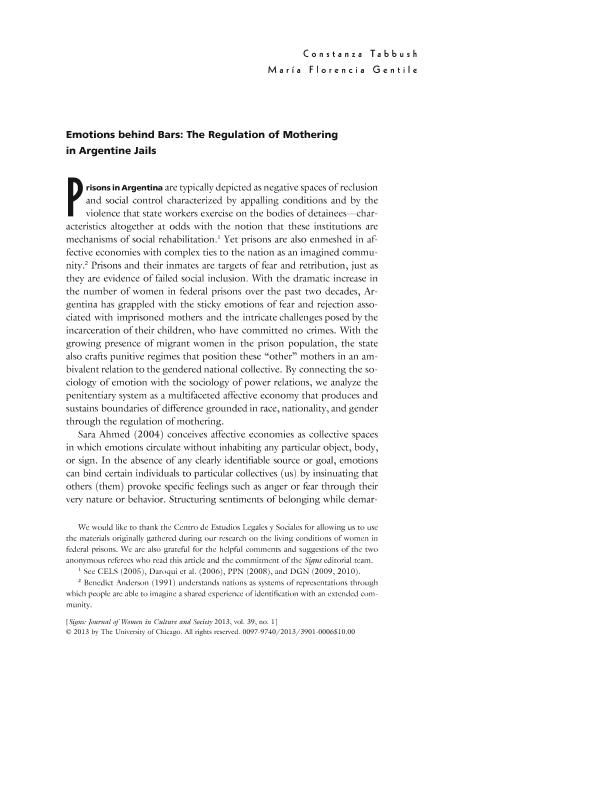
This article considers how the contemporary Argentine nation is produced through the regulation of mothering in the federal penitentiary system. The analysis is based on legal narratives of mothering and on women’s social exchanges with female guards. To explore the emotional dimensions of social justice, this article understands prisons as objects of public feelings and as affective economies where emotions circulate. It argues that, through the regulation of mothering in institutions of social control, the nation-state disciplines particular modes of emotional life to foster gendered illusions of belonging for young migrant women and girls. Penal legislation splits mothering into two periods: Until children are four years old, women are regarded solely as biological reproducers of the nation, and mothering is allowed in prison yet exclusively defined as a biological exchange between the bodies of mother and child. However, after the child reaches age four, the fear of moral contamination incarnated in these women constructs them as undesirable agents of cultural transmission to the next generation. The effect is the removal of their children from prison. These two models conceive the future generation’s well-being as dependent on women’s bodies until the children are four years old and, after that, on the fantasy of a nuclear, heterosexual family outside prison. The paradoxical position of incarcerated women vis-à-vis the nation is policed by guards who regulate prison’s affective economies, reducing women’s access to income and goods, shaping the technologies of punishment applied to them, and limiting the forms of agency and social transformation available.
Palabras clave:
Social Control
,
Gender
,
Emotion
,
Mothering
Archivos asociados

Tamaño:
150.6Kb
Formato:
PDF
Licencia
 Excepto donde se diga explícitamente, este item se publica bajo la siguiente descripción:
Creative Commons Attribution-NonCommercial 2.5 Unported (CC BY-NC 2.5)
Excepto donde se diga explícitamente, este item se publica bajo la siguiente descripción:
Creative Commons Attribution-NonCommercial 2.5 Unported (CC BY-NC 2.5)
Identificadores
Colecciones
Articulos(SEDE CENTRAL)
Articulos de SEDE CENTRAL
Articulos de SEDE CENTRAL
Citación
Tabbush, Constanza; Gentile, María Florencia; Emotions behind bars: the regulation of mothering a child in Argentine jails; University of Chicago Press; Signs; 39; 1; 9-2013; 131-150
Compartir

