Artículo
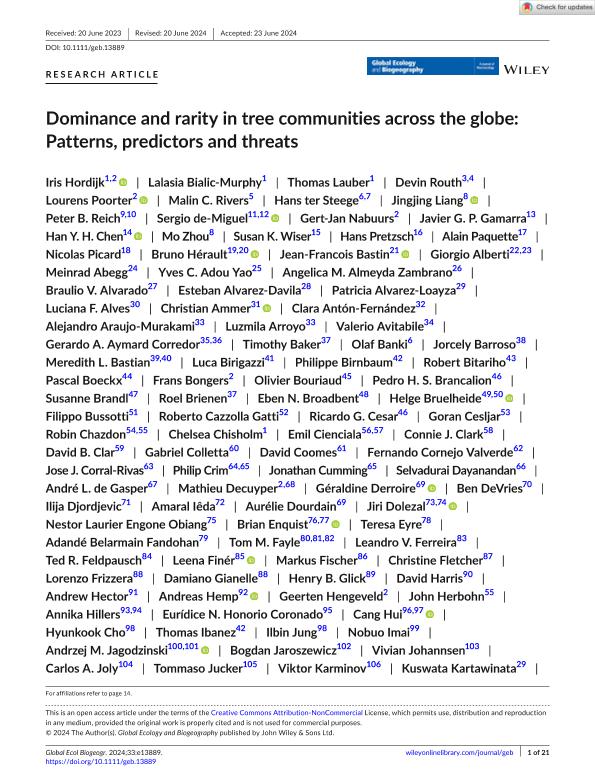
Dominance and rarity in tree communities across the globe: Patterns, predictors and threats
Hordijk, Iris; Bialic Murphy, Lalasia; Lauber, Thomas; Routh, Devin; Poorter, Lourens; Rivers, Malin C.; ter Steege, Hans; Liang, Jingjing; Reich, Peter B.; de Miguel, Sergio; Nabuurs, Gert Jan; Gamarra, Javier G. P.; Chen, Han Y. H.; Zhou, Mo; Wiser, Susan K.; Pretzsch, Hans; Paquette, Alain; Picard, Nicolas; Hérault, Bruno; Bastin, Jean Francois; Alberti, Giorgio; Abegg, Meinrad; Adou Yao, Yves C.; Almeyda Zambrano, Angelica M.; Peri, Pablo Luis ; Zhao, Xiuhai; Zhu, Zhi Xin; Zo Bi, Irie Casimir; Maynard, Daniel S.; Crowther, Thomas W.
; Zhao, Xiuhai; Zhu, Zhi Xin; Zo Bi, Irie Casimir; Maynard, Daniel S.; Crowther, Thomas W.
Fecha de publicación:
09/2024
Editorial:
Wiley Blackwell Publishing, Inc
Revista:
Global Ecology and Biogeography
ISSN:
1466-822X
Idioma:
Inglés
Tipo de recurso:
Artículo publicado
Clasificación temática:
Resumen
Ecological and anthropogenic factors shift the abundances of dominant and rare tree species within local forest communities, thus affecting species composition and ecosystem functioning. To inform forest and conservation management it is important to understand the drivers of dominance and rarity in local tree communities. We answer the following research questions: (1) What are the patterns of dominance and rarity in tree communities? (2) Which ecological and anthropogenic factors predict these patterns? And (3) what is the extinction risk of locally dominant and rare tree species? We used 1.2 million forest plots and quantified local tree dominance as the relative plot basal area of the single most dominant species and local rarity as the percentage of species that contribute together to the least 10% of plot basal area. We mapped global community dominance and rarity using machine learning models and evaluated the ecological and anthropogenic predictors with linear models. Extinction risk, for example threatened status, of geographically widespread dominant and rare species was evaluated. Community dominance and rarity show contrasting latitudinal trends, with boreal forests having high levels of dominance and tropical forests having high levels of rarity. Increasing annual precipitation reduces community dominance, probably because precipitation is related to an increase in tree density and richness. Additionally, stand age is positively related to community dominance, due to stem diameter increase of the most dominant species. Surprisingly, we find that locally dominant and rare species, which are geographically widespread in our data, have an equally high rate of elevated extinction due to declining populations through large-scale land degradation. By linking patterns and predictors of community dominance and rarity to extinction risk, our results suggest that also widespread species should be considered in large-scale management and conservation practices.
Palabras clave:
community
,
environmental predictors
,
dominance
,
forests
Archivos asociados

Tamaño:
4.110Mb
Formato:
PDF
Licencia
 Excepto donde se diga explícitamente, este item se publica bajo la siguiente descripción:
Creative Commons Attribution-NonCommercial-ShareAlike 2.5 Unported (CC BY-NC-SA 2.5)
Excepto donde se diga explícitamente, este item se publica bajo la siguiente descripción:
Creative Commons Attribution-NonCommercial-ShareAlike 2.5 Unported (CC BY-NC-SA 2.5)
Identificadores
Colecciones
Articulos(SEDE CENTRAL)
Articulos de SEDE CENTRAL
Articulos de SEDE CENTRAL
Citación
Hordijk, Iris; Bialic Murphy, Lalasia; Lauber, Thomas; Routh, Devin; Poorter, Lourens; et al.; Dominance and rarity in tree communities across the globe: Patterns, predictors and threats; Wiley Blackwell Publishing, Inc; Global Ecology and Biogeography; 33; 10; 9-2024; 1-21
Compartir


Altmétricas