Mostrar el registro sencillo del ítem
dc.contributor.author
Wendt, Lucile
dc.contributor.author
Sir, Esteban Benjamin
dc.contributor.author
Kuhnert, Eric
dc.contributor.author
Heitkämper, Simone
dc.contributor.author
Lambert, Christopher
dc.contributor.author
Hladki, Adriana I.
dc.contributor.author
Romero, Andrea Irene
dc.contributor.author
Luangsa-Ard, Janet Jennifer
dc.contributor.author
Srikitikulchai, Prasert
dc.contributor.author
Peršoh, Derek
dc.contributor.author
Stadler, Marc
dc.date.available
2017-10-03T17:33:33Z
dc.date.issued
2017-06-10
dc.identifier.citation
Wendt, Lucile; Sir, Esteban Benjamin; Kuhnert, Eric; Heitkämper, Simone; Lambert, Christopher; et al.; Resurrection and emendation of the Hypoxylaceae, recognised from a multigene phylogeny of the Xylariales; Springer Heidelberg; Mycological Progress; 10-6-2017; 1-40
dc.identifier.issn
1617-416X
dc.identifier.uri
http://hdl.handle.net/11336/25779
dc.description.abstract
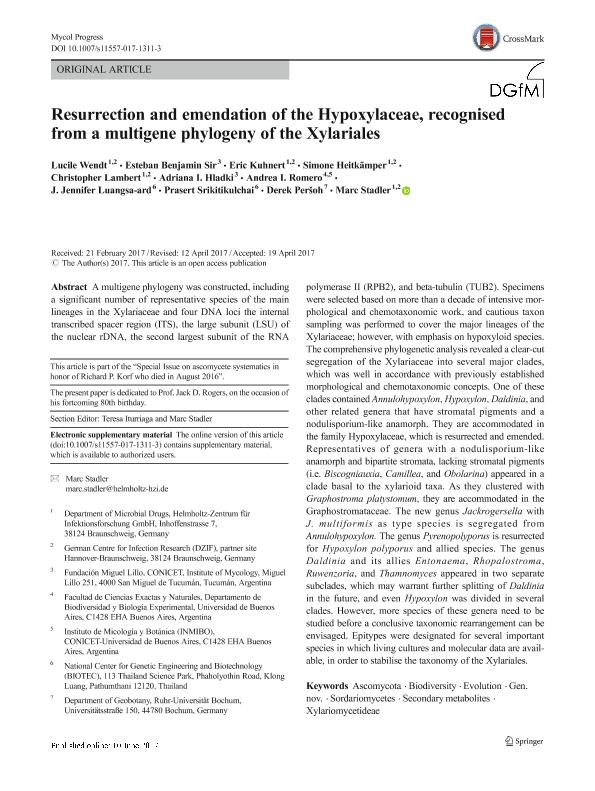
A multigene phylogeny was constructed, including a significant number of representative species of the main lineages in the Xylariaceae and four DNA loci the internal transcribed spacer region (ITS), the large subunit (LSU) of the nuclear rDNA, the second largest subunit of the RNA polymerase II (RPB2), and beta-tubulin (TUB2). Specimens were selected based on more than a decade of intensive morphological and chemotaxonomic work, and cautious taxon sampling was performed to cover the major lineages of the Xylariaceae; however, with emphasis on hypoxyloid species. The comprehensive phylogenetic analysis revealed a clear-cut segregation of the Xylariaceae into several major clades, which was well in accordance with previously established morphological and chemotaxonomic concepts. One of these clades contained Annulohypoxylon, Hypoxylon, Daldinia, and other related genera that have stromatal pigments and a nodulisporium-like anamorph. They are accommodated in the family Hypoxylaceae, which is resurrected and emended. Representatives of genera with a nodulisporium-like anamorph and bipartite stromata, lacking stromatal pigments (i.e. Biscogniauxia, Camillea, and Obolarina) appeared in a clade basal to the xylarioid taxa. As they clustered with Graphostroma platystomum, they are accommodated in the Graphostromataceae. The new genus Jackrogersella with J. multiformis as type species is segregated from Annulohypoxylon. The genus Pyrenopolyporus is resurrected for Hypoxylon polyporus and allied species. The genus Daldinia and its allies Entonaema, Rhopalostroma, Ruwenzoria, and Thamnomyces appeared in two separate subclades, which may warrant further splitting of Daldinia in the future, and even Hypoxylon was divided in several clades. However, more species of these genera need to be studied before a conclusive taxonomic rearrangement can be envisaged. Epitypes were designated for several important species in which living cultures and molecular data are available, in order to stabilise the taxonomy of the Xylariales.
dc.format
application/pdf
dc.language.iso
eng
dc.publisher
Springer Heidelberg
dc.rights
info:eu-repo/semantics/openAccess
dc.rights.uri
https://creativecommons.org/licenses/by-nc-sa/2.5/ar/
dc.subject
Ascomycota
dc.subject
Biodiversity
dc.subject
Evolution
dc.subject
Gen. Nov.
dc.subject
Sordariomycetes
dc.subject
Secondary Metabolites
dc.subject
Xylariomycetideae
dc.subject.classification
Bioquímica y Biología Molecular
dc.subject.classification
Ciencias Biológicas
dc.subject.classification
CIENCIAS NATURALES Y EXACTAS
dc.title
Resurrection and emendation of the Hypoxylaceae, recognised from a multigene phylogeny of the Xylariales
dc.type
info:eu-repo/semantics/article
dc.type
info:ar-repo/semantics/artículo
dc.type
info:eu-repo/semantics/publishedVersion
dc.date.updated
2017-09-13T16:17:38Z
dc.identifier.eissn
1861-8952
dc.journal.pagination
1-40
dc.journal.pais
Alemania
dc.journal.ciudad
Berlin
dc.description.fil
Fil: Wendt, Lucile. Helmholtz-Zentrum für Infektionsforschung GmbH. Department of Microbial Drugs; Alemania. German Centre for Infection Research; Alemania
dc.description.fil
Fil: Sir, Esteban Benjamin. Consejo Nacional de Investigaciones Científicas y Técnicas. Centro Científico Tecnológico Conicet - Tucuman. Unidad Ejecutora Lillo. Fundación Miguel Lillo. Unidad Ejecutora Lillo; Argentina
dc.description.fil
Fil: Kuhnert, Eric. Helmholtz-Zentrum für Infektionsforschung GmbH. Department of Microbial Drugs; Alemania. German Centre for Infection Research; Alemania
dc.description.fil
Fil: Heitkämper, Simone. Helmholtz-Zentrum für Infektionsforschung GmbH. Department of Microbial Drugs; Alemania. German Centre for Infection Research; Alemania
dc.description.fil
Fil: Lambert, Christopher. Helmholtz-Zentrum für Infektionsforschung GmbH. Department of Microbial Drugs; Alemania. German Centre for Infection Research; Alemania
dc.description.fil
Fil: Hladki, Adriana I.. Fundación Miguel Lillo. Dirección de Botánica. Instituto de Micologia; Argentina
dc.description.fil
Fil: Romero, Andrea Irene. Consejo Nacional de Investigaciones Científicas y Técnicas. Oficina de Coordinación Administrativa Ciudad Universitaria. Instituto de Micología y Botánica. Universidad de Buenos Aires. Facultad de Ciencias Exactas y Naturales. Instituto de Micología y Botánica; Argentina
dc.description.fil
Fil: Luangsa-Ard, Janet Jennifer. National Center for Genetic Engineering and Biotechnology; Tailandia
dc.description.fil
Fil: Srikitikulchai, Prasert. National Center for Genetic Engineering and Biotechnology; Tailandia
dc.description.fil
Fil: Peršoh, Derek. Ruhr-Universität Bochum; Alemania
dc.description.fil
Fil: Stadler, Marc. Helmholtz-Zentrum für Infektionsforschung GmbH. Department of Microbial Drugs; Alemania. German Centre for Infection Research; Alemania
dc.journal.title
Mycological Progress
dc.relation.alternativeid
info:eu-repo/semantics/altIdentifier/url/http://link.springer.com/10.1007/s11557-017-1311-3
dc.relation.alternativeid
info:eu-repo/semantics/altIdentifier/doi/http://dx.doi.org/10.1007/s11557-017-1311-3
Archivos asociados

Tamaño:
5.394Mb
Formato:
PDF