Mostrar el registro sencillo del ítem
dc.contributor.author
Ernst, Oswaldo
dc.contributor.author
Bianculli, Mariana Lujan
dc.date.available
2017-10-03T17:11:33Z
dc.date.issued
2013-12
dc.identifier.citation
Ernst, Oswaldo; Bianculli, Mariana Lujan; Rendimiento, fenología y uso de agua en intersiembra trigo-soja con relación a cultivos secuenciales y cultivo de cobertura-soja; Universidad de la República, Facultad de Agronomía. Instituto Nacional de Investigación Agropecuaria (INIA); Agrociencia; 17; 2; 12-2013; 33-44
dc.identifier.issn
1510-0839
dc.identifier.uri
http://hdl.handle.net/11336/25773
dc.description.abstract
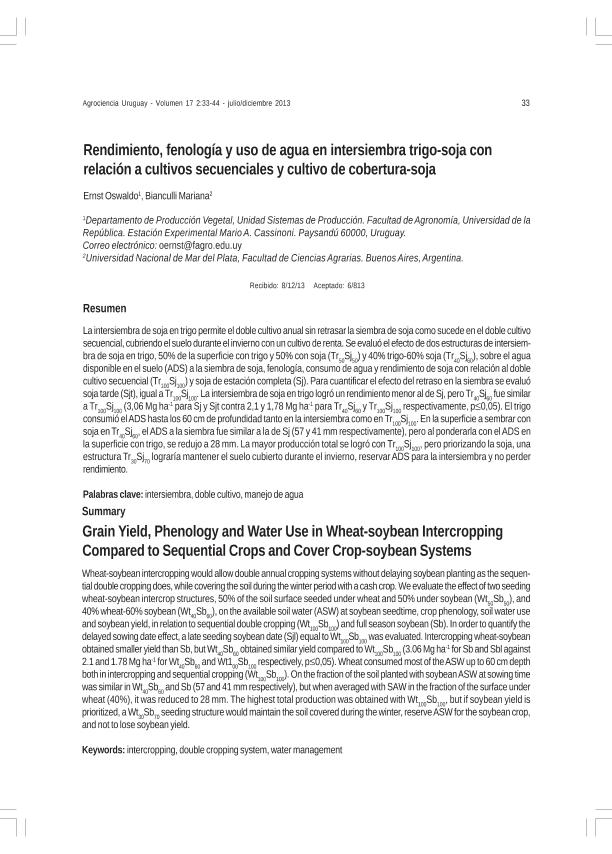
La intersiembra de soja en trigo permite el doble cultivo anual sin retrasar la siembra de soja como sucede en el doble cultivo secuencial, cubriendo el suelo durante el invierno con un cultivo de renta. Se evaluó el efecto de dos estructuras de intersiembra de soja en trigo, 50% de la superficie con trigo y 50% con soja (Tr50Sj50) y 40% trigo-60% soja (Tr40Sj60), sobre el agua disponible en el suelo (ADS) a la siembra de soja, fenología, consumo de agua y rendimiento de soja con relación al doble cultivo secuencial (Tr100Sj100) y soja de estación completa (Sj). Para cuantificar el efecto del retraso en la siembra se evaluó soja tarde (Sjt), igual a Tr100Sj100. La intersiembra de soja en trigo logró un rendimiento menor al de Sj, pero Tr40Sj60 fue similar a Tr100Sj100 (3,06 Mg ha-1 para Sj y Sjt contra 2,1 y 1,78 Mg ha-1 para Tr40Sj60 y Tr100Sj100 respectivamente, p≤0,05). El trigo consumió el ADS hasta los 60 cm de profundidad tanto en la intersiembra como en Tr100Sj100. En la superficie a sembrar con soja en Tr40Sj60, el ADS a la siembra fue similar a la de Sj (57 y 41 mm respectivamente), pero al ponderarla con el ADS en la superficie con trigo, se redujo a 28 mm. La mayor producción total se logró con Tr100Sj100, pero priorizando la soja, una estructura Tr30Sj70 lograría mantener el suelo cubierto durante el invierno, reservar ADS para la intersiembra y no perder rendimiento
dc.description.abstract
Wheat-soybean intercropping would allow double annual cropping systems without delaying soybean planting as the sequential double cropping does, while covering the soil during the winter period with a cash crop. We evaluate the effect of two seeding wheat-soybean intercrop structures, 50% of the soil surface seeded under wheat and 50% under soybean (Wt50Sb50), and 40% wheat-60% soybean (Wt40Sb60), on the available soil water (ASW) at soybean seedtime, crop phenology, soil water use and soybean yield, in relation to sequential double cropping (Wt100Sb100) and full season soybean (Sb). In order to quantify the delayed sowing date effect, a late seeding soybean date (Sjl) equal to Wt100Sb100 was evaluated. Intercropping wheat-soybean obtained smaller yield than Sb, but Wt40Sb60 obtained similar yield compared to Wt100Sb100 (3.06 Mg ha-1 for Sb and Sbl against 2.1 and 1.78 Mg ha-1 for Wt40Sb60 and Wt100Sb100 respectively, p≤0,05). Wheat consumed most of the ASW up to 60 cm depth both in intercropping and sequential cropping (Wt100Sb100). On the fraction of the soil planted with soybean ASW at sowing time was similar in Wt40Sb60 and Sb (57 and 41 mm respectively), but when averaged with SAW in the fraction of the surface under wheat (40%), it was reduced to 28 mm. The highest total production was obtained with Wt100Sb100, but if soybean yield is prioritized, a Wt30Sb70 seeding structure would maintain the soil covered during the winter, reserve ASW for the soybean crop, and not to lose soybean yield.
dc.format
application/pdf
dc.language.iso
spa
dc.publisher
Universidad de la República, Facultad de Agronomía. Instituto Nacional de Investigación Agropecuaria (INIA)
dc.rights
info:eu-repo/semantics/openAccess
dc.rights.uri
https://creativecommons.org/licenses/by-nc-sa/2.5/ar/
dc.subject
Intersiembra
dc.subject
Doble Cultivo
dc.subject
Manejo de Agua
dc.subject.classification
Otras Agricultura, Silvicultura y Pesca
dc.subject.classification
Agricultura, Silvicultura y Pesca
dc.subject.classification
CIENCIAS AGRÍCOLAS
dc.title
Rendimiento, fenología y uso de agua en intersiembra trigo-soja con relación a cultivos secuenciales y cultivo de cobertura-soja
dc.title
Grain Yield, Phenology and Water Use in Wheat-soybean Intercropping Compared to Sequential Crops and Cover Crop-soybean Systems
dc.type
info:eu-repo/semantics/article
dc.type
info:ar-repo/semantics/artículo
dc.type
info:eu-repo/semantics/publishedVersion
dc.date.updated
2017-09-29T14:44:40Z
dc.journal.volume
17
dc.journal.number
2
dc.journal.pagination
33-44
dc.journal.pais
Uruguay
dc.journal.ciudad
Montevideo
dc.description.fil
Fil: Ernst, Oswaldo. Universidad de la República; Uruguay
dc.description.fil
Fil: Bianculli, Mariana Lujan. Universidad Nacional de Mar del Plata. Facultad de Ciencias Agrarias; Argentina. Consejo Nacional de Investigaciones Científicas y Técnicas; Argentina
dc.journal.title
Agrociencia
dc.relation.alternativeid
info:eu-repo/semantics/altIdentifier/url/http://www.fagro.edu.uy/agrociencia/index.php/directorio/article/view/819
Archivos asociados

Tamaño:
313.2Kb
Formato:
PDF