Artículo
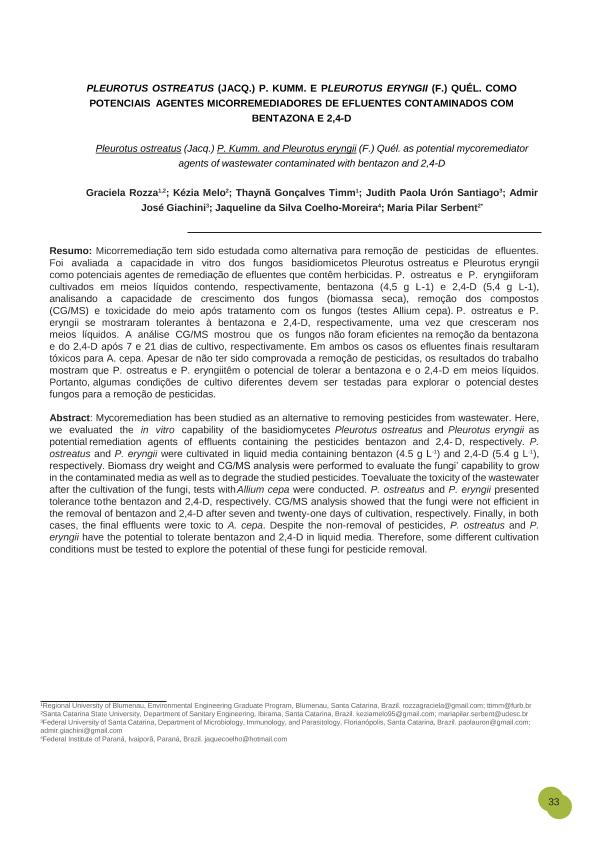
Mycoremediation has been studied as an alternative to removing pesticides from wastewater. Here, we evaluated the in vitro capability of the basidiomycetes Pleurotus ostreatus and Pleurotus eryngii as potential remediation agents of effluents containing the pesticides bentazon and 2,4-D, respectively. P. ostreatus and P. eryngii were cultivated in liquid media containing bentazon (4.5 g L-1) and 2,4-D (5.4 g L-1), respectively. Biomass dry weight and CG/MS analysis were performed to evaluate the fungi’ capability to grow in the contaminated media as well as to degrade the studied pesticides. To evaluate the toxicity of the wastewater after the cultivation of the fungi, tests with Allium cepa were conducted. P. ostreatus and P. eryngii presented tolerance to the bentazon and 2,4-D, respectively. CG/MS analysis showed that the fungi were not efficient in the removal of bentazon and 2,4-D after seven and twenty-one days of cultivation, respectively. Finally, in both cases, the final effluents were toxic to A. cepa. Despite the non-removal of pesticides, P. ostreatus and P. eryngii have the potential to tolerate bentazon and 2,4-D in liquid media. Therefore, some different cultivation conditions must be tested to explore the potential of these fungi for pesticide removal. Micorremediação tem sido estudada como alternativa para remoção de pesticidas de efluentes. Foi avaliada a capacidade in vitro dos fungos basidiomicetos Pleurotus ostreatus e Pleurotus eryngii como potenciais agentes de remediação de efluentes que contêm herbicidas. P. ostreatus e P. eryngiiforam cultivados em meios líquidos contendo, respectivamente, bentazona (4,5 g L-1) e 2,4-D (5,4 g L-1), analisando a capacidade de crescimento dos fungos (biomassa seca), remoção dos compostos (CG/MS) e toxicidade do meio após tratamento com os fungos (testes Allium cepa). P. ostreatus e P. eryngii se mostraram tolerantes à bentazona e 2,4-D, respectivamente, uma vez que cresceram nos meios líquidos. A análise CG/MS mostrou que os fungos não foram eficientes na remoção da bentazona e do 2,4-D após 7 e 21 dias de cultivo, respectivamente. Em ambos os casos os efluentes finais resultaram tóxicos para A. cepa. Apesar de não ter sido comprovada a remoção de pesticidas, os resultados do trabalho mostram que P. ostreatus e P. eryngiitêm o potencial de tolerar a bentazona e o 2,4-D em meios líquidos. Portanto, algumas condições de cultivo diferentes devem ser testadas para explorar o potencial destes fungos para a remoção de pesticidas.
Pleurotus ostreatus (JACQ.) P. Kumm. e Pleurotus Eryngii (F) Quél. como potenciais agentes micorremediadores de efluentes contaminados com bentazona e 2,4-D
Título:
Pleurotus ostreatus (Jacq.) P. Kumm. and Pleurotus eryngii (F.) Quél. as potential mycoremediator agents of wastewater contaminated with bentazon and 2,4-D
Rozza, Graciela; Melo, Kézia; Timm, Thaynã Gonçalves; Urón Santiago, Judith Paola; Giachini, Admir José; da Silva Coelho Moreira, Jaqueline; Serbent, María Pilar
Fecha de publicación:
10/2024
Editorial:
Universidade Regional de Blumenau
Revista:
Revista de Estudos Ambientais
ISSN:
1983-1501
Idioma:
Inglés
Tipo de recurso:
Artículo publicado
Clasificación temática:
Resumen
Palabras clave:
SANITATION
,
WASTEWATER
,
PESTICIDES
,
BASIDIOMYCETES
,
MYCOREMEDIATION
Archivos asociados

Tamaño:
268.9Kb
Formato:
PDF
Licencia
 Excepto donde se diga explícitamente, este item se publica bajo la siguiente descripción:
Creative Commons Attribution-NonCommercial-ShareAlike 2.5 Unported (CC BY-NC-SA 2.5)
Excepto donde se diga explícitamente, este item se publica bajo la siguiente descripción:
Creative Commons Attribution-NonCommercial-ShareAlike 2.5 Unported (CC BY-NC-SA 2.5)
Identificadores
Colecciones
Articulos(CITEQ)
Articulos de CENTRO DE INVESTIGACION Y TECNOLOGIA QUIMICA
Articulos de CENTRO DE INVESTIGACION Y TECNOLOGIA QUIMICA
Citación
Rozza, Graciela; Melo, Kézia; Timm, Thaynã Gonçalves; Urón Santiago, Judith Paola; Giachini, Admir José; et al.; Pleurotus ostreatus (JACQ.) P. Kumm. e Pleurotus Eryngii (F) Quél. como potenciais agentes micorremediadores de efluentes contaminados com bentazona e 2,4-D; Universidade Regional de Blumenau; Revista de Estudos Ambientais; 25; 1; 10-2024; 33-47
Compartir


Altmétricas