Artículo
New insights into the molecular phylogeny, biogeographical history, and diversification of Amblyomma ticks (Acari: Ixodidae) based on mitogenomes and nuclear sequences
Uribe, Juan E.; Kelava, Samuel; Nava, Santiago ; Cotes Perdomo, Andrea P.; Castro, Lyda R.; Rivera Paéz, Fredy A.; Perea, Silvia; Mans, Ben J.; Gofton, Alexander; Teo, Ernest J. M.; Zardoya, Rafael; Barker, Stephen C.
; Cotes Perdomo, Andrea P.; Castro, Lyda R.; Rivera Paéz, Fredy A.; Perea, Silvia; Mans, Ben J.; Gofton, Alexander; Teo, Ernest J. M.; Zardoya, Rafael; Barker, Stephen C.
Fecha de publicación:
03/2024
Editorial:
BioMed Central
Revista:
Parasites and Vectors
ISSN:
1756-3305
Idioma:
Inglés
Tipo de recurso:
Artículo publicado
Clasificación temática:
Resumen
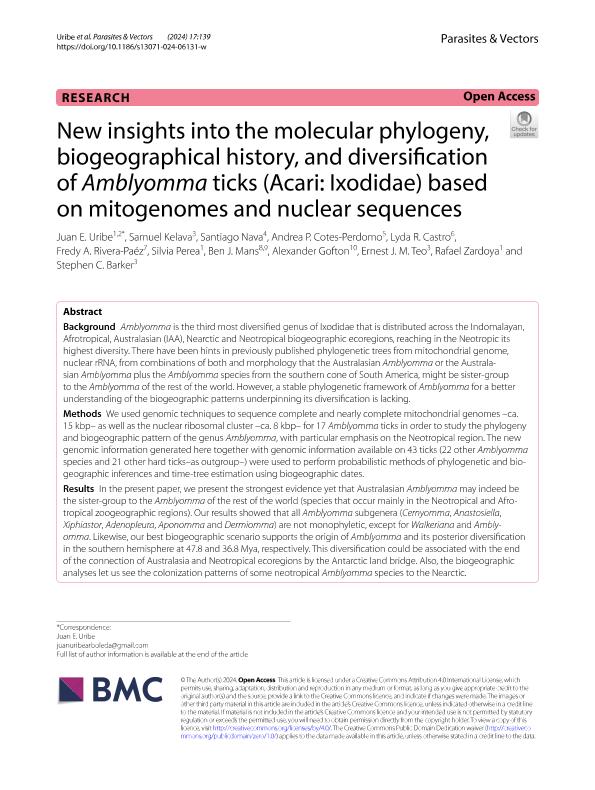
Background: Amblyomma is the third most diversified genus of Ixodidae that is distributed across the Indomalayan, Afrotropical, Australasian (IAA), Nearctic and Neotropical biogeographic ecoregions, reaching in the Neotropic its highest diversity. There have been hints in previously published phylogenetic trees from mitochondrial genome, nuclear rRNA, from combinations of both and morphology that the Australasian Amblyomma or the Australasian Amblyomma plus the Amblyomma species from the southern cone of South America, might be sister-group to the Amblyomma of the rest of the world. However, a stable phylogenetic framework of Amblyomma for a better understanding of the biogeographic patterns underpinning its diversification is lacking. Methods: We used genomic techniques to sequence complete and nearly complete mitochondrial genomes –ca. 15 kbp– as well as the nuclear ribosomal cluster –ca. 8 kbp– for 17 Amblyomma ticks in order to study the phylogeny and biogeographic pattern of the genus Amblyomma, with particular emphasis on the Neotropical region. The new genomic information generated here together with genomic information available on 43 ticks (22 other Amblyomma species and 21 other hard ticks–as outgroup–) were used to perform probabilistic methods of phylogenetic and biogeographic inferences and time-tree estimation using biogeographic dates. Results: In the present paper, we present the strongest evidence yet that Australasian Amblyomma may indeed be the sister-group to the Amblyomma of the rest of the world (species that occur mainly in the Neotropical and Afrotropical zoogeographic regions). Our results showed that all Amblyomma subgenera (Cernyomma, Anastosiella, Xiphiastor, Adenopleura, Aponomma and Dermiomma) are not monophyletic, except for Walkeriana and Amblyomma. Likewise, our best biogeographic scenario supports the origin of Amblyomma and its posterior diversification in the southern hemisphere at 47.8 and 36.8 Mya, respectively. This diversification could be associated with the end of the connection of Australasia and Neotropical ecoregions by the Antarctic land bridge. Also, the biogeographic analyses let us see the colonization patterns of some neotropical Amblyomma species to the Nearctic. Conclusions: We found strong evidence that the main theater of diversification of Amblyomma was the southern hemisphere, potentially driven by the Antarctic Bridge's intermittent connection in the late Eocene. In addition, the subgeneric classification of Amblyomma lacks evolutionary support. Future studies using denser taxonomic sampling may lead to new findings on the phylogenetic relationships and biogeographic history of Amblyomma genus.
Palabras clave:
TICKS
,
AMBLYOMMA
,
EVOLUTION
Archivos asociados

Tamaño:
3.623Mb
Formato:
PDF
Licencia
 Excepto donde se diga explícitamente, este item se publica bajo la siguiente descripción:
Creative Commons Attribution 2.5 Unported (CC BY 2.5)
Excepto donde se diga explícitamente, este item se publica bajo la siguiente descripción:
Creative Commons Attribution 2.5 Unported (CC BY 2.5)
Identificadores
Colecciones
Articulos (IDICAL)
Articulos de INSTITUTO DE INVESTIGACION DE LA CADENA LACTEA
Articulos de INSTITUTO DE INVESTIGACION DE LA CADENA LACTEA
Citación
Uribe, Juan E.; Kelava, Samuel; Nava, Santiago; Cotes Perdomo, Andrea P.; Castro, Lyda R.; et al.; New insights into the molecular phylogeny, biogeographical history, and diversification of Amblyomma ticks (Acari: Ixodidae) based on mitogenomes and nuclear sequences; BioMed Central; Parasites and Vectors; 17; 1; 3-2024; 1-13
Compartir


Altmétricas