Mostrar el registro sencillo del ítem
dc.contributor.author
Abaca, Facundo Máximo
dc.contributor.author
Zamora, Darío Javier
dc.date.available
2025-02-28T10:19:00Z
dc.date.issued
2024-07
dc.identifier.citation
Abaca, Facundo Máximo; Zamora, Darío Javier; Multicomponent entropic cosmology model with generalized entropy; Elsevier; Physics of the Dark Universe; 45; 7-2024; 1-6
dc.identifier.issn
2212-6864
dc.identifier.uri
http://hdl.handle.net/11336/255359
dc.description.abstract
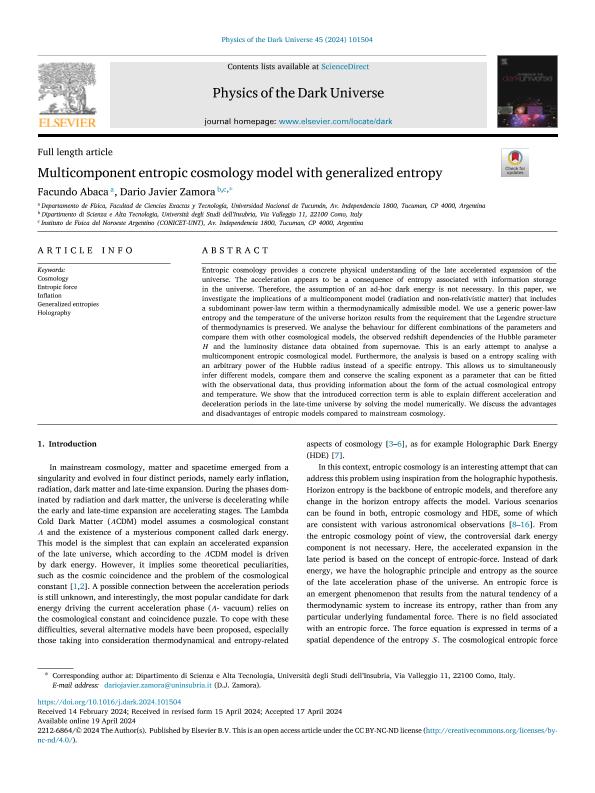
Entropic cosmology provides a concrete physical understanding of the late accelerated expansion of the universe. The acceleration appears to be a consequence of entropy associated with information storage in the universe. Therefore, the assumption of an ad-hoc dark energy is not necessary. In this paper, we investigate the implications of a multicomponent model (radiation and non-relativistic matter) that includes a subdominant power-law term within a thermodynamically admissible model. We use a generic power-law entropy and the temperature of the universe horizon results from the requirement that the Legendre structure of thermodynamics is preserved. We analyse the behaviour for different combinations of the parameters and compare them with other cosmological models, the observed redshift dependencies of the Hubble parameter and the luminosity distance data obtained from supernovae. This is an early attempt to analyse a multicomponent entropic cosmological model. Furthermore, the analysis is based on a entropy scaling with an arbitrary power of the Hubble radius instead of a specific entropy. This allows us to simultaneously infer different models, compare them and conserve the scaling exponent as a parameter that can be fitted with the observational data, thus providing information about the form of the actual cosmological entropy and temperature. We show that the introduced correction term is able to explain different acceleration and deceleration periods in the late-time universe by solving the model numerically. We discuss the advantages and disadvantages of entropic models compared to mainstream cosmology.
dc.format
application/pdf
dc.language.iso
eng
dc.publisher
Elsevier
dc.rights
info:eu-repo/semantics/openAccess
dc.rights.uri
https://creativecommons.org/licenses/by-nc-nd/2.5/ar/
dc.subject
Cosmology
dc.subject
Entropic force
dc.subject
Inflation
dc.subject
Generalized entropies
dc.subject
Holography
dc.subject.classification
Física de Partículas y Campos
dc.subject.classification
Ciencias Físicas
dc.subject.classification
CIENCIAS NATURALES Y EXACTAS
dc.title
Multicomponent entropic cosmology model with generalized entropy
dc.type
info:eu-repo/semantics/article
dc.type
info:ar-repo/semantics/artículo
dc.type
info:eu-repo/semantics/publishedVersion
dc.date.updated
2024-09-02T11:37:54Z
dc.journal.volume
45
dc.journal.pagination
1-6
dc.journal.pais
Países Bajos
dc.journal.ciudad
Amsterdam
dc.description.fil
Fil: Abaca, Facundo Máximo. Universidad Nacional de Tucumán. Facultad de Ciencias Exactas y Tecnología. Departamento de Física; Argentina
dc.description.fil
Fil: Zamora, Darío Javier. Universidad Nacional de Tucumán. Instituto de Física del Noroeste Argentino. - Consejo Nacional de Investigaciones Científicas y Técnicas. Centro Científico Tecnológico Conicet Noa Sur. Instituto de Física del Noroeste Argentino; Argentina
dc.journal.title
Physics of the Dark Universe
dc.relation.alternativeid
info:eu-repo/semantics/altIdentifier/url/https://linkinghub.elsevier.com/retrieve/pii/S2212686424000864
dc.relation.alternativeid
info:eu-repo/semantics/altIdentifier/doi/http://dx.doi.org/10.1016/j.dark.2024.101504
Archivos asociados

Tamaño:
605.6Kb
Formato:
PDF