Mostrar el registro sencillo del ítem
dc.contributor.author
Baulenas, Eulàlia
dc.contributor.author
Versteeg, Gerrit
dc.contributor.author
Terrado, Marta
dc.contributor.author
Mindlin, Julia
dc.contributor.author
Bojovic, Dragana
dc.date.available
2025-02-25T13:31:25Z
dc.date.issued
2023-05
dc.identifier.citation
Baulenas, Eulàlia; Versteeg, Gerrit; Terrado, Marta; Mindlin, Julia; Bojovic, Dragana; Assembling the climate story: use of storyline approaches in climate‐related science; Wiley; Global Challenges; 7; 7; 5-2023; 1-19
dc.identifier.issn
2056-6646
dc.identifier.uri
http://hdl.handle.net/11336/255146
dc.description.abstract
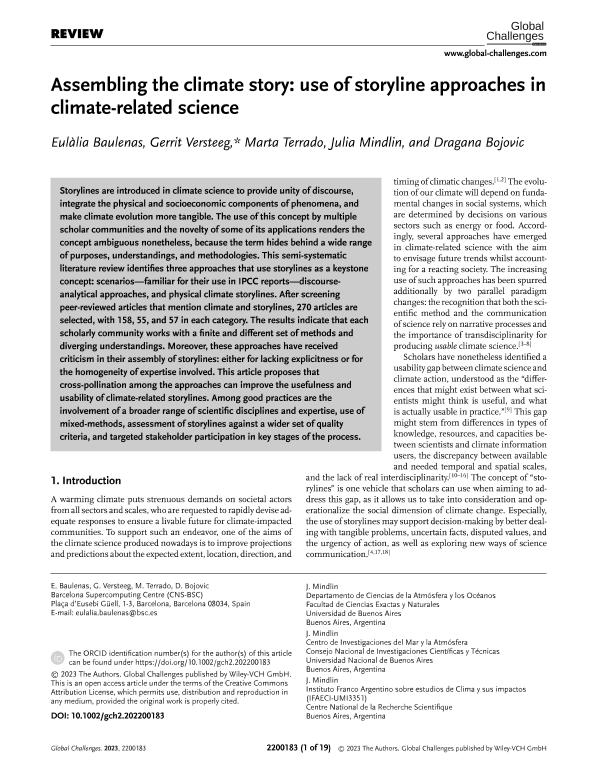
Storylines are introduced in climate science to provide unity of discourse, integrate the physical and socioeconomic components of phenomena, and make climate evolution more tangible. The use of this concept by multiple scholar communities and the novelty of some of its applications renders the concept ambiguous nonetheless, because the term hides behind a wide range of purposes, understandings, and methodologies. This semi-systematic literature review identifies three approaches that use storylines as a keystone concept: scenarios—familiar for their use in IPCC reports—discourse-analytical approaches, and physical climate storylines. After screening peer-reviewed articles that mention climate and storylines, 270 articles are selected, with 158, 55, and 57 in each category. The results indicate that each scholarly community works with a finite and different set of methods and diverging understandings. Moreover, these approaches have received criticism in their assembly of storylines: either for lacking explicitness or for the homogeneity of expertise involved. This article proposes that cross-pollination among the approaches can improve the usefulness and usability of climate-related storylines. Among good practices are the involvement of a broader range of scientific disciplines and expertise, use of mixed-methods, assessment of storylines against a wider set of quality criteria, and targeted stakeholder participation in key stages of the process.
dc.format
application/pdf
dc.language.iso
eng
dc.publisher
Wiley
dc.rights
info:eu-repo/semantics/openAccess
dc.rights.uri
https://creativecommons.org/licenses/by/2.5/ar/
dc.subject
storylines
dc.subject
climate change
dc.subject.classification
Ciencias Medioambientales
dc.subject.classification
Ciencias de la Tierra y relacionadas con el Medio Ambiente
dc.subject.classification
CIENCIAS NATURALES Y EXACTAS
dc.title
Assembling the climate story: use of storyline approaches in climate‐related science
dc.type
info:eu-repo/semantics/article
dc.type
info:ar-repo/semantics/artículo
dc.type
info:eu-repo/semantics/publishedVersion
dc.date.updated
2024-11-25T11:22:47Z
dc.journal.volume
7
dc.journal.number
7
dc.journal.pagination
1-19
dc.journal.pais
Estados Unidos
dc.description.fil
Fil: Baulenas, Eulàlia. Barcelona Supercomputing Center - Centro Nacional de Supercomputacion; España
dc.description.fil
Fil: Versteeg, Gerrit. Barcelona Supercomputing Center - Centro Nacional de Supercomputacion; España
dc.description.fil
Fil: Terrado, Marta. Barcelona Supercomputing Center - Centro Nacional de Supercomputacion; España
dc.description.fil
Fil: Mindlin, Julia. Consejo Nacional de Investigaciones Científicas y Técnicas. Oficina de Coordinación Administrativa Ciudad Universitaria. Centro de Investigaciones del Mar y la Atmósfera. Universidad de Buenos Aires. Facultad de Ciencias Exactas y Naturales. Centro de Investigaciones del Mar y la Atmósfera; Argentina
dc.description.fil
Fil: Bojovic, Dragana. Barcelona Supercomputing Center - Centro Nacional de Supercomputacion; España
dc.journal.title
Global Challenges
dc.relation.alternativeid
info:eu-repo/semantics/altIdentifier/url/https://onlinelibrary.wiley.com/doi/10.1002/gch2.202200183
dc.relation.alternativeid
info:eu-repo/semantics/altIdentifier/doi/http://dx.doi.org/10.1002/gch2.202200183
Archivos asociados

Tamaño:
3.109Mb
Formato:
PDF