Artículo
Patterns of woody plant invasion in an Argentinean coastal grassland

Fecha de publicación:
10/2013
Editorial:
Elsevier Masson
Revista:
Acta Oecologica
ISSN:
1146-609X
Idioma:
Inglés
Tipo de recurso:
Artículo publicado
Clasificación temática:
Resumen
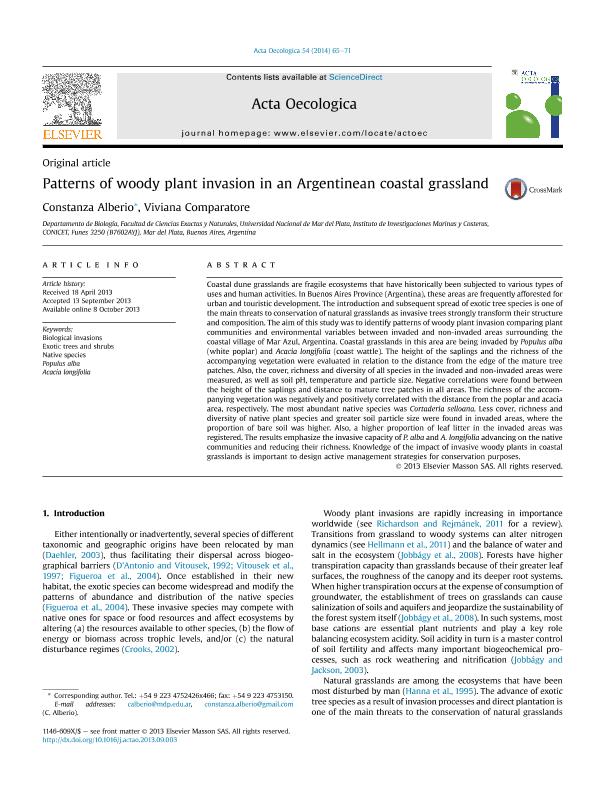
Coastal dune grasslands are fragile ecosystems that have historically been subjected to various types of uses and human activities. In Buenos Aires Province (Argentina), these areas are frequently afforested for urban and touristic development. The introduction and subsequent spread of exotic tree species is one of the main threats to conservation of natural grasslands as invasive trees strongly transform their structure and composition. The aim of this study was to identify patterns of woody plant invasion comparing plant communities and environmental variables between invaded and non-invaded areas surrounding the coastal village of Mar Azul, Argentina. Coastal grasslands in this area are being invaded by Populus alba (white poplar) and Acacia longifolia (coast wattle). The height of the saplings and the richness of the accompanying vegetation were evaluated in relation to the distance from the edge of the mature tree patches. Also, the cover, richness and diversity of all species in the invaded and non-invaded areas were measured, as well as soil pH, temperature and particle size. Negative correlations were found between the height of the saplings and distance to mature tree patches in all areas. The richness of the accompanying vegetation was negatively and positively correlated with the distance from the poplar and acacia area, respectively. The most abundant native species was Cortaderia selloana. Less cover, richness and diversity of native plant species and greater soil particle size were found in invaded areas, where the proportion of bare soil was higher. Also, a higher proportion of leaf litter in the invaded areas was registered. The results emphasize the invasive capacity of P. alba and A. longifolia advancing on the native communities and reducing their richness. Knowledge of the impact of invasive woody plants in coastal grasslands is important to design active management strategies for conservation purposes.
Archivos asociados

Tamaño:
882.4Kb
Formato:
PDF
Licencia
 Excepto donde se diga explícitamente, este item se publica bajo la siguiente descripción:
Creative Commons Attribution-NonCommercial-ShareAlike 2.5 Unported (CC BY-NC-SA 2.5)
Excepto donde se diga explícitamente, este item se publica bajo la siguiente descripción:
Creative Commons Attribution-NonCommercial-ShareAlike 2.5 Unported (CC BY-NC-SA 2.5)
Identificadores
Colecciones
Articulos(CCT - MAR DEL PLATA)
Articulos de CTRO.CIENTIFICO TECNOL.CONICET - MAR DEL PLATA
Articulos de CTRO.CIENTIFICO TECNOL.CONICET - MAR DEL PLATA
Citación
Alberio, Constanza; Comparatore, Viviana; Patterns of woody plant invasion in an Argentinean coastal grassland; Elsevier Masson; Acta Oecologica; 54; 10-2013; 65-71
Compartir


Altmétricas